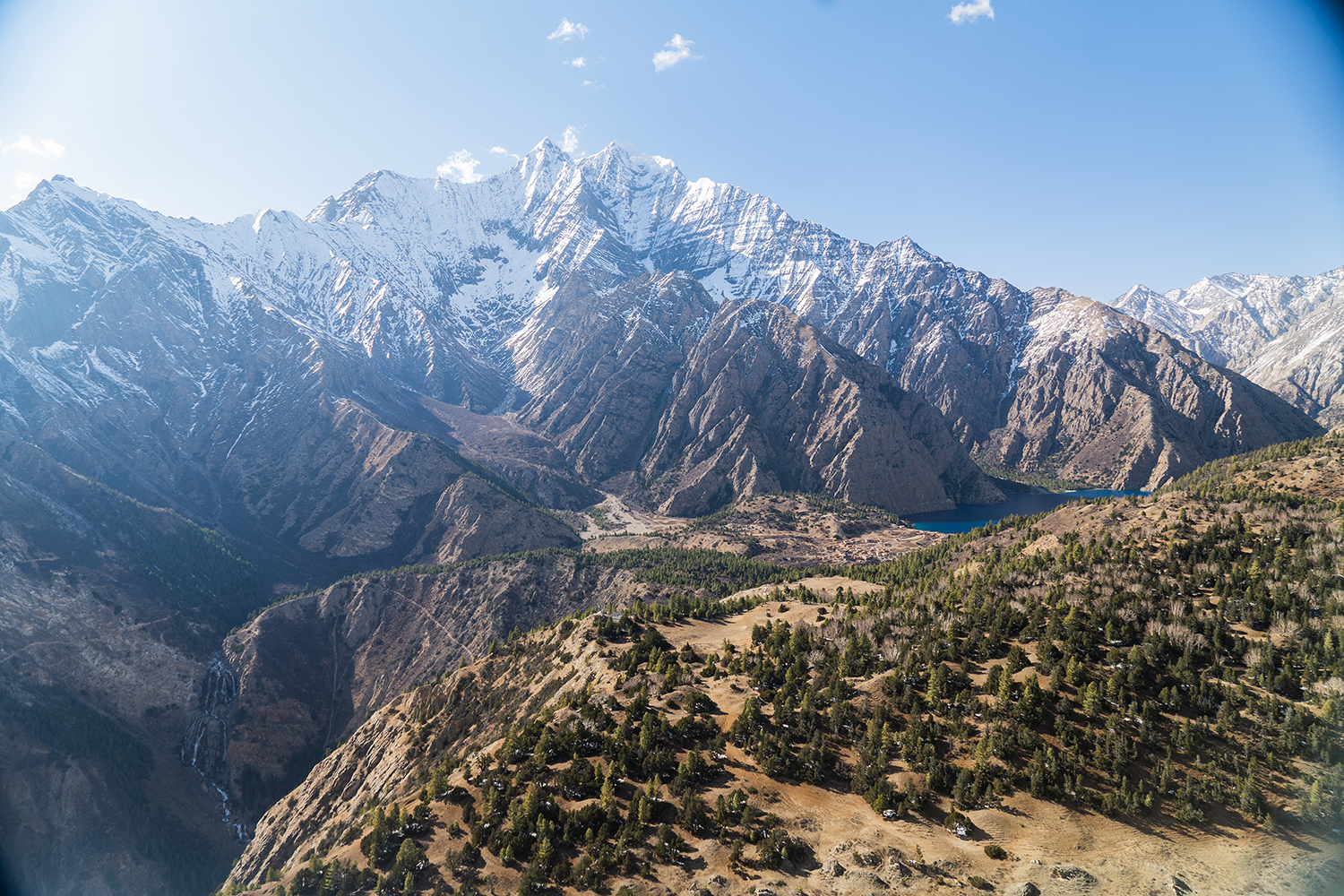
The Himalaya is a hotspot in more ways than one. Climate breakdown is melting its ice at an unprecedented rate, countries that border the Himalaya are not in speaking terms, and the world’s youngest mountain range is in a seismically active zone.
Geopolitics and geotectonics collide along the 2,400km Himalayan arc, even while its glaciers shrink and the snowline recedes. The Siachen Glacier at 6,000m elevation is the world’s highest battlefield where the militaries of India and Pakistan have been eyeball-to-eyeball since 1984. Thousands of troops have died either because of altitude or by avalanches, few in actual fighting.
India and China have over 60,000 troops facing each other in a disputed part of Ladakh, and dozens on both sides were killed when clashes erupted in 2020.
Accelerated melting of Himalayan glaciers have created hundreds of new lakes along the mountains. Because they are dammed by fragile moraines, these are in danger of bursting — a risk that has been compounded by earthquake risk.
The climate crisis is a water crisis, and nowhere is this more acute than in the Himalaya. What happens at the UN Climate Summit (COP27) in Egypt this week will determine whether greenhouse gas emissions that thaw the Himalaya will be reduced in the coming decade.
Some 2 billion people living downstream depend on rivers that originate in the Himalaya and the Tibetan Plateau. In fact, as the permanent ice in the Himalaya melts, water is going to be a strategic commodity that could further inflame geopolitical tensions in an already volatile region.
In their new monograph Governing the ‘Water Tower of Asia’: The Case for a System of Integrated Knowledge for the Hindu Kush Himalaya, Jayanta Bandyopadhyay and Sayanangsu Modak of the Observer Research Foundation (ORF) in New Delhi make a strong case for integrating water management of the ten river basins of the Hindu Kush Himalaya mountain range.
The circulation of water vapour in the atmosphere, along rivers and of underground water does not respect international boundaries, but policies governing the water cycle are national in scope. The authors propose the creation of ‘integrated knowledge’ that is essential for combined management of water in future as the climate crisis magnifies current problems. Such knowledge has to be trans-boundary as well as trans-disciplinary, they argue.
In their study, Bandyopadhyay and Modak come up with the concept of SINK (System of Integrated Knowledge) that tries to transcend present fragmented planning to include inter-disciplinary knowledge.
‘Nature organises itself in a systematic and integrated manner, (but) the reductionism that has predominated the contemporary governance paradigm interrupts nature’s systems,’ they write.
The Himalayan landscape is a ‘climate-maker’ that precipitates water from sky rivers as snow and rainfall. The ice on mountains has accumulated over millennia, advancing and retreating with the Ice Ages, but the present glacial retreat is different because of its pace, and since it is caused by anthropogenic carbon build-up in the atmosphere.
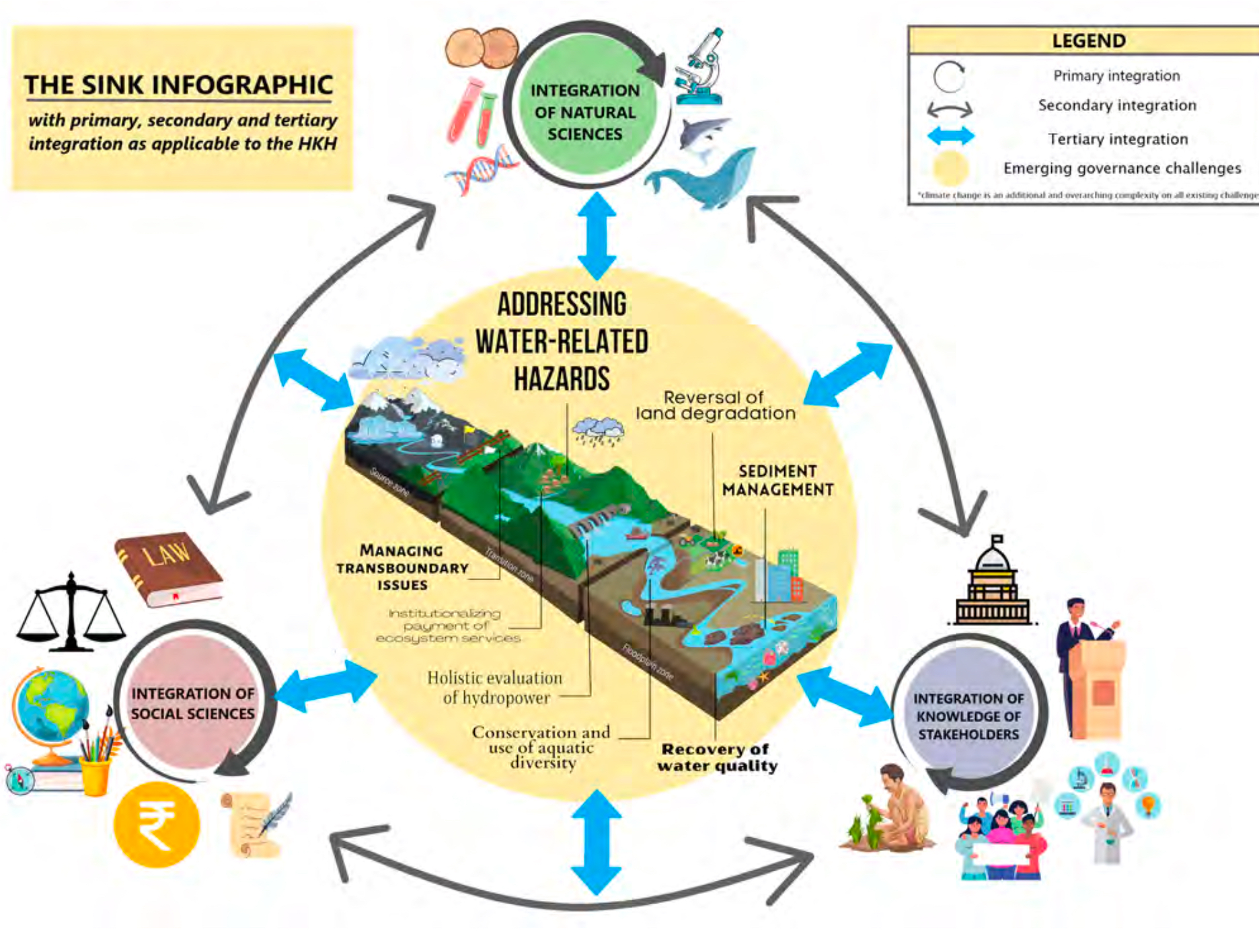
Although ice and snow are more visible and get most of the attention in the climate debate, it is groundwater stored in deep aquifers and released slowly through perennial springs into rivers on which most people depend. In fact, besides being the ‘Water Tower of Asia’, the Himalaya has also been described as a gigantic sponge.
Both the ice and groundwater storage is now being impacted by global warming and the changes in landcover due to deforestation, haphazard infrastructure, or mining activities. The hydrology of Himalayan rivers from the Amu Darya to Brahmaputra, the Ganga and its Nepal tributaries, the Mekong, the Burmese rivers, and the Yangtse and the Yellow Rivers are all changing rapidly.
Because of the transboundary nature of water, the author’s SINK model cannot be nationally defined. The way a country tampers with its river-floodplain ecosystem does not just affect its own population, but spills over the border to people living downstream in another country.