
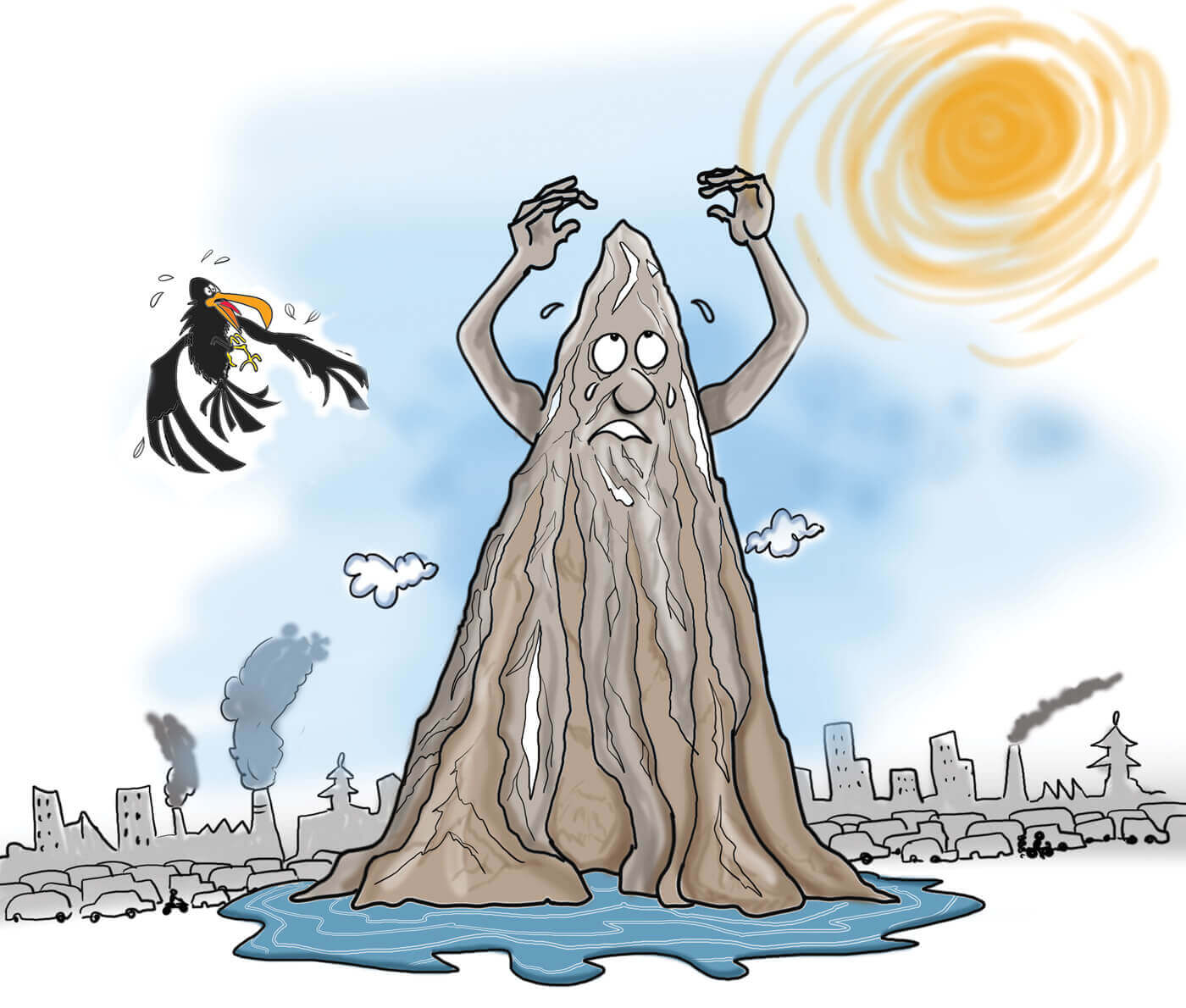
One week before the United Nation’s 25thConference of Parties (COP25) began in Madrid the World Meteorological Organisation warned that by 2100 the average global temperature is likely to increase by 3 to 5o Celsius above the preindustrial average. This is almost three times higher than the goals set by the 2015 Paris Accord.
Earlier, the UN Environment Programme (UNEP) had said that in the coming decade global GHG emissions need to fall by 7.6% annually to meet the goals of Paris Accord. But this goal seems unachievable, and we will likely be seeing increasing impacts on natural systems in the coming ten years up to 2030 and beyond.
Read also: Global heating melts mountains
A January 2019 assessment by the Kathmandu-based International Centre for Integrated Mountain Development (ICIMOD) had warned that if the present emissions rates continue (which from the waffling in Madrid looks certain) two-thirds of Himalayan glaciers will be gone during this century.
‘Even if the average global temperature is kept below 1.5̊oC, as envisaged by 2015 Paris Accord, glacier volumes will decline by one-third,’ the report said. ‘Snow-covered areas and snow volumes will decrease over the coming decades due to increased temperatures and snowline elevations will rise.’
In 2019, Iceland's Okjokull and Switzerland’s Pizol glaciers disappeared. Will Himalayan glaciers and snow volumes face a similar fate? Referring to the Gangotri Glacier, Journalist George Black in his book On the Ganges, Encounters With Saints and Sinners Along India’s Mythic River writes: ‘When glaciers decay, they become sad, derelict things. The ice cracks and crumbles and turns dirty pale blue before melting away altogether.’
The disruptions in the Himalayan snow ecosystem are real and will occur along with similar disruptions in the midhill and the plains. Changes in rainfall patterns are affecting conditions that sustain ecosystems, leading to the depletion of springs in the midhills with significant implications on the health and livelihoods of people living in them. Frequent and high-intensity rainfall, landslides, and floods damage communities, decrease diversity of species, and increase disease and pest dynamics.
The changes in rainfall and snowmelt will continue to lower dry season river flows in the coming decade, leading to declines in the availability of fresh water, resulting in lower crop yields, reduced electricity production and increased water stress Longer hot periods, increased energy needed for running air-condition for example will be hallmark of the 2020-2030 decade.
The implications of these decade-long changes have not really hit the political class and civic leaders in Nepal and in other South Asian countries which have always shown short political time horizons. Most of them consider climate change to be something in the distant future, nothing to worry about now, a problem that someone, somewhere (mostly in developed west), will provide technical and financial solutions for.