
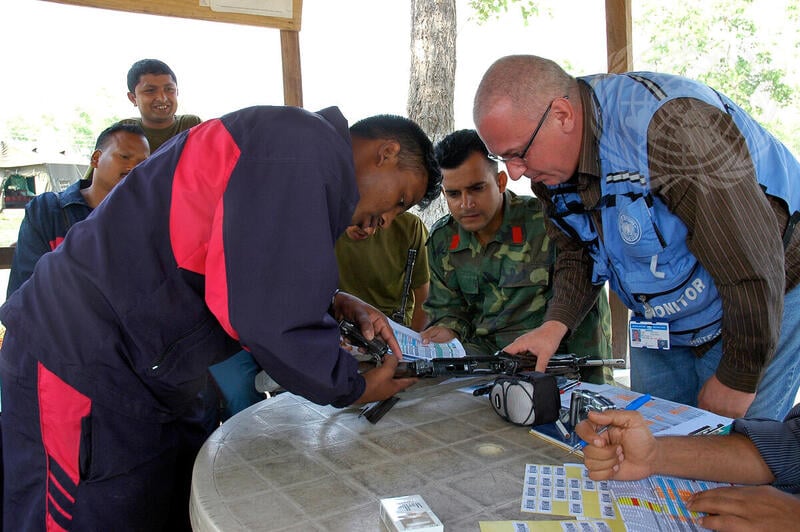
After I joined the United Nations Mission in Nepal (UNMIN) in June 2007 as the Language and Admin Assistant, I was assigned to the Arms Monitor section in Nepalganj. UNMIN was established by the UN Security Council after the end of the Maoist conflict to monitor and implement the Comprehensive Peace Accord of 2006. Aside from other peacekeeping work, UNMIN maintained and administered demobilised Maoist guerrillas in seven main and 21 satellite camps across Nepal.
My main role in Nepalganj was to assist the international Sector Commander during meetings with various officials in the Mid-western region, including CDOs of various districts, politicians, security personnel from the police and army.
The first meeting of the Jordanian Sector Commander was at the Nepal Army barrack in Bardia. Our group consisted of 9 people from the Arms Monitor section from various countries. The Jordanian’s English was easy to understand but the accents of others was harder to comprehend.
Read also: Lost in translation, Alisha Sijapati
We received a warm welcome from the Nepal Army, and the Battalion Commander explained the situation in the area, and gave us a tour of the base. I was nervous, but thought I had handled the interpretation well enough. Following the meeting, the soldiers served us breakfast.
Inside the personal dining room of the Battalion Commander, I noticed sandwiches, sliced mangoes, Coke, toast, jam, and butter laid out on the table. As we were getting ready to begin, a soldier approached the Commander and whispered something in his ear. The Commander then looked at me and asked, “लोकल कुखुराको मासु र चिउरा खान्छन् कि सोध्नु त?”
I turned to the Jordanian Sector Commander and was relaying the question but got stuck, “Would you like to eat local chicken with...”
Looking back at the Commander I asked: “चिउरालाई के भन्छन् अङ्ग्रेजीमा?” He found it hilarious that I did not know what चिउरा was is in English, and said, “Bitten Rice, हैन त?” He responded as if I had confirmed his unofficial translation. I then finished my sentence to the Sector Commander, asking whether he would like local chicken with “bitten” rice.
Read also: "Mai commin, Sir?", Anbika Giri
Being an interpreter was fun because of gaffes like that that are funny in hindsight. The international staff of the Arms Monitor section were friendly, and were understanding of my difficult sometimes interpreting their English accents. They spoke in brief, simple sentences to make it easy for me.
After the ‘bitten rice’ episode, one day our team was being led by a Swedish military officer for a meeting with the Senior Superintendent of the Nepal Police. We arrived at his station, but he was not there because his force had been busy evicting members of the Maoist Young Communist League (YCL) from a house where they were occupying.
Luckily, both sides resolved the situation through dialogue, and the tension subsided. After meeting the YCL leader, we wanted to get the Police’s side of the story. When the SSP finally arrived, he looked preoccupied and we began promptly once he took his seat.
Read also: "If I were to tell you everything I know about Prachanda ..."
As I was translating his lengthy introduction of himself into a more concise version, I mistakenly referred to him as a Deputy Superintendent of Police (DSP) rather than an SSP, which seemed to upset him. He asked me to repeat his full introduction correctly, including details about his long and illustrious career.