
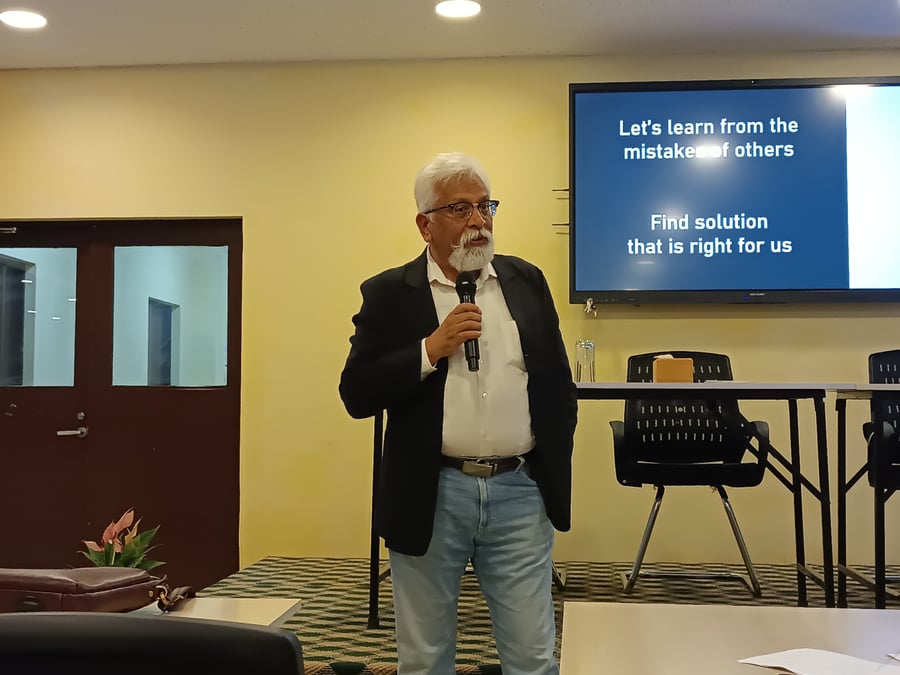
“I was brave enough to take a motorcycle taxi around Kathmandu yesterday, I probably died five times during that journey,” says Alok Jain, an international expert on public transport operations and management. “The Kathmandu of my memory from 30 years ago is all gone, I don’t like what it is now.”
Jain was in Kathmandu this week for a symposium on public transport organised by Sajha Yatayat. Originally from Rajbiraj he remembers a time when there were no buses, everyone bicycled or walked.
After getting a degree in engineering from the Indian Institute of Technology, Jain worked for the irrigation department in Nepal. He got fed up with chronic corruption. “I wanted no part in it, so I left,” he recalls. “I was fresh out of college and idealistic, and wanted to change the world.”
Jain then got a scholarship to pursue a master's at the Asian Institute of Technology in Bangkok and as a gold medallist, he was offered international jobs but he returned to Nepal to give his country one more try.
“I told my father that if I stayed in Nepal I would remember to only calculate the percentage at this rate,” recalls Jain, now 57.
For the next 15 years Jain worked in Hong Kong’s public transport system, and shifted his career from engineering to strategy and planning, to finance and then to operations and marketing. “I was restless at this point, I wanted to learn new things as well as take on challenges, I was still young,” he says.
After Hong Kong, Jain worked as a freelancer and during this time he commissioned a number of metro projects including Delhi Airport Express, Dubai Metro, Hyderabad Metro Rail, Chennai Metro and Mumbai Metro.
Then in 2011, the Singapore government hired him to revamp contract modelling to move from net cost contract to gross cost contract. The government would buy back all public transport assets and create a centralised body to retain all revenue collected while operators are paid a fixed sum.
Then he went back to Hong Kong where he was hired to turn around the Kowloon Motor Bus (KMB). Till this point he had not worked with buses, but managed to put the loss-making bus system into profit.
KMB is the world’s largest private bus operator with 4,000 buses, 11,000 drivers on 400 routes. It was not easy because of the management culture and rival driver unions. So he became a driver himself, started talking with other drivers to understand the business from the bottom up.
“We didn't do anything big but tried to improve things gradually and organically such as saving fuel on every trip, we used a lot of data to improve efficiency and focus on quality, not quantity because running too many buses is not the solution but running them where they are needed,” explains Jain.