

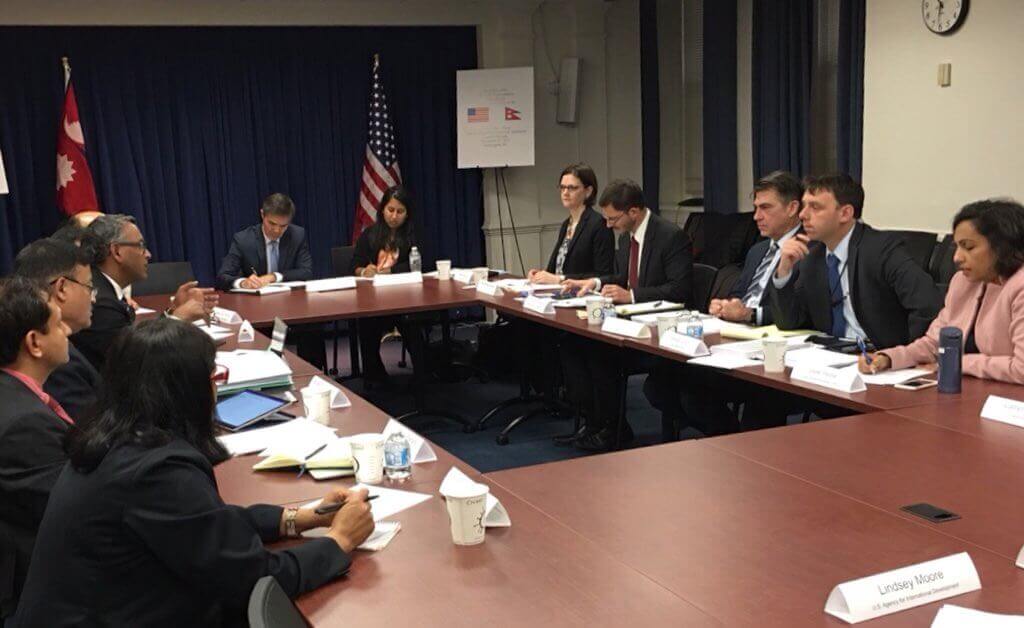
One To Watch, a Dutch-Nepal joint venture, co-hosted a well attended mini investment conference in London last month. What was originally planned as a Demo Day for the new cohort of 10 companies under their business accelerator program – Enterprise, turned bigger in scope thanks to Nepal’s Ambassador to the UK Durga B Subedi.
The centerpiece of the event was the keynote by Finance Minister Yuba Raj Khatiwada. He used the occasion as a curtain raiser for the Nepal Investment Summit in Kathmandu 29-30 March, and impressed the audience with his strong grasp of the economy and foreign investment in Nepal. He presented Nepal as a worthy destination for foreign investors, and that the country was ready for business.
The IMF’s recent Article IV Consultation Report supports the minister’s point that Nepal’s economy is enjoying solid expansion and that the near-term outlook is favourable. Political stability, more reliable electricity and re-construction activities are drivers of the current growth.
There is a consensus that Nepal offers tremendous business opportunities in multiple sectors. A senior IFC executive concluded her trip to Nepal recently with a ‘deep and profound sense of optimism about Nepal’s development prospects’ and indicated IFC’s appetite to ‘radically scale up’ its investment in Nepal from the current $57 million to even $1 billion by 2023.
Due to inadequate domestic capital formation, the local banking sector is not able to keep up with robust demand for credit in recent years. The need to channel in foreign capital is more pronounced now than ever. In addition to new money, FDIs enable businesses acquire technology, access international markets and improve quality of governance thus ensuring long-term sustainability.
However, Nepal’s track record on FDI inflows has been dismal. By contrast, Bangladesh, considered a basket case until early 90s, quadrupled its economy in last 15 years with the help of FDIs and exports.
Pundits have identified the following as main bottlenecks to securing foreign investment into Nepal:
- Inadequate or ambiguous laws and regulations
- Need for approvals from multiple authorities causing delays
- Primitive foreign exchange regulations
- Lack of currency hedging mechanism
- Poor infrastructure and enabling environment
- Absence of sovereign rating
- Poor governance standards, corruption etc.
- The negative list is still too long; there’s no ‘automatic route’ either
The good news is that the government has recognised the need to improve investment climate in general, and more particularly, make an effort to attract foreign capital. Infrastructure projects have been initiated. A dozen or so new laws, including the Foreign Investment and Technology Act (FITTA), Foreign Exchange Regulations Act (FERA), Intellectual Property Act are in various stages of approval or implementation.