“The paradox is this: if economic rationality tells us that the next century will be the age of global integration of the world’s economies, cultural ‘irrationality’ steps in to inform us that it will also be the century of ethnic demands and revived nationalisms. Both reason and imagination tell us that the name of the solution, that point where you can balance the demands of integration and those of the nationalities, is federalism.”
-Carlos Fuentes, 1996
These were the concluding remarks in 2003 by geologist Harka Gurung quoting the Mexican novelist in his discourse ‘Trident and Thunderbolt: Cultural Dynamics in Nepalese Politics’ as part of Social Science Baha’s Mahesh Chandra Regmi Lecture.
There was a reason and relevance to Gurung quoting Fuentes. Nepal was at the peak of the Maoist conflict and had just come off one of the bloodiest years of the insurgency. Abolition of the monarchy and state restructuring were being hotly debated even in the remotest corners of Nepal. King Gyanendra had staged a coup and political parties were preparing to take to the streets.
Gurung was killed in the Ghunsa helicopter crash a few months after the ceasefire, but his 'federalism' solution was finally adopted in the 2015 Constitution.
The preamble to the Constitution reads, ‘... resolving to build an egalitarian society based on the principles of proportional inclusion and representation to ensure economic equality, prosperity and social justice by assimilating the multi-ethnic, multi-lingual, multi-religious, multi-cultural and geographically diverse characteristics...’
In accordance with this constitutional commitment and provision, elections for 753 local governments were held in 2017. Next month, it will be five years since they took office and on 13 May Nepalis will vote for the second time in local elections.
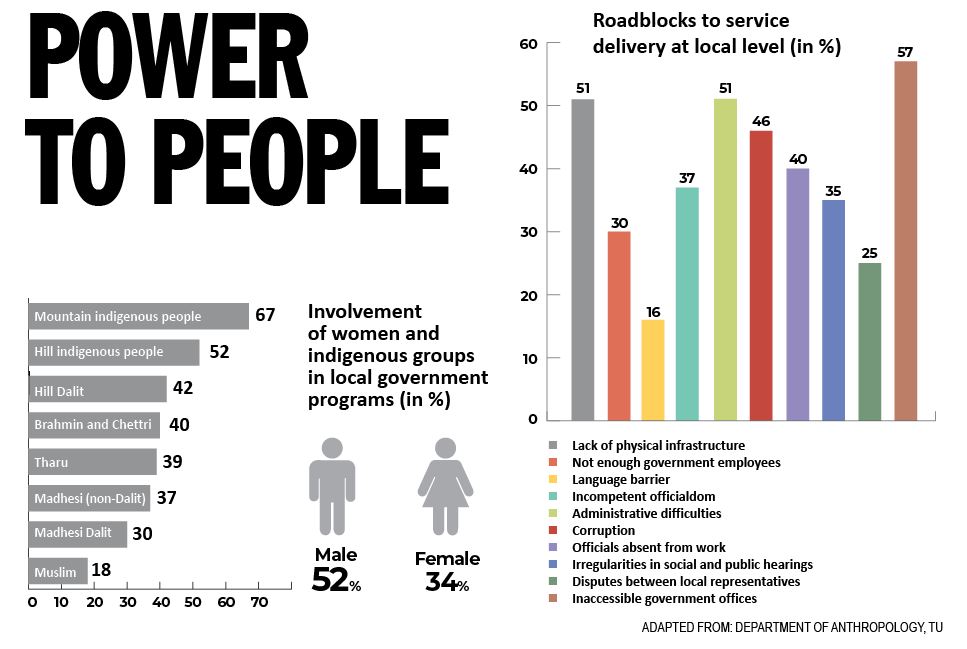
How successful have local governments been in 'establishing prosperity with social justice by addressing the diverse features of Nepali society' as directed by the Constitution? How much has service delivery improved, is it equitable, and is there better governance? What worked, what did not?
The lessons learnt during the past five years can be a guide for the next crop of local leaders. We need to thoroughly review the workings of local governments.
If we were to believe the political class and commentators in Kathmandu, federalism in five short years has failed Nepal. They argue that federalism has decentralised corruption and sowed the seeds of social division.
However, despite some of this being true, most local governments have performed above expectations. According to a recent evaluation, most municipalities scored more than 50 points out of 100 in their report cards.