Nepali Times celebrated its 25th anniversary on 25 July, and this piqued my curiosity about how the paper covered migration in the early days. Things must have been so different back then. Or were they?
If we look at restrictive emigration policies that disproportionately impact women, contributors have changed, protagonists have changed, but the message remains more or less the same. Many aspects of what we write today about bans are no different from what was written back then, and it is timely to revisit this issue today on World Day Against Trafficking in Persons.
Trafficking can only be addressed when people have access to safe and legal migration pathways, not with bans.
In an article in 2000, the year this paper was born, correspondent Hemlata Rai wrote an article called ‘Misplaced Chivalry’ that criticised the ban on women migration. Back then, it was not a ban on just domestic work but on women migration altogether.
Excerpt from the article:
What the prohibition has done is make women more vulnerable to economic and sexual exploitation. Since the women now use illegal channels to reach their destinations, they remain invisible in official books and therefore unprotected by laws that ensure workers’ rights…. The government has simply not been able to put an end to this trafficking, and by its across-the-board ban on women workers going to the Gulf has only succeeded in pushing an employment channel underground.
Twenty-five years later, I could just reuse this paragraph, and it would still be relevant, albeit the current ban is on domestic work that disproportionately impacts women and not all women migrants.
In a 2003 news piece, there was a hopeful government announcement that the ban on women working in Gulf countries was lifted, provided a recruiter and embassy could guarantee safe working conditions, after ‘activists criticised the restriction as discriminatory’.
In 2006, Dambar Shrestha noted that the remaining restriction on women migrating to the Gulf for domestic work would also likely be repealed after the introduction of the Foreign Employment Act in 2007:
‘There was a general consensus (among Government and advocates) that the ban should be repealed, as a way to monitor overseas employment, and ensure women have legal recourse if mistreated.’
Indeed, the ban was lifted but its aftermath. Mallika Aryal’s 2009 article ‘The Invisible’ and Rubeena Mahato’s ‘Womanpower’ noted that women still struggled to migrate because of the bureaucratic challenges:
‘Despite being legally allowed to go abroad to work, government rules make it as difficult as possible for them to do so.’ (Mallika Aryal) or because of the perception of the ban, ‘After the Foreign Employment Act 2007 was passed, the ban has officially been lifted, and there are no restrictions on women migrant workers going abroad. But the perception of a ban remains, and this has led many women to continue using illegal routes.’
By the time people become aware that bans have been lifted or get a grasp of how to navigate the post-ban recruitment system, another iteration of the ban is introduced whether it is conditional (age-specific, country-specific) or blanket bans bringing us back to square 1.
See the flipflopping I attempted to trace in a 2021 article, History of Female Im-mobility in Nepal. Just like the ban is a reactionary policy, this article was a reaction to a bizarre proposal to require consent from a guardian and local government for women under the age of 40 travelling to the Gulf or Africa which fortunately got quashed.
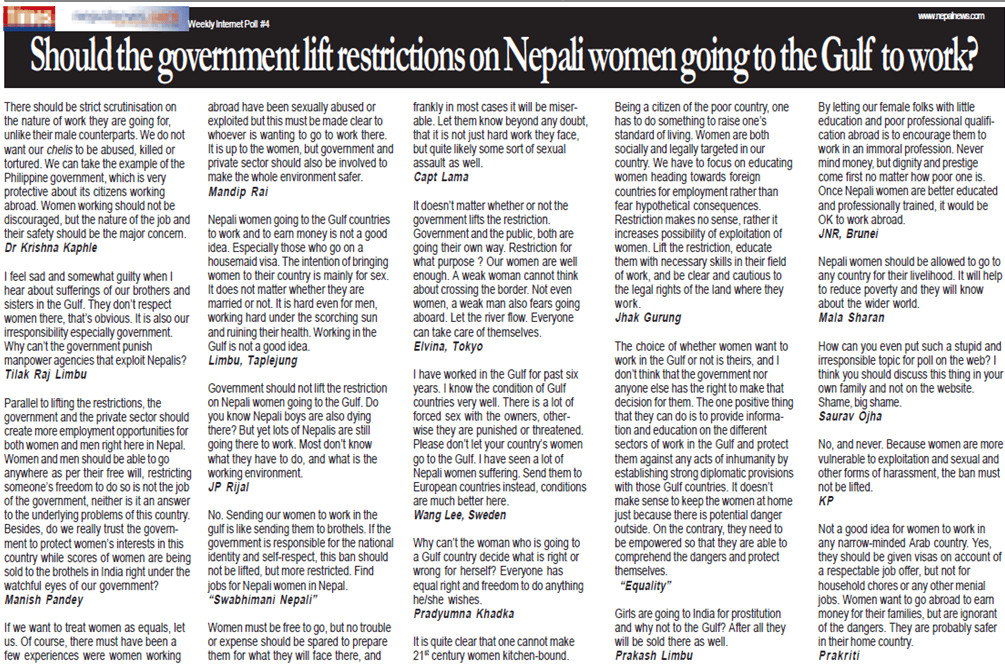
But bans don’t work, have never worked, given irregular options via open borders and visit visas, as has been extensively covered in this paper since its first year. The latest ban, imposed in 2017 after a Parliamentary committee visited the Gulf and decided it was unsafe for domestic workers, regardless of gender.
Any promise for change such as a 2020 Parliamentary trip after which the committee instructed the government to revisit the ban considering country-specific policies and several preconditions, which were still deemed restrictive, has stalled. A proposal around lifting the ban starting with a pilot agreement with the UAE submitted by the Labour Ministry has also stalled.