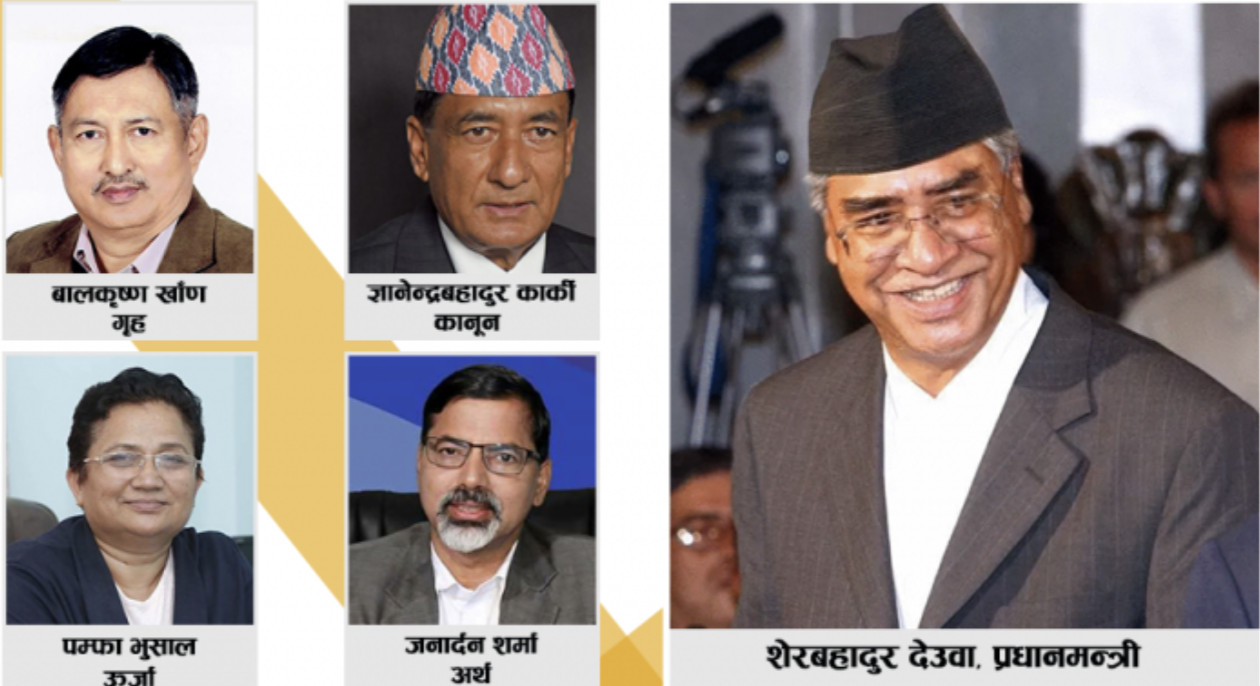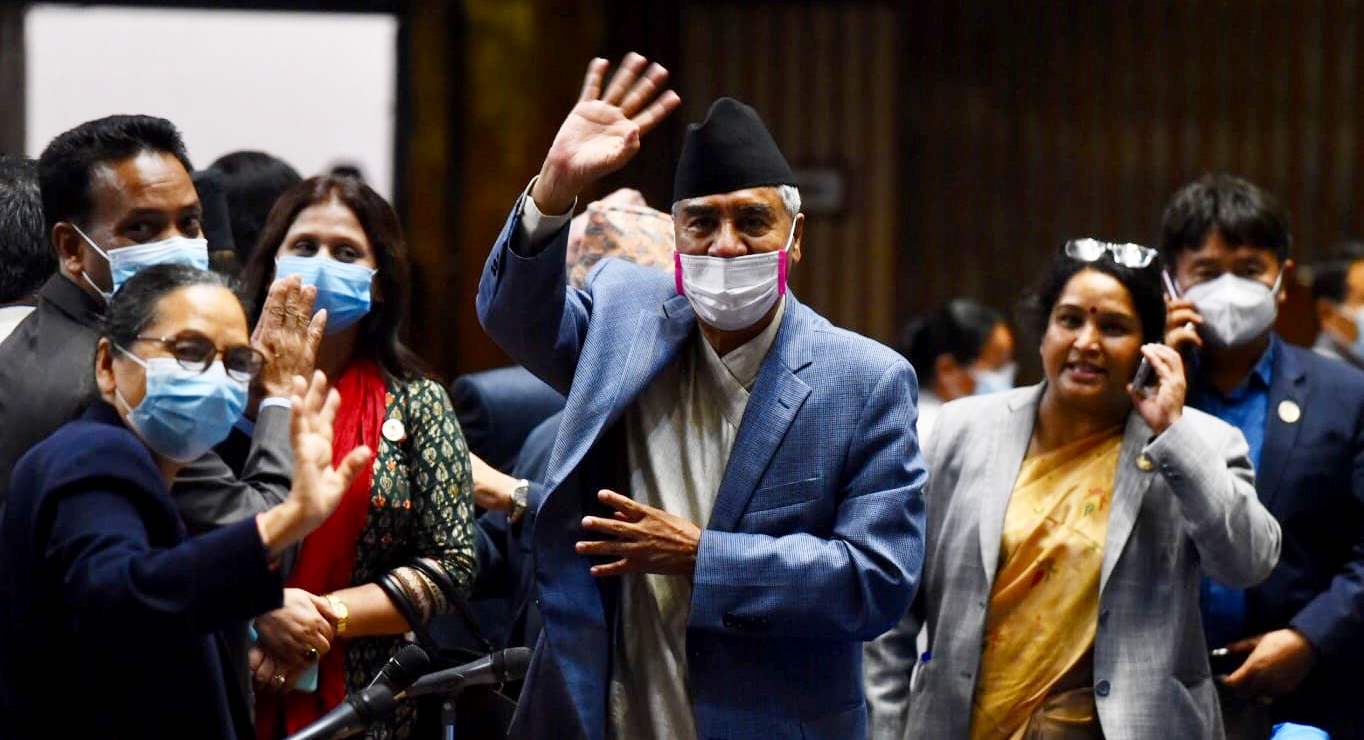
Three months after assuming office for the fifth time, Prime Minister Sher Bahadur Deuba on Friday finally expanded his Cabinet after reaching a power-sharing agreement with his coalition partners.
Sixteen new ministers and two new state ministers were inducted to be later sworn in by President Bidya Devi Bhandari. The appointments were delayed by haggling over important ministerial portfolios between four of the five members of the coalition, and between factions within individual parties.
The Cabinet expansion triggered a widening controversy this week as news emerged that Chief Justice Cholendra SJB Rana wanted two of his nominees to also be given ministries. This raised objections from a cross-section of the media as well from within the legal fraternity and Prime Minister Deuba’s own Nepali Congress (NC).
Critics saw this as not just going against the accepted practice of not nominating unelected representatives to the Cabinet, but also because of what they characterised as a blatant violation of the doctrine of separation of powers.
In the end, Deuba only took in one of the candidates reportedly proposed by Chief Justice Rana: Gajendra Bahadur Hamal who is now Industry, Commerce and Supplies Minister.
Hamal is the brother-in-law of Chief Justice Rana, and has also been a long-standing NC member in western Nepal, but was not a MP in the federal Parliament. Rana refuted allegations that he had proposed Hamal’s ministership, but most analysts believe that he was exacting a pound of flesh for his landmark Supreme Court ruling in May that led to Deuba replacing K P Oli as prime minister.
The coalition partners have divided up the ministerial portfolios such that the NC has eight ministers, and the Maoist Centre (MC) has five, while Upendra Yadav’s JSP and Madhav Nepal’s UML Unified Socialist (US) have four ministers each. (See list, below)
The MC, US, and the JSP also have one state minister each.
The expansion had been delayed due to competing demands within members of the five-party alliance, including from the Ram Chandra Poudel faction of Deuba’s own NC, as well as factions within Nepal’s UML-US party.
And since this is going to be a coalition that will oversee elections in 2023, the parties all wanted influential ministries like home, foreign, communication, or those with the biggest budgets: education, agriculture, transport and physical infrastructure.
While the MC had already sent its list of recommended ministers to Deuba on Wednesday, and the UML-US had reached an internal agreement, the JSP and NC were still finalising their list of ministers till early Thursday.
Of the eight ministers from NC, Deuba has distributed the Law and Defence Ministries to Poudel loyalists: Dilendra Prasad Badu and Minendra Rijal respectively. Additionally, Uma Kanta Chaudhary from the NC’s Krishna Prasad Sitaula camp has been appointed Minister of Water Supply.
The NC had already taken Home, Foreign, and Law Ministries when Deuba took office three months ago. Now it also has Ministries of Communications and Information Technology, Women, Children and Senior Citizens, and Industry, Commerce and Supplies.