

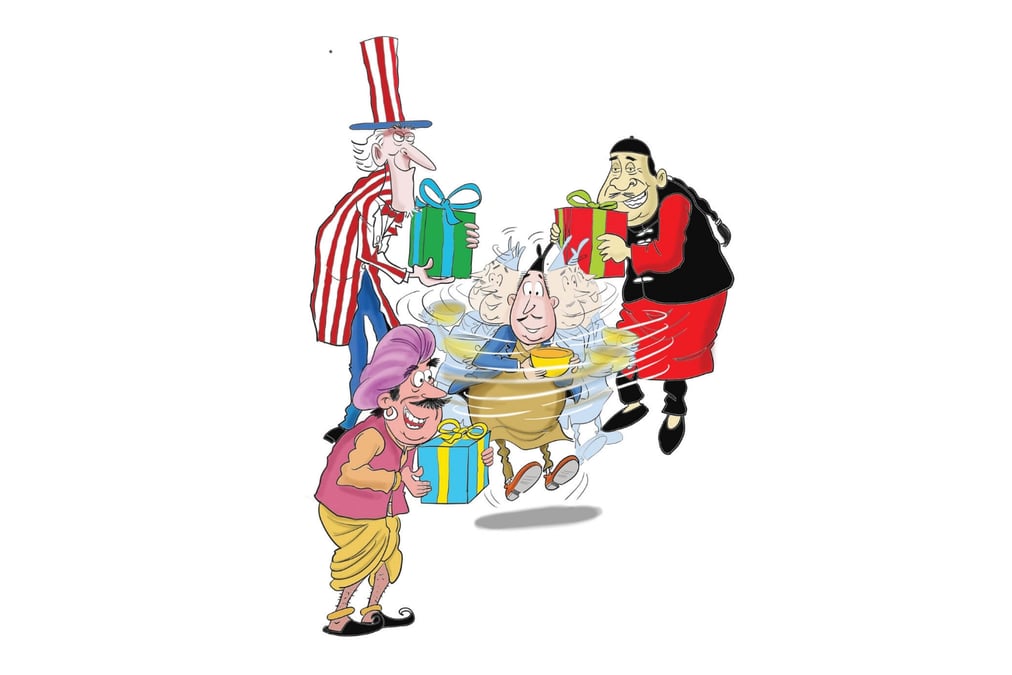
The Rastriya Swatantra Party (RSP) that swept Nepal’s post-GenZ election last month has taken office at a fraught period in global geopolitics. The war in West Asia could potentially reshape the world order with far-reaching strategic and economic consequences for Nepal and the region.
The foreign policy of any state is largely dependent on the extant structural features of the international system, and Nepal and its remittance-driven economy faces a challenging geo-strategic environment.
The position of the United States in international affairs is still largely unrivalled, and provides a rather large window into the country. But the impact of greater Chinese power in Nepal is not yet properly understood, while India has always been and will continue to exert regional hegemonic influence.
With 5% of the global population contributing to 20% of the world economy, and flexing 50% of military might, the United States looms large just about everywhere in the world, including Nepal. Its rivalry with an emergent China puts Nepal in strategic proximity.
Whether it is the Millennium Challenge Corporation (MCC) project or the State Partnership Program (SPP), if President Donald Trump and the State and Defense Departments want it done in Nepal, they will get it done. The more germane question is whether this is beneficial to long term regional peace and stability. That is a consideration Washington will surely have to take into account moving forward.
How all this corresponds, or not, to Indian policy towards Kathmandu is the real question that will affect Nepal, given the strained relations between Washington and New Delhi lately.
There should be no confusion that as far as New Delhi is concerned, Nepal is part and parcel of India’s grand security structure. It has always been so, going all the way back to the British period under Viceroy George Curzon, and perhaps even earlier.
The Chinese assessment of Nepal is defined by Beijing’s interest to ensure the stability and security of the Tibet Autonomous Region. Any great power wishes to expand its influence beyond its borders and China, after all, now considers itself a global power. It has the engineering and financial capability to project its interest on a neighbouring country like Nepal whose economy is 400 times smaller.
However, expansion of Chinese influence in Nepal becomes a matter of historical significance only because it comes up against what India regards as its sphere of influence. New Delhi’s power especially vis-a-vis neighbouring South Asian states is grossly underestimated. India is emerging as the next great power in Asia, and at the current juncture of history, China is unlikely to become an alternative to India in Nepal.
COUNTERWEIGHT
This is also improbable and impractical because of the current power distribution in the international system. The United States is an off-shore power balancer, and is unlikely to countenance projection of Chinese influence into Nepal beyond certain limits.
India is not just a fellow democracy, but also serves as a counterweight to US fears of Chinese dominance of Eurasia. Washington can be expected to exert ever possible influence to ensure that China is not a decisive power in Nepal.
It may be the case that Beijing does not wish to enlist itself in such a position either such a manoeuvre in the Himalayan frontiers of the Subcontinent could draw the United States still more deeply into the Nepal’s political tapestry.
The result would be a more combustible Nepal with too many friction points to manage, and lead to a veritable headache deleterious to regional peace and stability.
How the new government in Nepal maintains domestic peace and stability will be closely watched in the region. It is a question contingent on a wait-and-see approach, as there are too many variables at play which cannot at present be set into watertight prognostications.
Nepal’s domestic politics therefore is governed by international developments. The first quarter of the 21st century is already characterised by the interplay of interdependent variables.
As the geopolitical thinker Robert Kaplan describes it, conditions are taut like in a musical instrument where too much pressure at one point on the string can disrupt the entire system in ways that are unpredictable.
How that will play out in Nepal will be a function of the intersection of civilian and military leadership within Nepal, and the tripolar contestation of China, India and the United States in the region.
Bhaskar Koirala is an independent analyst associated with Peking University.