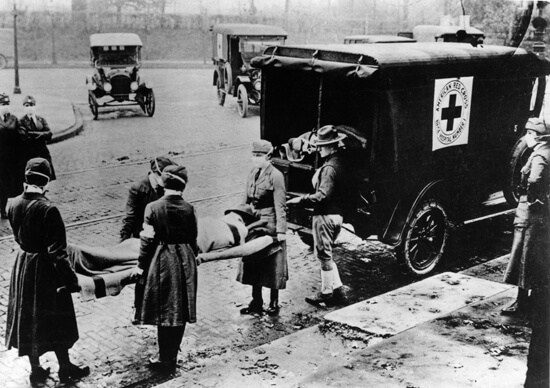
The current COVID-19 pandemic has forced many to Google other historic outbreaks, and the search usually brings them to the 1918 influenza epidemic that killed between 20-40 million people – half of them in South Asia.
Just over 100 years ago, as Europe was coming out of a ruinous four-year trench warfare, American soldiers brought the flu to the front lines from where it had spread like wildfire across Europe.
Although it is called the ‘Spanish’ Flu, the virus first appeared in North America and crossed the Atlantic on US troopships bound for the front lines. It is called Spanish Flu because the virus was making people sick in the Pyrenees long after it had subsided elsewhere.
After the war, British Army soldiers returning to India (some of them could very well have been Gurkhas) brought the virus to Bombay from where it spread along India’s vast railway network. 50 in every 1,000 Indians died of the virus.
There were two waves of the influenza epidemic. It was probably transferred from returning migratory waterfowl to humans in Kansas in spring of 1918 before jumping across the Atlantic to Europe. The spread slowed over the summer, but returned with a vengeance in the autumn that year.

Although there are many books about the Spanish Flu in Western literature, in South Asia there is no properly archived documentation about the tragic pandemic that took many lives.
Even Mahatma Gandhi was stricken by the bug, and bodies were piled high along river banks in India as cremation sites ran out of firewood. Unlike COVID-19, the 1918 influenza virus struck people in the 20-40 age group.
While it affected 28% of all Americans, killing 675,000 – of the US soldiers killed in World War I, half died of influenza. But surprisingly, the pandemic had very little effect on China.
Many viruses have an animal reservoir, and the Spanish Flu was associated with ducks and pigs as is usual for influenza viruses. The MERS coronavirus that affected the Gulf region in 2012 is associated with camels, and the SARS coronavirus of 2003 transferred from civet cats. While the COVID-19 probably originated in bats like the other coronaviruses, its host is believed to be the pangolin.
As the ‘Spanish’ flu clearly showed, there is no evidence to show that we in South Asia have better immunity towards the novel coronavirus COVID-19. So, what can be done?
First thing is to increase tests for COVID-19 in suspected patients even without a travel history to affected areas. The more tests we do, the more we will know about the spread of the actual disease.