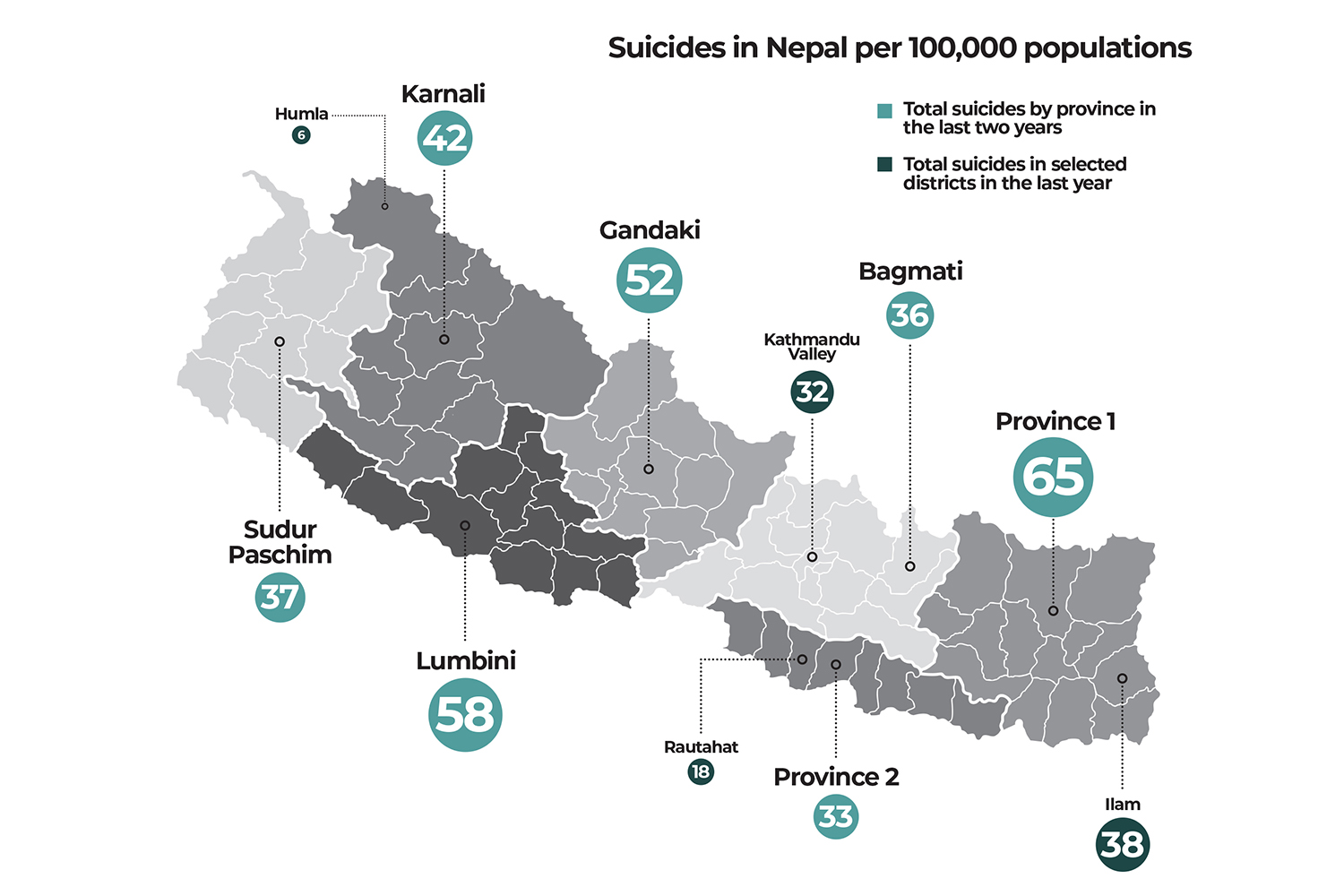
The coronavirus disease is one of the most well-documented health crises of recent times, with its correlation to almost every sector in society -- including the mental cost of prolonged lockdowns and the stress during the pandemic.
Studies have linked a higher prevalence of anxiety, depression, post-traumatic stress disorder (PTSD), hypochondria, obsessive disorders and psychotic symptoms among the general population in the last two years.
But for the first time, a new study squarely links the rise in suicide ideation with the pandemic in Nepal. Police records also show a spike in suicides and self-harm cases in the past two years.
Suicide cases had been rising even before the pandemic with 5,509 in 2018 and 5,898 in 2019. However, it jumped to 6,968 during the first year of the pandemic in 2020 — putting the suicide rate at 23.9 per 100,000 population.
‘The yearly increase in the suicide rate from 2019 to 2020 is 16%, which is more than threefold higher than a yearly increase in the suicide rate from 2018 to 2019 (5%),’ states the paper published on PLOS ONE last month.
Titled ‘Association between COVID-19 pandemic and the suicide rates in Nepal’ and conducted by Binod Acharya, Keshav Subedi, Pramod Acharya and Shweta Ghimire, research analysed a total of 24,350 suicides in four years from July 2017 to June 2021 based on Nepal Police data.
It investigated changing suicide rates in Nepal during the Covid-19 pandemic period (April 2020 to June 2021), compared to the pre-pandemic period (July 2017 to March 2020), adjusted for seasonality and long-term trends in the suicide rate.
Males had a higher suicide rate (26.9 per 100,000) than females (16.5 per 100,000), but suicide rates went down over the last two years among males, but was sustained for a longer duration among females.
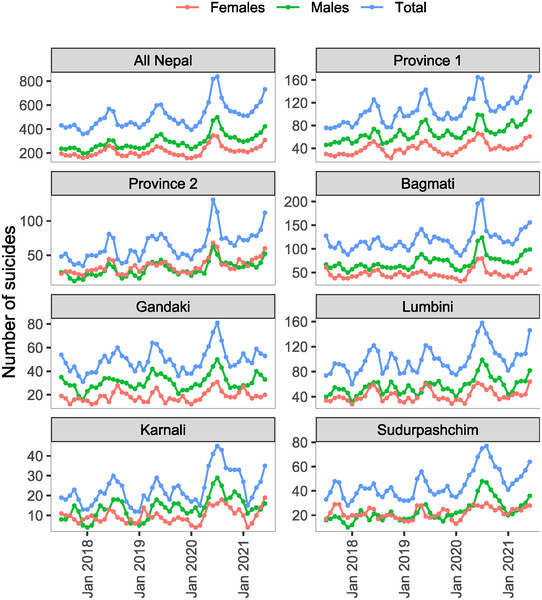
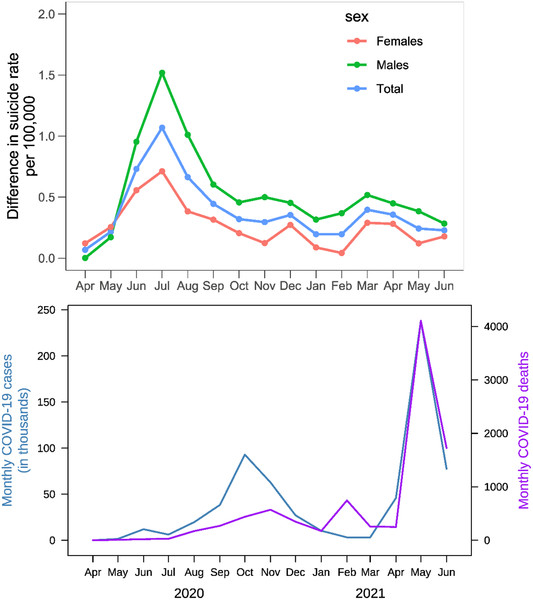
For example, all the pandemic months except April and May of 2020 and February and March of 2021 had a significantly higher suicide rate compared to the same months in 2019. In comparison to the same month in 2019, July 2020 (just after the first lockdown) had the highest increase in the suicide rate with an increment of 55%.
Researchers have pointed out limited or lack of economic resources, public health infrastructure and awareness about mental health as leading factors for the increase in suicides in Nepal during the pandemic.
Nepal is one of the countries with highest suicides rates in the world according to the World Health Organization (WHO). The 2021 Nepal Health Research Council (NHRC)’s National Mental Health Survey found the prevalence of suicidality (current suicidal thoughts, lifetime suicidal attempt and future likelihood of suicidal thoughts) at a high of 7.2% among Nepalis.
During the study period of this latest survey, the highest proportion of the suicides were observed in Bagmati province (5,709; 23.4%), followed by Province 1 (5,161; 21.2%), Lumbini (4,757; 19.5%), Madhes (3,053; 12.5%), Gandaki (2,369; 9.7%), Sudurpaschim (2,176; 8.9%), and Karnali (1,125, 4.6%).
But Sudurpaschim and Karnali provinces, two of the provinces with the lowest Human Development Index (HDI), had the highest increase in suicide rates associated with the Covid-19 pandemic.