

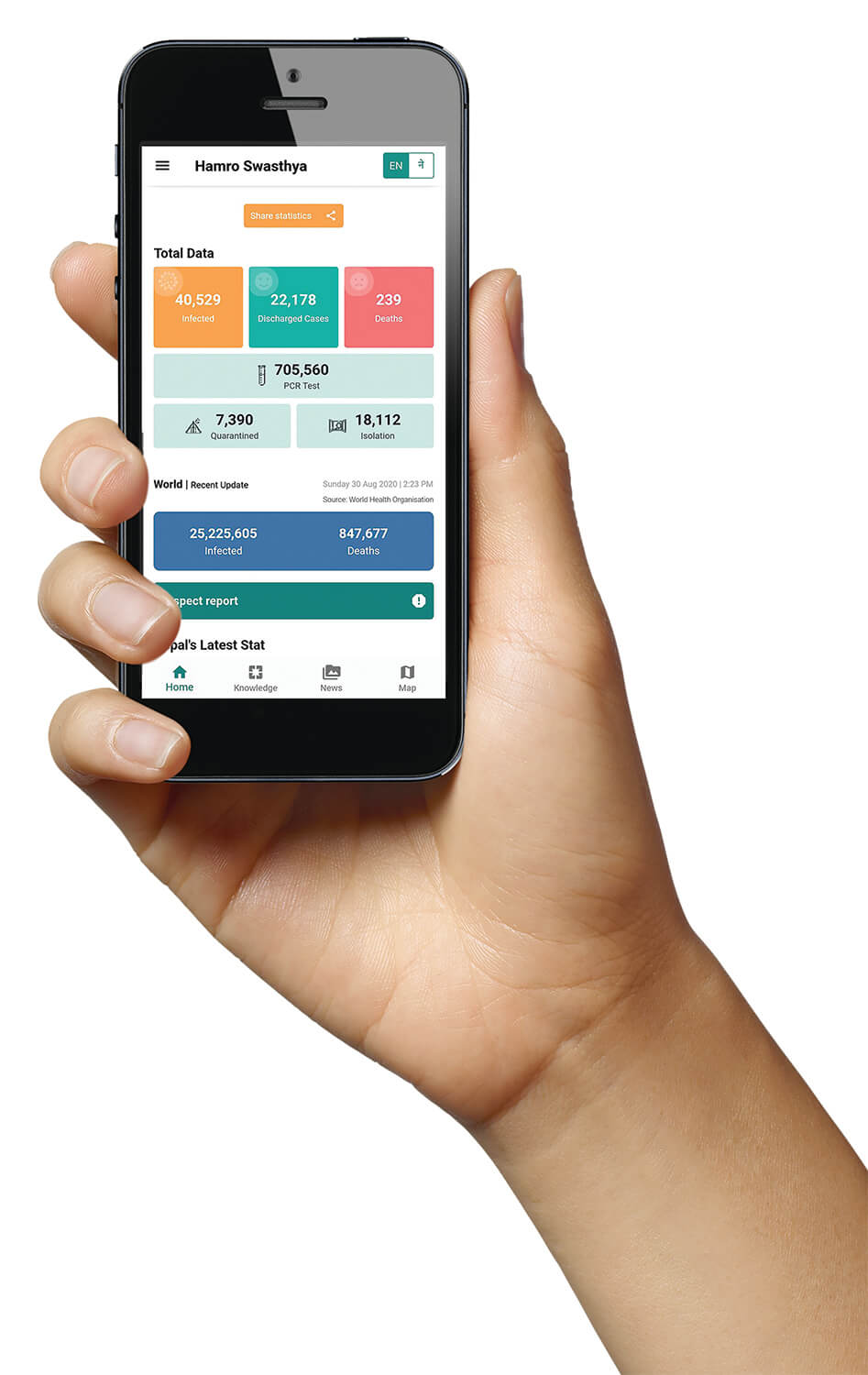
Countries across the world are using technology to organise, manage, prevent and track Covid-19 rates, while Nepal has fallen behind in the pandemic app race.
China, being the first country to contract Covid-19, was naturally first off the mark to launch a ‘health code’ app nationwide. Installing the app was made mandatory by the government, and while many labelled it a breach of privacy and part of China’s state surveillance system, it was also the only effective way to control the virus across a wide population.
The app directed people to stay indoors, report their travel history and share knowledge of any symptoms they may be experiencing. Each user then received a coloured QR code to indicate their infection status: red for those considered infected by the virus, yellow for those who may have come into contact with a Covid-positive person, and green code for those who seemed fine and virus-free. Public spaces could only be accessed with a green QR code, to ensure that a Covid-positive individual doesn’t enter, say, a shopping mall and endanger others.
India followed China in its contact tracing app (CTA) strategy and method when Prime Minister Modi’s office set up a committee to guide and quickly launch the ‘AarogyaSetu’ app. AarogyaSetu is Sanskrit for ‘the bridge for liberation from disease’.
It was pretty clear that the Indian government was activating a robust PR campaign around the app as soon as it was launched on both Android and iOS app stores. Indian celebrities such as national cricket captain Virat Kohli and Bollywood actor Ajay Devgn endorsed the app via video clips requesting citizens to safeguard themselves from getting infected, The app crossed 100 million downloads and broke Pokemon Go’s record of being the fastest growing app ever.
It has been one year since the app came into mandatory practice, and now airports, malls, clinics and local businesses ask Indian citizens to show their AarogyaSetu app to report their Covid status before they come into contact. As in China, the app uses the green-if-negative and red-if-positive simple colour-based communication.
The app is not based on prediction but strives for accuracy in reporting. In major cities like Mumbai, the government sends a home testing medical team to test members of households, and if their report is positive, it automatically updates their Covid status on the app, which is linked to their Aadhar Card (government-issued ID).
In the United States the federal government did not launch an official app or impose any mandatory rules to use CTAs. Instead, local governments collaborated with Apple and Google to develop regional apps relying on Bluetooth technology, but only for those who wish to use it. These apps ensure user safety by promising not to store personal information on their servers. A survey revealed that roughly 39% of US citizens supported or accepted the use of CTAs to control the pandemic, compared to a whopping 80% in China, indirectly suggesting that the Chinese have more trust in their government institutions than the Americans.
Unlike these large economies that developed quick action digital tools under tight timelines, Germany came up with the ‘Corona-Warn-App’ months later, without any rush, taking its time to tackle possible data privacy issues. The download of the German app is voluntary, and it is designed to respect people’s privacy by not permanently storing personal information.