


In terms of global vaccine equity, the answer to the question of whether it is ethical for rich countries to boost with a third dose of Covid-19 vaccine, seems like a no brainer.
But ethics aside, it has been pointed out that no one is safe until everyone is safe. It is in the public health interest of rich countries to ensure that as many people around the world are vaccinated to prevent new variants and spikes.
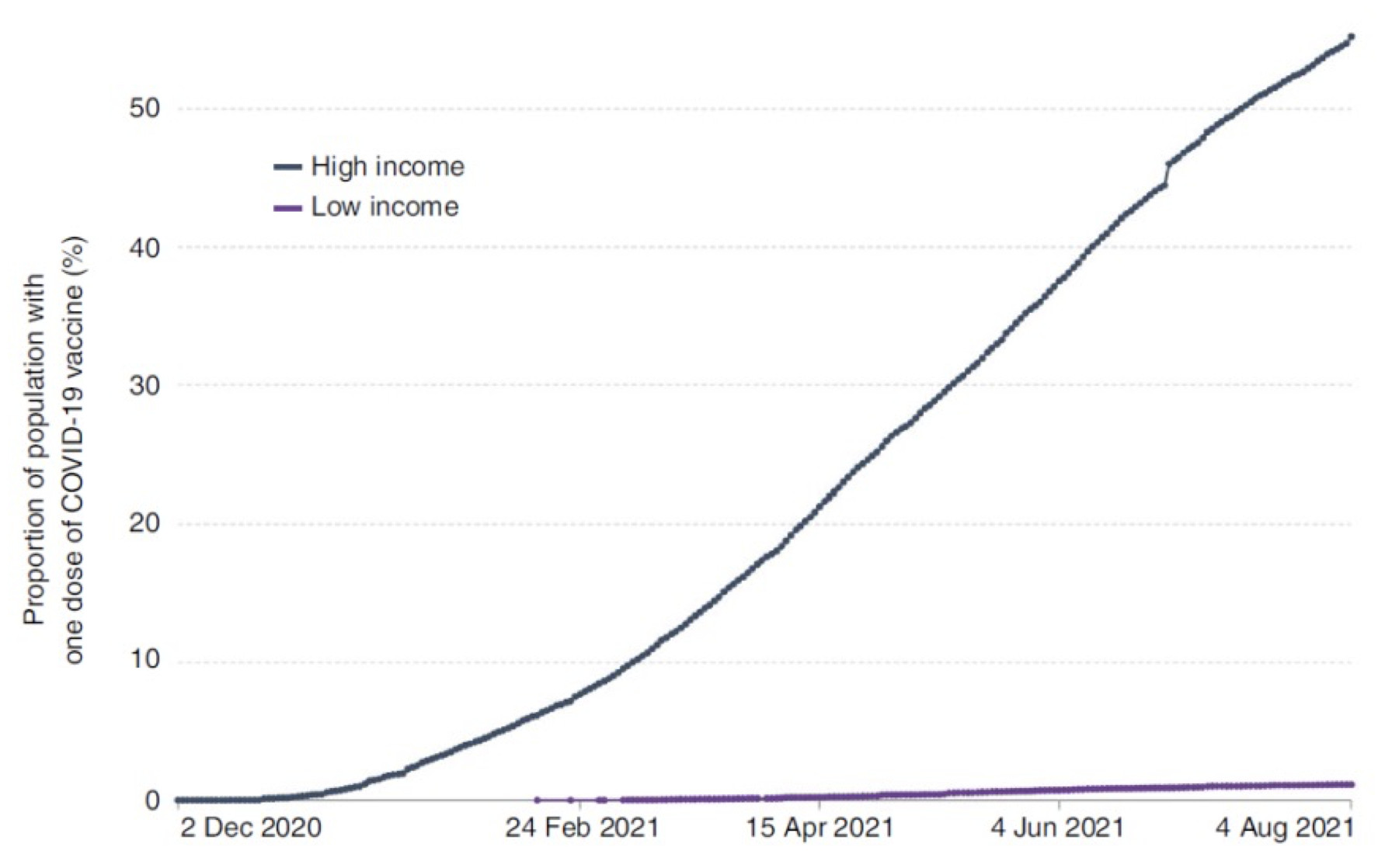
The graph below starkly illustrates the big gap between the jab and jab-nots – showing the wide chasm between rich and poor countries in terms of the proportion of the population which has got even the first dose.
Booster vaccination is a moot point for low-income countries because at the moment the option is limited to high- income countries, where some research has shown waning antibody presence and the authorities in the US are advising a third dose eight months after the second one.
As of now there is only scant data to show that boosting will help real-life protection in the general population. Clearly the vast majority of the people who received the full dose of approved vaccines, including the Chinese VeroCell here in Nepal, already have adequate protection against severe (as opposed to mild or moderate infections) Covid-19 disease with the present vaccine schedule.
Crucially, a strong international drive to vaccinate the unvaccinated could potentially save many more lives than would boost the already vaccinated.
But this is a very wily virus which almost overnight changed the rules of the game by mutating into the highly infectious Delta variant. We need look no further than what happened in neighbouring India earlier this year as this variant ripped through the unvaccinated population regardless of herd immunity that was thought to be widespread.
Delta surged across the open border into Nepal, where it overwhelmed the country’s inadequate and inequitable health care system. There is credible data to suggest that there might have been 3-5 million excess deaths in India during the second wave.
Estimates for Nepal by the Institute of Health Metrics and Evaluation of the University of Washington in Seattle show that although the official cumulative deaths due to Covid-19 as of this week was nearing 11,000, the real figure with excess mortality is closer to 40,000.
It is among the vast number of the unvaccinated that the virus has a greater chance of randomly mutating and becoming a variant (from alpha to omega and now the mu variant in South America) and potentially spreading worldwide.
Every time the virus replicates, its likelihood of mutation increases. The novel coronavirus, unlike the other SARS-CoV-1 from 2003 may not be as keen on killing people as it is in perpetuating infections by replicating as much as possible .
After India, the Delta virus affected the UK population in a widespread manner, but there was one huge difference -- in Britain it infected many who had already been vaccinated, even though the severity of the illness was significantly lower in this subset.
Hence, as these variants generally develop in the unvaccinated population and some (there are 15 variants at present) turn out like the Delta variant, it would be in the enlightened self-interest of the richer countries to have as much of the world vaccinated as possible so that random mutations and variants will be substantially limited, and will not reach their shores.