Mohan and Sarita (name changed) studied together in the same school from Grade 6 onwards. They were friends initially, but fell in love and wished to be together, though underage.
Sarita’s parents did not approve of this relationship. They restricted her from going to school, and having any interaction with Mohan. Both then decided to quit school and elope, even though they knew marriage before age 20 was illegal.
They crossed the border into India, to get married. But the parents of Sarita filed a police complaint against Mohan charging him with human trafficking, and rape of a minor.
After a year, Sarita and Mohan returned to the village with a baby. Mohan was detained and taken to court. By this time, Sarita’s own parents had forgiven her and accepted her child. They were also sympathetic towards Mohan.
Sarita’s father approached the police to withdraw his case, but it was not legally possible. Today, Mohan is serving out his sentence. His father-in-law regrets having filed a police case against him. He takes lunch for Mohan every day in jail.
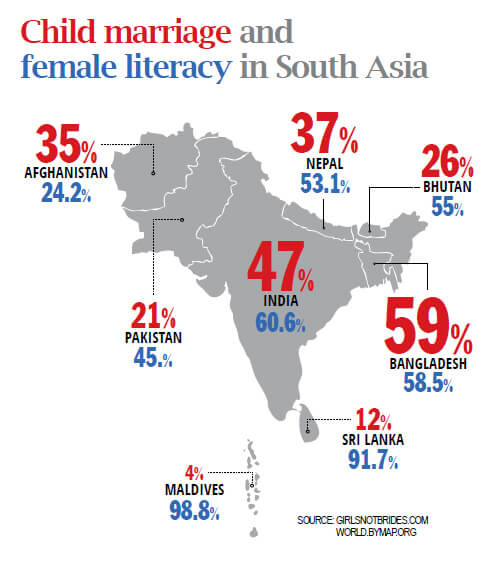
This is not an isolated case. As per the Nepali law the age of consent is 18 years. Girls, in such instances, have been mostly sent back to their parent’s home and the boy, if under 18, is sent to a correction home.
Child marriage in Nepal, eloped at 13, mother by 17, Sewa Bhattarai
As per the National Civil Code Act 2017, the legal age of marriage has been raised to 20 for both boys and girls so that young people can finish school, become independent and mature before they can make informed marriage choices.
However, there is a wide gap between the purpose of the law and practice, and social norms. This gap needs to be addressed for the law to be effectively implemented. In 2014, at the Global Girl Summit held in London the Minister of Women, Children and Senior Citizens made a pledge to end child marriage by 2030, a commitment reflected in the National Ending Child Marriage Strategy.
Marriage is viewed as a traditional and religious institution and is considered a ‘must’ for girls in Nepali society. Parents and members of the family are expected to be responsible for the marriages of their daughters and sisters.
The reasoning is ‘protection of girls’, ensuring a ‘secured future’ and a ‘better life’. Girls are also seen as an economic burden on families, and the pressure of dowry has made this worse. Girls from a very young age are also socialised in such a manner that they see marriage as the only possible future.
Many girls feel a sense of security when married, and also perceive marriage as the beginning of their lives. Even among school girls one rarely finds a girl brave enough to declare that she may consider marriage only after school, or may not wish to marry at all.
Can Nepal end child marriage by 2030?, Namrata Sharma
The thinking of parents, family members and even the young girls are shaped by strong patriarchal mind-sets that view girls as objects to be married off to a ‘permanent home’. The result of all this. Our girls are not safe, and parents play a part in keeping it that way.
In reality, the expectations that the girls and their families have of marriage are not always met. With weak agency, low self-esteem, and less confidence, girls are unable to negotiate equal status in marriage.
The unequal power relationship between men and women always place young married girls as subordinates – they are expected to solve their married life challenges by themselves.
Parents mostly shrug their shoulders if married daughters land in trouble from in-laws. Girls are often left alone to fight their fight. Despite being aware of their rights, lack of economic independence, confidence to speak up for themselves and poor knowledge of sexual and reproductive health among the girls result in unwanted pregnancies, gender-based violence and, sometimes even rape.