Although the Nepal budget this year cut tax breaks for electric vehicles and did not acknowledge a green path to post-COVID economic recovery, Nepal has an opportunity to tap into next-door China’s rapid strides in green financing.
China was first mover among developing countries to put itself on a low carbon trajectory, using green finance as one of the main tools, and it has now become the world’s largest market for carbon credit, green bond markets and investments in a sustainable economy.
Being right next door, Nepal could tap into this potential and use its international goodwill in restructuring the country’s economy towards a green transition.
Nepal’s chance to green its budget, Kaustubh Dhital
After the 2014 climate agreement between President Xi Jinping and President Barack Obama alongside the consequent ratification of the Paris Agreement, China has taken a leadership role in global climate governance.
Beijing went against the commonly held ‘Common but Differentiated Responsibility (CBDR) framework’, which protected developing countries from taking costly and ambitious climate action that allowed them to opt for voluntary incentives to reduce greenhouse gas emissions.
There has been public pressure on the Chinese government to act on worsening air pollution, and China was shamed at the Copenhagen climate summit in 2009 for rising carbon emissions.
Since then, there has been strong political will from President Xi Jinping himself that led to China’s U-turn on environmental and climate policies. China also benefited from technocrats and advocacy coalitions to realise the benefits of a green economy.
Nepal can learn from China’s Green Finance Task Group made up of experts from ministries, financial regulators, academics, banks and other financial institutions, complemented by international experts. It was set up in 2014 to help the central government identify barriers and opportunities in green finance.
Its recommendations formed a key part of the 2016 ‘Guidelines for Establishing the Green Financial System’ policy document, which sparked rapid development of green finance in China. It makes sense for Nepal to similarly bring together experts from across the industry to design a green financial system appropriate for Nepal.
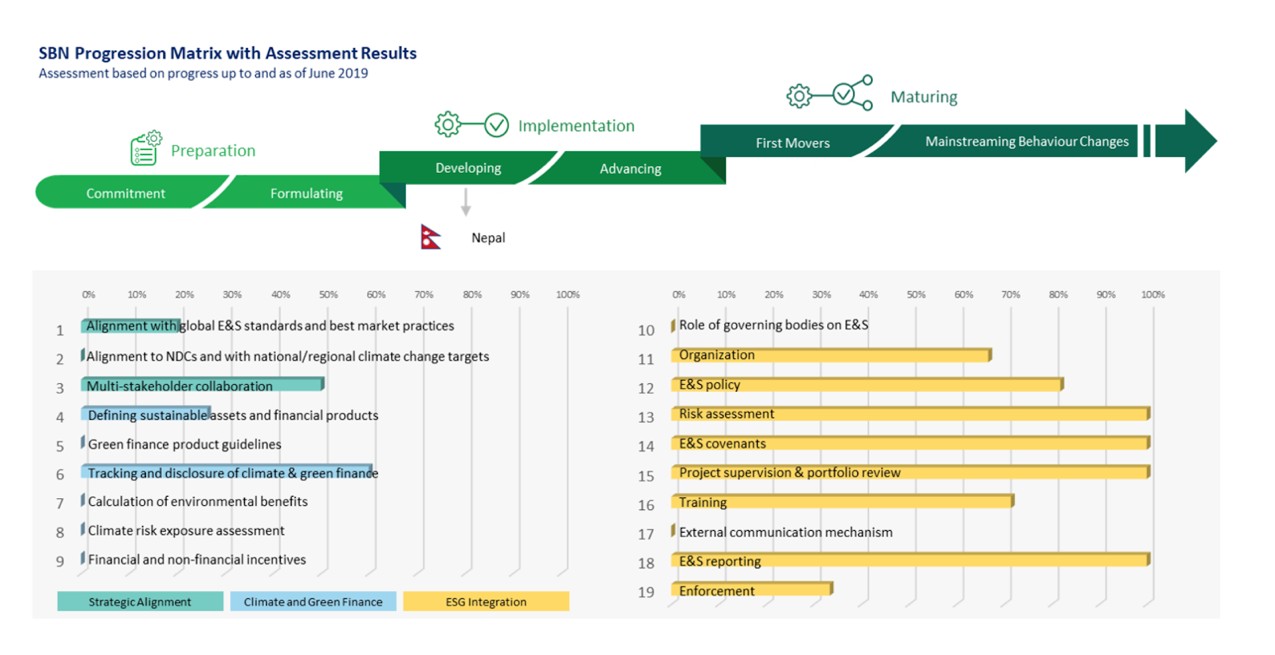
It is equally important for Nepal to step up its climate and green investment reporting alongside the measurement of environmental benefits and climate risk exposure. Presently, Nepal requires financial institutions (FIs) to report on climate/green finance flows and activities.
However, the framework does not require FIs to report on climate risk exposure on the portfolio level. Nor does it make environmental and social policies externally verified through independent reviews. Nepal also does not require FIs to calculate the environmental benefits of their investments and any climate risk exposure assessment.
Build back greener, Bishwa Nath Oli, Maheshwar Dhakal and Rudriksha Rai Parajuli
Along with a systematic update of Nepal’s framework, there is much space for capacity building within the country’s banking sector in climate risk exposure methodologies. This is because banks play a key role in ‘assessing risks, originating loans, and underwriting the issuance of equities and debts’.
Nepal’s membership of the Sustainable Banking Network gives hope for the future of Nepal’s green finance regime. However, international agencies, financial and academic institutions, banks and lobby groups should also facilitate bilateral channels to allow China to play a key role in knowledge transfer and capacity building in Nepal.
For example, the Green Finance Leadership Program led by Tsinghua University, focused on technical assistance on green finance to developing country financial regulators could be a starting point.