Nepalis are living longer than ever. By 2028, the country is set to join the ranks of other ageing societies around the world, and by 2054, 1 out of every 7 people in Nepal will be over 65.
Life expectancy at birth has risen dramatically from just 55 in 1990 to 71 today, thanks to improvements in public health and access. But as more people live longer, the country must also prepare for a parallel rise in age-related illnesses and the complex social and medical needs that come with an ageing population.
Extended families have always acted as a safety net for the elderly, with children and grandchildren shouldering most caregiving duties. But with more than 1,600 Nepalis migrating every day, older parents are left behind with no one to care for them.
Remittances from migrating youth, which account for nearly a third of Nepal’s GDP, have kept the economy afloat. But money sent home cannot make up for the chronic departure of kin and caregivers, who are often the first to catch the signs and symptoms of disease in elders.
In rural areas where over 85% of Nepal’s elderly live, the absence of this daily vigilance means early signs of illness often go unnoticed until they become debilitating. As a result, chronic conditions like hypertension, diabetes, and depression are left unmanaged.
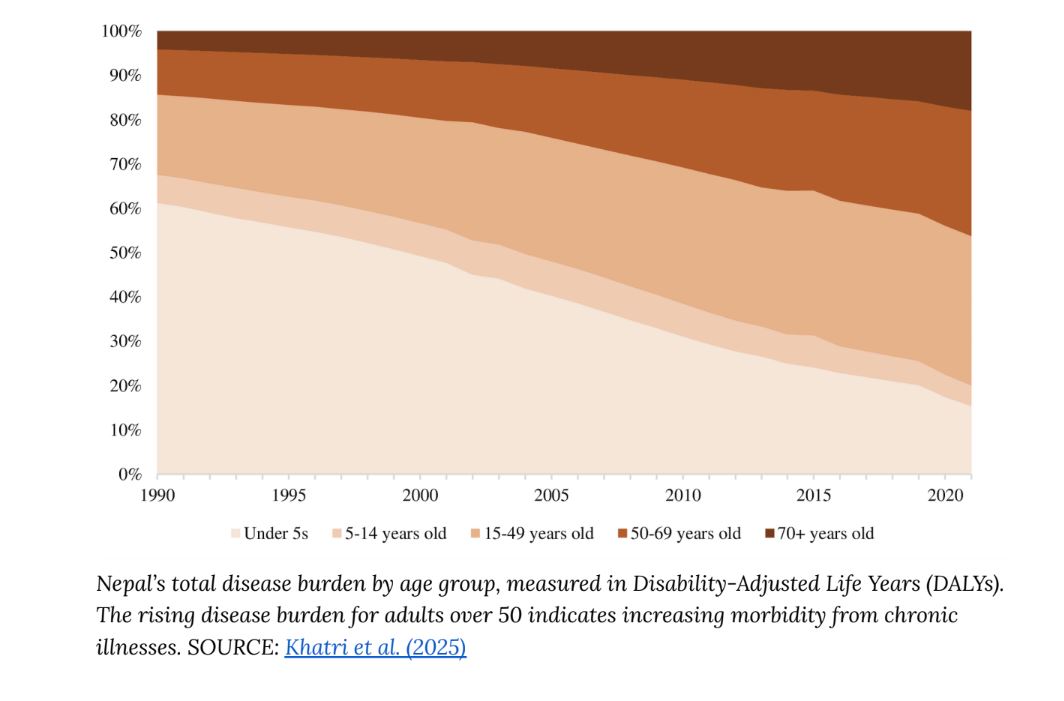
Geriatric medicine is largely absent from medical curricula and there is no national plan in place to manage cognitive decline, memory loss and confusion. These are often mistaken for signs of normal ageing, instead of dementia, delaying care until it is too late. The same pattern plays out with strokes, osteoarthritis, and vision problems — conditions that could be managed early but are instead allowed to spiral into disability.
Nepal is not ready for an older future. It needs a strategy for ‘smart ageing’ where the focus is not adding years to life, but enhancing years lived through the intelligent application of policy, infrastructure, and crucially, technology.
Many models of smart ageing, however, are sculpted around modern societies where independent living in later life is the norm. Furthermore, eroding traditional family care and an underdeveloped formal care system means there is a large gap that can’t simply be filled by copy-pasting from foreign models. Nepal must shape its own version of smart ageing.
The tech boom has led to homegrown digital healthcare apps such as Hamro Doctor, Cura Health, Jeevee and Health Yaad Ayo which offer teleconsultations, online appointments, and at-home test bookings. As smartphones and internet access extend to the most rural fringes of the Nepali countryside, geography is no longer a barrier to the use of these digital tools.
What limits their use is the lack of digital proficiency among the older generation. Others find the idea of turning to a device instead of a familiar, reassuring face unfathomable. That is why digital literacy efforts must be paired with guided human support to build trust alongside technical skill.
Such a model of community-led digital mediation is already gaining traction elsewhere. In the UK, ‘digital health ambassadors’—often young people or even schoolchildren—are trained to co-design and advocate for online platforms that resonate with peers who might otherwise feel excluded from automated health services.