
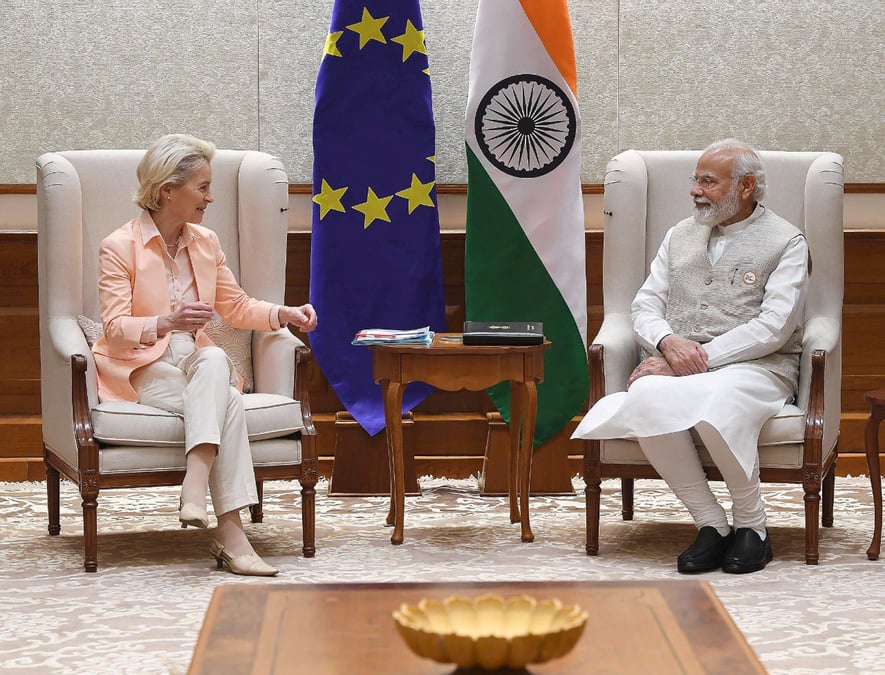
Last month, European Commission President Ursula von der Leyen announced that the first official foreign visit of the commission in her second term would be to India. On the same day, Marco Rubio held his first bilateral meeting as US Secretary of State with India’s minister of external affairs, Subrahmanyam Jaishankar.
Prime Minister Narendra Modi’s two-day visit to Washington last month confirmed his country’s rising international profile. The visit ended with the promise of what Modi called a US-India “mega partnership.” He has committed to double trade with the US by 2030, increase oil and gas imports, and expand US military sales to India.
India is now the fastest-growing major economy, with the IMF forecasting a 6.5% increase in GDP this year. India is expected to overtake Japan and Germany to become the world’s third-largest economy by 2030.
Read also: India’s election and its economic future, Raghuram G Rajan
Despite its vast potential, India has long been overlooked by the West, both economically and geopolitically. But a fundamental global realignment is now underway. America’s ‘unipolar moment’ has given way to an era of great-power competition that, unlike during the Cold War, features demands by emerging and developing economies for a more inclusive and representative multilateral system.
In this multipolar age, both the US and Europe see India, a neutral foreign-policy actor and dynamic emerging economy, as vital to the future of their strategic priorities.
A founder of the Non-Aligned Movement, India has plenty of experience navigating precarious moments in world affairs. During the Cold War, it skillfully balanced its policies toward the US and the Soviet Union.
When it engaged with the Soviet Union, from which it received considerable military assistance, it calibrated its approach to offset US support of Pakistan, without taking sides in the great-power competition.
India has since maintained this pragmatic balancing act, adapting its foreign policy to a shifting geopolitical landscape. Today, that means recognising its potential to shape global affairs, including by playing a leading role in building an efficient, realistic, and inclusive multilateralism.
This is reflected in Modi’s pursuit of a more assertive, internationalist foreign policy. Beyond building new partnerships and strengthening old ones, Modi has sought to increase India’s influence in traditional and emerging multilateral fora. In 2023 alone, India held the presidency of both the G20 and the Shanghai Cooperation Organisation (a Chinese creation, comprising nine Middle Eastern and Asian countries).