

“Countries knock at our doors all the time for capital, as it is getting harder and harder to obtain development funds. We are holding $500 million for Nepal. We cannot wait forever. When will it be the right time for Nepal?”
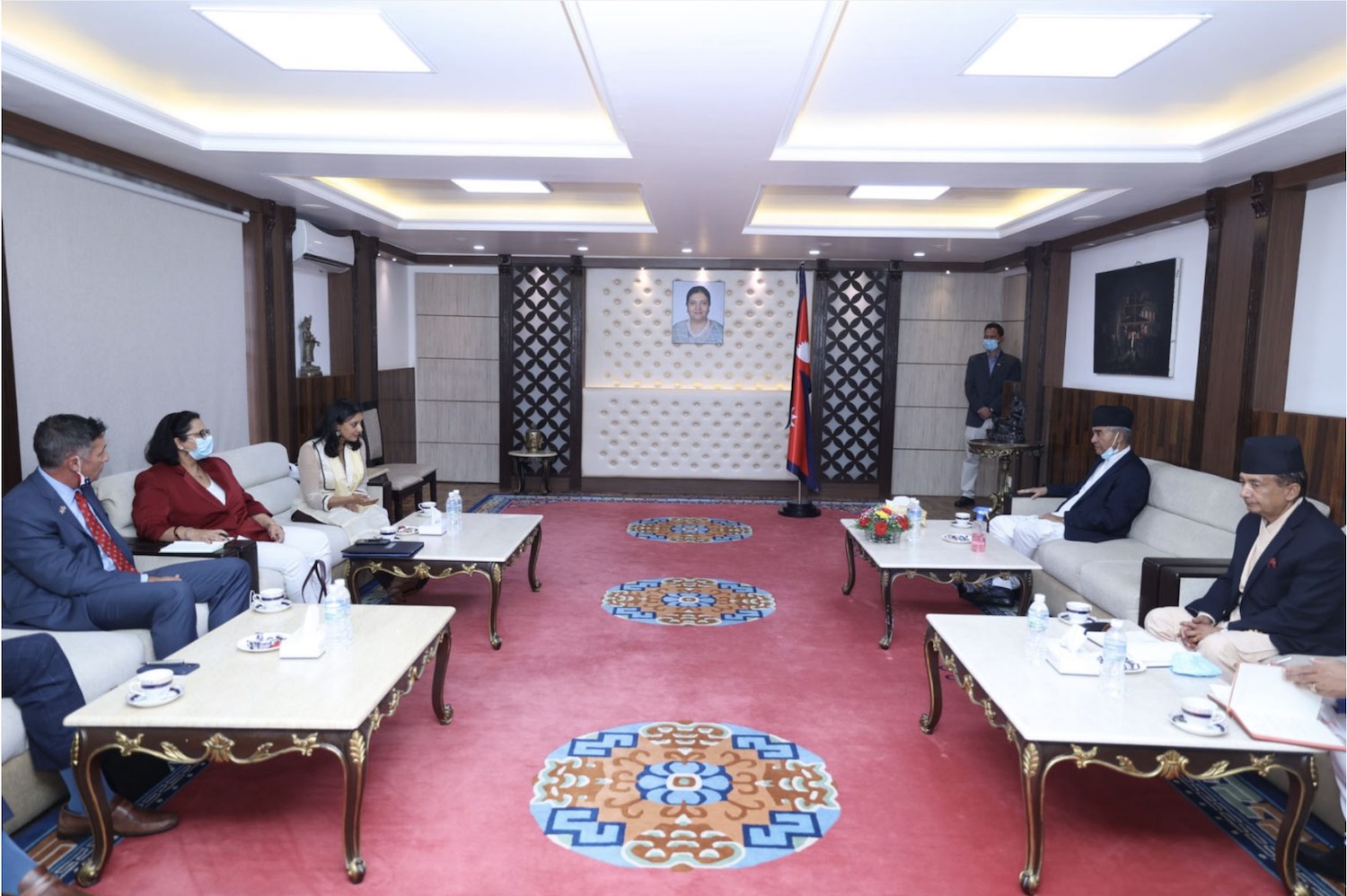
Fatema Z Sumar, Vice President of Compact Operations at the Millennium Challenge Corporation (MCC) appeared mystified about why a country like Nepal that needs all the help it can get to develop its infrastructure, should be so hesitant about the grant her government is offering.
Sumar was on the final day of her four-day visit to Nepal on Sunday, speaking at an engagement with opinion makers. There was a litany of questions from across the table, and Sumar sounded like someone who is getting somewhat jaded answering the same questions over and over again in Kathmandu.
“No, the MCC is not part of the Indo-Pacific Strategy and there is no US Army involvement.”
“This is a treaty between two countries and has gone through the Obama, the Trump and now the Biden administrations.”
“In order to make this a treaty, the Nepal government wanted to ratify it through Parliament. So, we are waiting for that.”
Sumar was a former assistant secretary for South and Central Asia at the US State Department before joining the MCC. Her family is Malaysian Indian, so she understands the region well, but she was hearing in Nepal some of the same political rhetoric that led to the Sri Lankans cancelling the MCC last year for being ‘against the national interest’.
MCC makes three types of grants: compacts, threshold programs and concurrent compacts for regional investment. Nepal’s grant is a five-year compact agreement with the MCC that allows an eligible country to fund specific programs targeted at reducing poverty and stimulating economic growth.
The concept of the MCC is to make US development assistance ‘smarter’, and to study a country’s bottlenecks so that catalytic investment can allow it to take an economic leap. A panel of Nepali and American experts concluded in 2017 that increasing hydropower transmission capacity and upgrading highways would be most cost-effective, at a time when the country was suffering 12-hour daily power cuts.
When a country applies for a grant from the MCC, the board examines its performance based on 20 policy indicators, and selects based on policy performance. The MCC says its grants are given to country-driven and country-led investments and infrastructure priorities for achieving sustainable economic growth and poverty reduction, and Nepal qualified.
So far MCC has approved $13.7 billion in compacts and $631 million in threshold programs worldwide. After Sri Lanka pulled out, Nepal is the only South Asian country on the list of MCC-approved compacts.
“The $500 million we are holding for Nepal is money not given to other countries which need to get out of poverty,” said Sumar’s colleague Jonathan A Brooks at the interaction. Although Brown said he had no idea where the confusion about the MCC having a military component comes from, a comment by US Under Secretary of State David J Ranz in 2019 that the MCC was indeed a part of the US Indo-Pacific Strategy did a lot of self-inflicted damage.