
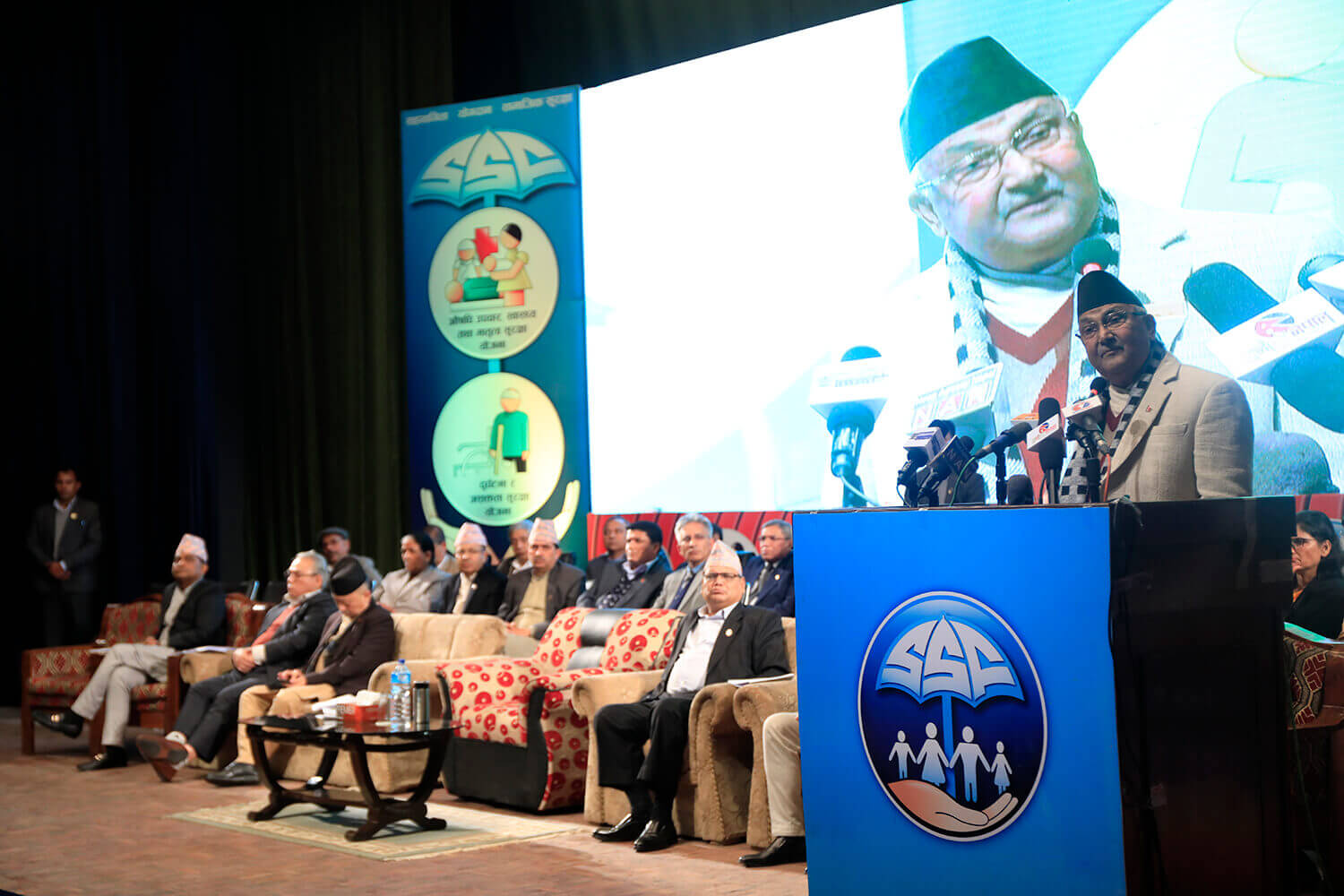
The Nepal government’s announcement of a social security scheme for formal sector workers this month has once again thrust social protection policy into the political spotlight. While such schemes can be important social policy instruments, significant concerns have been raised about this scheme and previous policies, particularly regarding government’s ability to fund and implement them.
Now more than ever, it is important that social protection policies and programs effectively address issues of marginalisation and vulnerability that undergird social insecurity and injustice.
Read also:
Social insecurity, Om Astha Rai
Govt, not employers, responsible for employees, From the Nepali Press
Marginalisation is deeply ingrained into Nepali social, economic, and political practice. Lines of exclusion across caste, gender, religion, geography have resulted in complex, multi-dimensional poverty. When poverty is entrenched over long periods of time vulnerability graduates from individuals and households to community and government levels. Ultimately, the cost of not addressing vulnerability is borne across society.
Vulnerability is exaggerated during times of instability, and in Nepal it is caused and exacerbated by politics, natural disasters, informality of labour and income, and so on. Vulnerable individuals suffer double jeopardy, and tend to enter a downward spiral of wretchedness if left unnoticed by government.
Governmental responses to vulnerability through social protection policies and programs have mirrored the trajectory of the country’s transformational politics. Social movements, government restructuring and changes to legal and constitutional frameworks have shaped how marginalisation and vulnerability are addressed.
Today, all major parties recognise the political value of adopting social protection elements into their policy platforms. Alongside the recognition of the political significance of social protection policies, there is also growing appreciation of the positive impact of these policies for the country’s development. Despite this, poor policy design impedes social protection efforts in Nepal.
It may be useful to analyse the effectiveness of Nepal’s social protection schemes by considering the following three design approaches:
- Equality-based approaches provide blanket security to the entire population. The best examples are many of the labour market regulations, which regulate working conditions, occupational safety, worker rights, and minimum wages.
Equality-based schemes assume that all people are alike and have the same needs. However, this assumption of homogeneity ignores the fact that some groups experience marginalisation and vulnerability more acutely than others.
- Equity-based schemes recognise varying types of vulnerability and marginalisation and employ targeted strategies of redressal. An example is Nepal’s Disability Grant, which targets persons with disabilities to ensure greater social inclusion and economic independence.
Most of the budgetary allocation in Nepal’s social protection portfolio is directed toward equity-based social assistance and allowance programs. This reflects the evolving political understanding of equality and equity: with policy shapers increasingly seeking to incorporate targeted instead of universal strategies. However, since Nepal’s universal schemes play a significant role in protecting the vulnerable, it is vital that the government pursues both equality-and equity-based strategies.