


The war in West Asia has exposed the fragility of the economic architecture Nepal has built on over two generations. If the conflict continues, growth across developing Asia will slow and prices will rise.
For Nepal, this will be felt through higher living costs, weaker economic activity, and growing uncertainty for the millions of families who depend on remittances.
Nepal now needs to structurally transform from exporting labour to investing in domestic job creation.
The country's current path toward a knowledge economy has a blind spot. A report by the Institute for Integrated Development Studies (IIDS) in Kathmandu shows that IT export companies alone generated 7,228 jobs and income for 66,509 freelancers.
We are building digital labour export, not an economy that accumulates institutional knowledge. The Nepali Upwork developer and a migrant construction worker in the Gulf are engaged in the same economic activity, but with different tools.
Nepal’s reliance on a remittance-driven economy, means the country has failed to create enough quality jobs at home. For millions of young people, leaving the country is not a choice but a necessity to survive and support families back home.
Remittances have no doubt helped reduce poverty. Thirty years ago, 55% of Nepal’s population lived on less than $2.15 a day, now it is 20% after the absolute poverty line was revised upwards. This progress has come at a cost — an economy that depends more on exporting workers than creating opportunities at home.
This development reflects a deeper political failure to create meaningful jobs within the country. Since the democratic transition in 1991, Nepal’s leadership has largely recycled the same faces, with limited progress on job creation or industrial growth.
Nepal cannot build a knowledge economy while its most ambitious people are outbound to Doha and Tokyo. We are also not just losing ‘labour’. We are losing the entrepreneurial risk tolerance of our youth.
If the most ambitious 25-year-olds are abroad, who is left to support innovation and entrepreneurship? The same people who are working tirelessly abroad, are our biggest asset for development. Their work ethic and the know-how inurban renewal could well fit into the new RSP government’s mandate of 7% annual growth.
The $1B milestone of IT exports is a celebratory moment for Nepal. However, that cannot lead to a pathway to a $100 billion economy without innovation ecosystems that go beyond individual labour export. Companies like SecurityPal and industry associations such as NASIT have made significant efforts in building such an environment, recently championed by private sector leaders as a Silicon Peaks model that emphasises a home growth tech cluster.
The need to accelerate this transition is even more urgent with the escalating conflict in West Asia. The recent International Labour Organisation (ILO) report shows that LDC graduation is expected to adversely impact manufacturing with losses of $1 billion by 2030.
If manufacturing takes such a large hit from losing trade preferences, then Nepal’s services and IT sectors need to structurally transform and shift from exporting individual talent to building firms.
A generation’s frustration has finally forced a shift in Nepal’s political structure, handing the new government a clear mandate to fix failures. But the question still persists: what prevents Nepal from achieving sustained, productivity-driven growth?
RSP is in the right place at the right time to put Nepal's economy on a firm footing. At the heart of Nepal’s economic underperformance lies a major development binding constraint: low returns to investment on projects.
The government invests like a high-growth economy, with gross capital formation at around 25–30 percent of GDP. Yet economic growth remains modest. The problem is not how much the country invests, but how little it gets in return. One way to see this is by looking at how much investment is required to generate growth.
Nepal needs large amounts of capital to produce relatively small gains in output (graph, below). For instance, in 2024, the ICOR was 8.29, this suggests that Nepal had to invest more than 8 units of capital to produce a one unit of additional economic output.
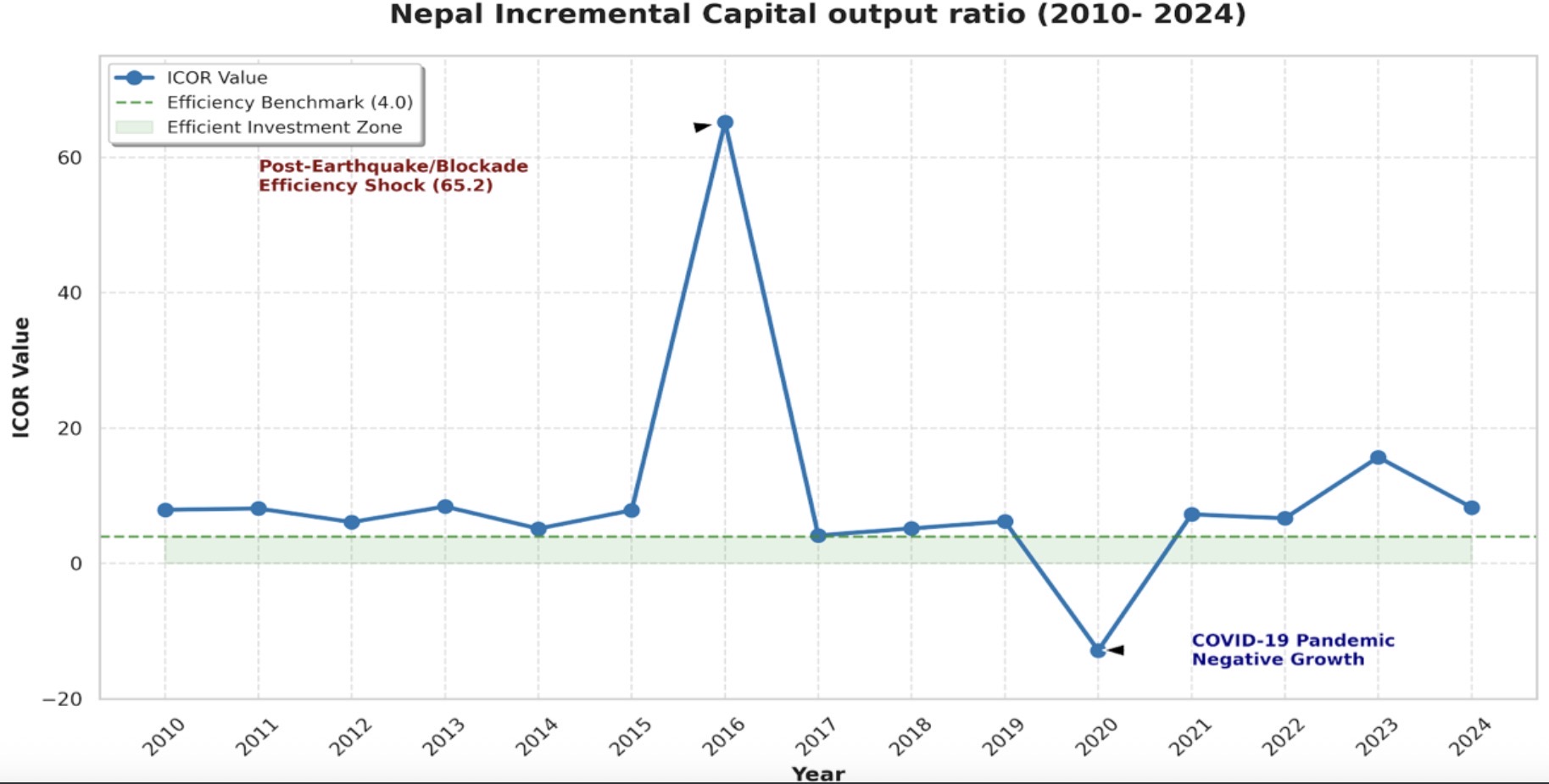
This reflects a deeper issue in how investment is allocated and executed. Capital is often locked in low-productivity sectors or diluted by delays, inefficiencies, and policy uncertainty.
As a result, even high levels of investment fail to translate into sustained growth. Until investment shifts toward productive, firm-building activities, higher spending alone will not deliver results.
To reverse this, the government must focus on raising the returns to investment by enabling firms to grow and compete. This requires a shift from managing scarcity to creating an environment where capital can generate consistent and predictable returns.
A central priority should be given to attracting and retaining both domestic and foreign private investment. Investors do not just respond to direct incentives, but also to policy stability in the country. Nepal’s economy cannot sustain high growth if its human capital continues to leave the country.
The goal should not simply be to create jobs, but to build companies that scale, innovate, and compete beyond Nepal. This requires supporting sectors with strong productivity potential and ensuring that firms can expand without being constrained by infrastructure gaps or regulatory friction.
Finally, the state must improve the quality of its own investment. Public spending should focus on lowering the cost of doing business through reliable electricity, efficient logistics, and digital infrastructure.
The GenZ movement took two days to bring change. The economic transformation of Nepal might take a generation. The RSP can accelerate this transition, but only if it focuses on building a better investment climate for business and not just feeding the global labour pool.
Kailash Raj Pandey is an MPA/ID and MBA candidate at Harvard Kennedy School and MIT Sloan School of Management and a fellow at MIT Kuo Sharper Center for Innovation and Prosperity.
Siddhartha Raymajhí is a policy researcher based in Kathmandu.