
Just three weeks in, Prime Minister Balendra Shah has already shed two ministers, and is having to contend with the economic fallout of the West Asia war plus the global order that it has upended.
The new dispensation in Nepal has aroused interest in New Delhi, Beijing as well as Washington. The ouster of Home Minister Sudan Gurung, whose first act in office was to arrest former prime minister K P Oli, has foreign policy wonks scratching their heads.
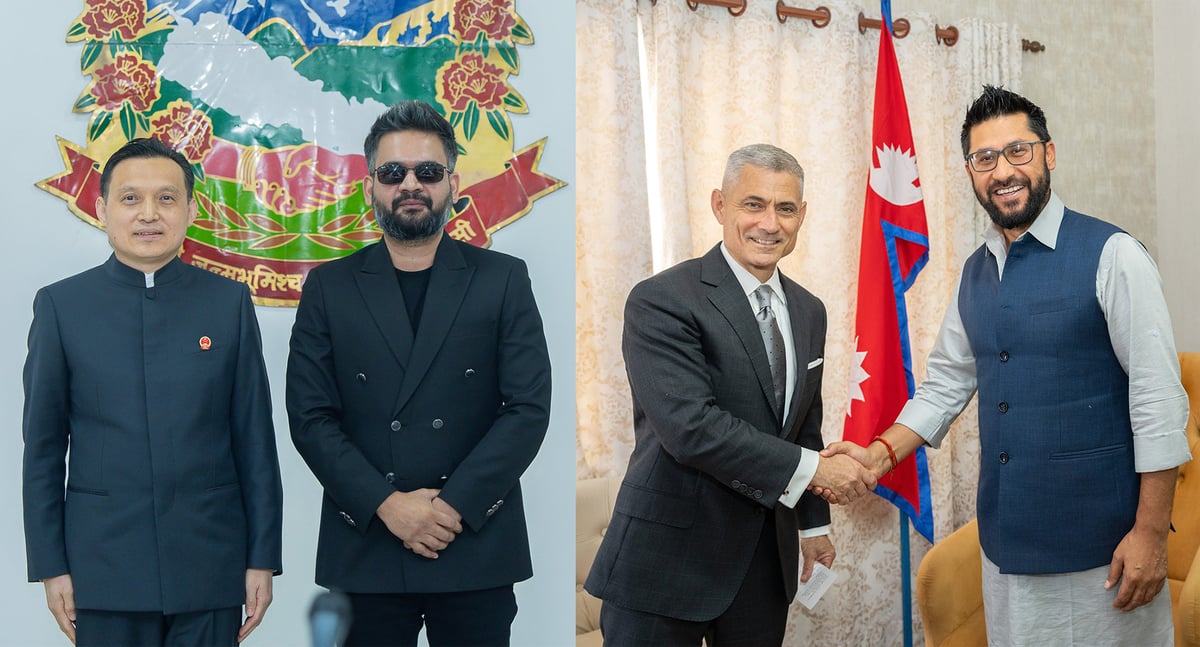
The US sent Assistant Secretary of State for South and Central Asian Affairs Samir Paul Kapur on a special mission to figure out what is happening in Kathmandu. In town at the same time was Cao Jing, Deputy Director General of the Asian Affairs Department of China’s Ministry of Foreign Affairs. And Prime Minister Shah is preparing for an official visit to India.
For the Americans, it is mostly about containing China and looking after the welfare of Tibetan refugees, while pushing its own MCC Compact and State Partnership Program (SSP). Beijing is mindful of the post-Dalai Lama era, and does not want instability in Nepal to encourage free-Tibet activities. India lately seems more wary of American activity in what it considers its backyard.
The Chinese appear relieved to see Sudan Gurung go. Only last week, Ambassador Zhang Maoming met Gurung during which he raised the issue of Tibetan and Taiwanese activities in Nepal, seeking firm commitment that Kathmandu would not harbour activities hostile to Beijing.
“Geographically we are close to Tibet and not to the Mainland, so China remains suspicious of us, especially after the TOB and free-Tibet components that emerged from the GenZ protests,” says geopolitical analyst Indra Adhikari.
Kapur, for his part, met RSP Chair Rabi Lamichhane, Finance Minister Swarnim Wagle and Foreign Minister Shishir Khanal. Although investment and infrastructure was on the agenda, the main issue seems to have been about Tibetan refugees. In nearly parallel meetings with ministers, Cao Jing warned Nepal not to be too cosy with the Americans.
For Indian academic and Nepal watcher Sukh Deo Muni, all this harks back to American activity in Nepal during the height of the Cold War. He tweeted: ‘US senior diplomat Paul Kapur's statement in Kathmandu must be understood carefully in New Delhi. He said the US does not want China or any other country to dominate Nepal.’
‘Any other country’ could be a pointed reference to India, and what this means is that Nepal may now have to navigate even more carefully a tri-polar world order reshaped by the West Asia war.
Nepali journalist based in New Delhi Akanshya Shah agrees that the United States may not be seeing Nepal through the Indian lens anymore, while New Delhi does not want heightened US activity in what it considers its sphere of influence. All this is further complicated by recent frostiness in Washington-New Delhi ties.
“New Delhi doesn’t have that familiarity factor it used to with old leadership in Nepal, but it is curious about what the young Balen Shah will do and what kind of relation he will pursue with India,” she adds. “Certain decisions of the Balen government such as ending VIP culture and delivering passport at homes have hugely resonated with the Indian people, he has in some ways become a role model among the youth in India as well.”
India has invited Prime Minister Shah for an official state visit, which will be his first foreign trip as per tradition. Shah graduated in structural engineering from a college in Bengaluru, and knows India well. Shah has injected religious elements into his public exposure as prime minister and this could help project Nepal’s ‘soft power’ in dealing with India.
But he has also been a nationalist on the Limpiyadhura map dispute, and there are other thorny issues like air connectivity, river projects and power exports that need to be ironed out.
Sukh Deo Muni warns that the old Indian diplomatic approach based on religio-cultural stakeholders in Kathmandu may not work anymore. He wrote: ‘India's Modi government must prepare itself well to deal with new Nepalese leadership and their empowered support base, which is self-confident, highly nationalist, aspirant and impatient.’
The RSP’s 22-page National Commitment document said Nepal should abandon its historical ‘buffer state’ identity to serve as a ‘vibrant bridge’ between regional and global powers. Much of this debate is theoretical, and there is much navel-gazing that distracts from regional realpolitik.
“Whether we are a buffer state or a vibrant bridge, in today’s heightened geopolitical scenario we have to have good relations with good neighbours,” explains Akanshya Shah. “What is of paramount importance is that our ties are based on the aspirations of the young generation, so that they are engaged.”
Indra Adhikari goes as far as to say that the concepts of “buffer state” and “vibrant bridge” have both failed and Nepal is neither. “We have had zero roles in mediating or de-escalating the tensions between India and China to call ourselves a buffer state. As a vibrant bridge, we cannot facilitate trade of the two countries. The new government should have researched and consulted more before proposing the same outdated and failed foreign policy concepts.”
What will be much more important for Prime Minister Shah is to continue Nepal’s traditional policy of ‘equidistance’ and convince his interlocutors that it is not an anti-Indian stance.
“At a time when there is increased interest of big powers in Nepal, we need to do a bit of our own homework for the systemic reforms we want,” says Akanshya Shah. “As for India, we first need to clearly define what we want on connectivity, energy and culture. But most importantly, we have to capitalise on the goodwill of India which we haven’t been able to in the past.”
Adds Indra Adhikari: “When it comes to fundamental aspects of foreign policy that ensures and enhances the well being of our citizens, national parties should all have one unified voice that doesn’t change when the government does. Only then the future generations can own it.”