

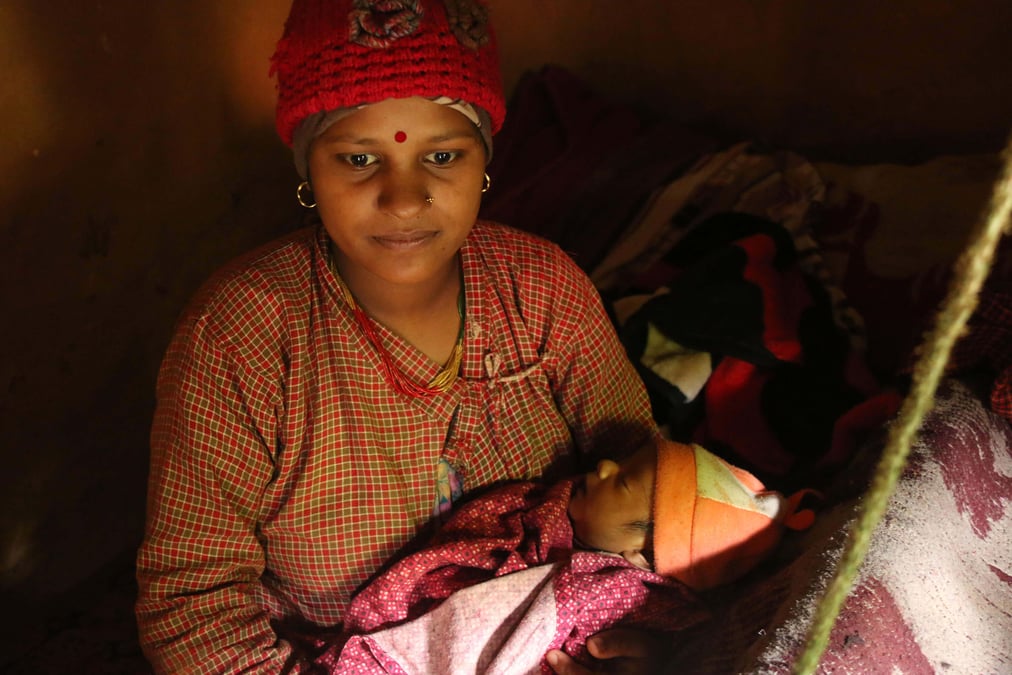
Despite funding setbacks, Nepal’s public health sector keeps developing new initiatives to strengthen maternal and newborn health. Two in particular, aimed at improving maternal nutrition and safe delivery, are in the pipeline for 2026.
The first initiative is multiple micronutrient supplementation (MMS) for pregnant women. The MMS will replace the iron and folic acid (IFA) supplements that the government now provides with 15 essential vitamins and minerals, including IFA.
The second plan is to do field research on the use of carbetocin as a drug to prevent post-partum haemmorhage (PPH). This is important because carbetocin is not as heat-sensitive as oxytocin, the current main option for treating PPH. In fact, the new medicine is known as heat-sensitive carbetocin (HSC).
The study is scheduled to start early in the new year. It will be a collaboration between One Heart Worldwide, Ferring Pharmaceuticals and the family welfare division (FWD) of the Department of Health.
A recent study in Nigeria found that health-care providers preferred giving HSC to women delivering babies because it had fewer side-effects and was of higher quality than oxytocin, which was often reported to be degraded by heat or supply-chain issues. The same issues are also barriers in Nepal.
PPH has for decades been one of the leading causes of maternal deaths, in Nepal and globally.
“We are confident that transitioning from IFA to MMS will enable expectant mothers to receive a more comprehensive suite of micronutrients, leading to improved pregnancy outcomes,” says Pooja Pandey Rana, Country Director of Helen Keller International for Bangladesh and Nepal.
The MMS plan is a collaboration between the FWD, the NGO Helen Keller International, Eleanor Crook Foundation, a US-based organisation that funds nutrition work globally, and other development partners.
According to Lili Bikram Thapa, Chief Nutrition Officer at the FWD, they are now preparing a road map for the rolling out of MMS once an assessment is finalised. Meanwhile, Indra Dhoj Kshetri of Helen Keller International said that his organisation is providing technical support to develop the road map.
“We hope that the government will gradually roll out MMS in a few provinces towards the end of this fiscal year July 2026,” said Kshetri, Officer, Africa and Asia Content Marketing, at the organisation.
He added that the partners are now researching possible “issues and bottlenecks” about switching to MMS as well as acceptance of the new supplements by pregnant women. Findings of both analyses are expected in January 2026.
MONEY MATTERS
Another current task, said Kshetri, is trying to get MMS added to Nepal’s essential medicine list (EML). That would reduce its cost. Today, MMS is imported as a food supplement and subject to 30% customs duty. But once on the EML, that duty would drop to about 5%, making it easier on the wallets of development partners and — if the government eventually takes over the programme as planned — on the public purse.
Of course, getting it on the list does not guarantee its availability. As many previous reports have pointed out, including a recent article in NepalNews, local governments have had a hard time keeping all medicines in stock. This would of course also apply to HSC if it is approved for use.
Earlier this year a Micronutrient Survey planned for 2025 was cancelled after USAID shut down.
When asked if it was a good idea to go ahead with MMS if they didn’t know the current state of micronutrients in Nepali diets, Pooja Pandey Rana of Helen Keller International said that while a micronutrient survey would have added useful insights, it is unlikely to have a significant impact on the government’s planned transition to MMS.
“There’s already a body of evidence from the Nepal Demographic and Health Survey and past micronutrient surveys that Nepali women have high levels of micronutrient deficiencies and undernutrition,” she added.
“Prior research consistently shows that MMS leads to better pregnancy outcomes compared to IFA alone. A large body of global evidence reinforces these findings. And therefore, WHO has recommended to include MMS in the antenatal care package. We are confident that transitioning from IFA to MMS will enable expectant mothers to receive a more comprehensive suite of micronutrients, leading to improved pregnancy outcomes.”
The plan is to start rolling out MMS in one province by July 2026.