

Wars and conflicts fundamentally alter landscapes and ecosystems, leaving behind scars that often go unaccounted for amid discussions dominated by human casualties and strategic competition.
Rarely do analyses on wars consider the environment – and there are major conflicts raging across the world at the moment from Ukraine to Gaza to Sudan.
Nature is regarded as an unavoidable collateral of human warfare. Yet, the intersection between conflict and ecology is critical in today’s global polycrisis. This interplay positions the environment not just as the backdrop but as a key variable in geopolitical dynamics.
Framing the environment as a silent victim suggests its passivity during armed conflicts. But the ecological consequences of war are loud and astonishing -- deforestation, pollution, biodiversity loss and fossil fuel use contributing to climate breakdown.
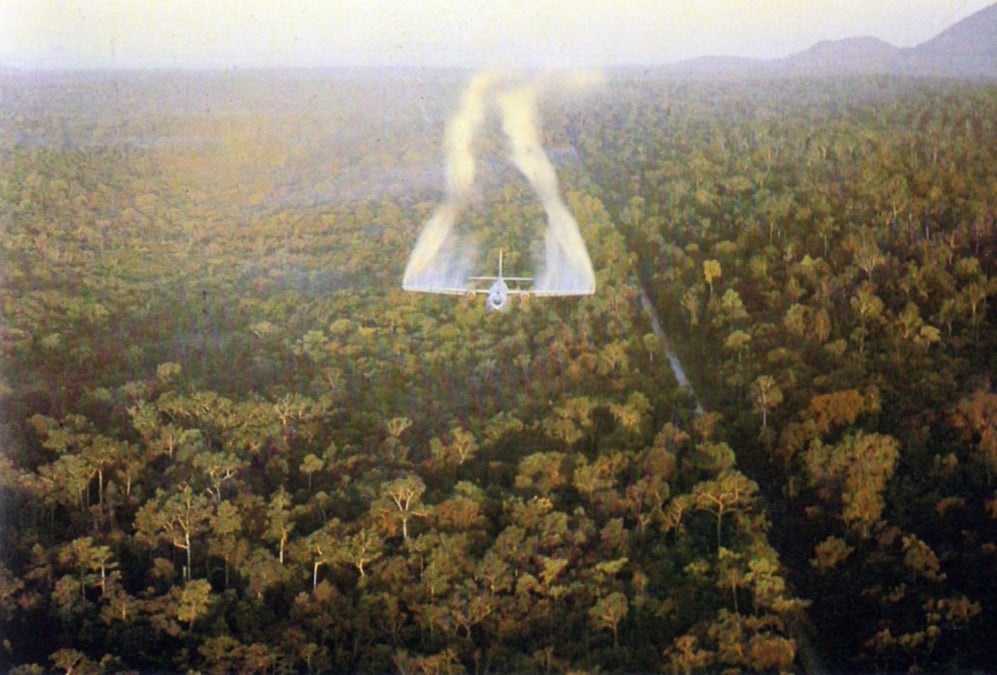
The use of Agent Orange in the Vietnam War led to the contamination of over three million hectares of forest, affecting biodiversity, agricultural productivity, and leaving a lasting impact on the health of the people fpr generations.
In Afghanistan, longstanding conflicts led to a reported 33.8% decline in forest cover in the already-arid country between 1990 and 2005. Post-conflict Sri Lanka saw a loss of approximately 188,407 hectares of forest cover.
Wars inject pollutants such as heavy metals, fuel residues, and other toxic substances into the air and water. The burning of 700 Kuwaiti oil wells during the Gulf War in 1991 caused massive air pollution and water contamination that impacted the whole region.
HIMALAYAN HOTSPOT
Human violence is violence against nature, and exacerbates the damage caused during peacetime. In the north-west Himalaya between India and Pakistan, militarisation and climate change depleted 29% of the Machoi glacier between 1972 and 2019.
The China-India border region has seen significant militarisation since the 1962 war, further endangering the fragile ecologies to deforestation, landslides, and glacial lake bursts. The Himalaya is a climate and conflict flashpoint.
Globally, militaries account for 5.5% of total carbon emissions, making it the fourth-largest emitter. Military spending worldwide reached a staggering $2.44 trillion in 2023, dwarfing global climate finance.
And all this does not even take into account the potential impact of an all out, or even regional, nuclear confrontation, the radiation poisoning and planetary winter it would unleash.
The environmental consequences of war and militarisation are barely recognised in traditional international relations theory and praxis. Dominated by realist thinking, global geopolitics prioritises military power and ‘hard’ security over ‘soft’ ecological concerns.
Realist narratives naturalise war as an inevitable reality of the anarchical international system and essentialise military power for states’ survival. They view nature as irrelevant to statecraft, refute ecological casualty, and resource interdependence. Nature remains an afterthought — a resource pit to exploit, rather than an active agent in itself.
International relations therefore not only silence the environmental ramifications of wars but also fail to account for emerging problems posed by planetary limits, transboundary ecological risks, environmental casualties of war, and global interdependence in ecological flows – all of which are inextricably tied to global geopolitics.
These ecological crises, compounded with climate change, transcend national boundaries and individual states’ capabilities. While these may not directly cause conflicts, they are likely to be threat multipliers to potentially worsen existing conflicts and weaken national security and sovereignty.
To better understand the silencing of the environment, we can adopt the constructivist lens to explore how ideas, norms, and discourses shape security narratives in international politics. Contrary to traditional reliance of international relations on power and conflicts as immutable referents, constructivism posits that security and power are socially constructed concepts defined by states’ perceptions of threats.
Thus, traditional international relations has often articulated threats to privilege military and national sovereignty considerations, while neglecting ecological violence. Nature is conceived as a passive resource, a battlefield, or at most, a strategic asset.
This distortion has become the dominant, universal episteme, influencing strategic policies and international law. The state’s constructed identity as the legitimate security provider is intricately tied to militaristic capabilities and not ecological stewardship.
Indeed, dominant global modernisation logic equates progress with resource extraction, crafting a narrative where conflict becomes a tool for resource control, and nature itself becomes a site of contention and competition rather than cooperation.
Critical theory helps demystify the relationship between war and environmental degradation further and explains who benefits from the strategic silencing and invisibilisation of the environment in conflicts.
Tracing the socio-economic and political roots of dominant theories, norms, and practices, critical theory unravels the linkages between capitalism, militarism, and ecological violence. There emerges a deeply capitalistic structural root of the ‘military-carbon complex’ which refers to the intricate symbiotic relationship between the military establishment, the defence and the fossil industries, and the resulting environmental destruction.
Militarism actively reproduces ecological violence through arms production and distribution, both heavily fossil fuel dependent. War is a technology that drives the military capitalist order, it becomes a method of stabilising access to and the continued exploitation of carbon-intensive resources.
Conflict necessitates and facilitates the commodification of nature through reckless resource extraction, including minerals, oil, and rare earths. Environmental damage is a feature, not a bug, of militarised capitalism.
Thus, global military actions, strategies, and conflicts perpetuate ecological destruction in the name of national security while serving capitalist interests. To mitigate environmental harm resulting from wars, it is crucial to acknowledge and understand these structural drivers.
Politically constructed concept of ‘security’ must therefore be redefined to encompass ecological and human security, and climate justice. Sovereignty should be reimagined to include ecological health, not only territorial integrity.
Wars must be ‘de-naturalised’ as the historically contingent institutions that they are. There must be a wider recognition that the global triple environmental threats erode the usefulness of Westphalian notions of sovereignty and bounded territoriality.
Robert Mizo, PhD, is an Assistant Professor of Political Science and International Relations at the University of Delhi, India. He holds a PhD in Climate Policy studies. He is a Japan Foundation Indo-Pacific Partnership Research Fellow based at the Toda Peace Institute, Tokyo.
This article was issued by the Toda Peace Institute and has been republished from the original with permission.