
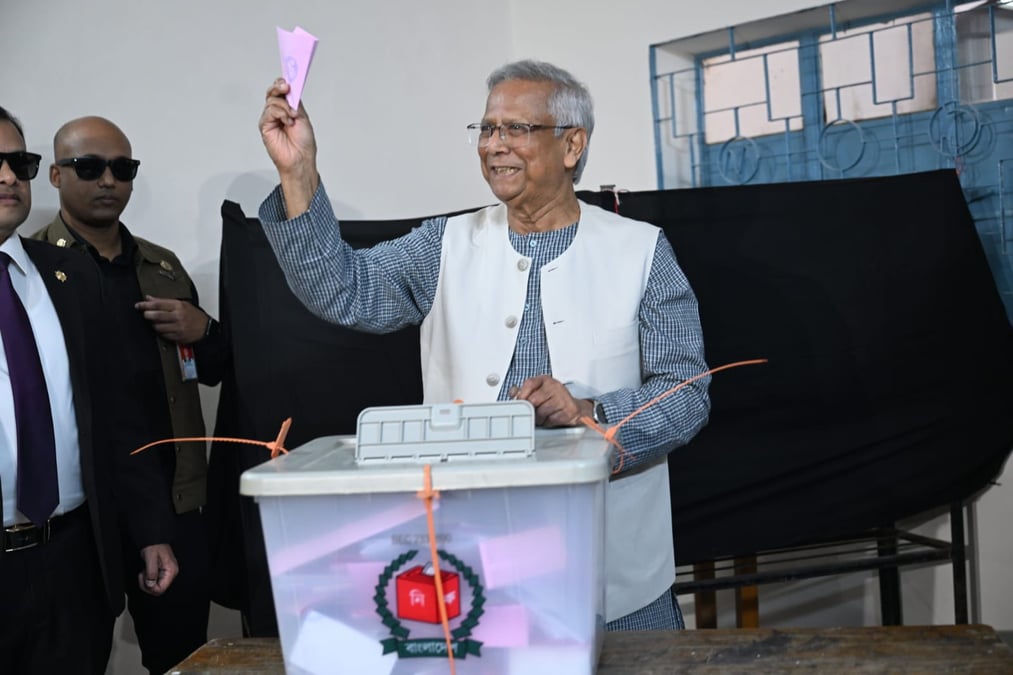
Bangladesh has just done something remarkable.
On 12 February, in what observers are calling the country’s first genuinely competitive national election in over a decade, millions of voters queued at thousands of polling stations across constituencies, many casting a meaningful ballot for the first time since 2008.
That this election took place at all, that it was conducted with sufficient procedural credibility for observers and citizens alike to describe it as largely peaceful and orderly, and that it happened on schedule, is not an accident.
It is the culmination of 18 months of work by the interim government that inherited a country in crisis and was tasked with steering it toward democratic renewal.
As Bangladesh turns the page, it is worth taking honest stock of what the administration of Dr. Yunus accomplished over 18 months and where it fell short.
The context matters enormously. When Sheikh Hasina fled Bangladesh on 5 August 5 2024, following a student-led revolution in which over a thousand people lost their lives, the country was not simply between governments. It was in freefall.
The police had largely abandoned their posts. Violence erupted across multiple districts. The banking sector was riddled with non-performing loans accumulated through years of politically directed lending. The judiciary, the civil service, the election commission, and key regulatory bodies had all been systematically subordinated to a single party’s interests over fifteen years.
What Dr. Yunus and his team of advisers stepped into was not a functioning state awaiting a caretaker, it was institutional wreckage requiring reconstruction.
What followed was a period of institution-building that, whatever its imperfections, deserves recognition.
The reform process was arguably the interim government’s most consequential undertaking. Eleven commissions were established, covering areas from constitutional design and the judiciary to policing, media, labour, and women’s rights. Their recommendations were consolidated and put through seven months of nationally televised consultations with political parties, producing the July Charter: a package of 84 reform proposals endorsed by some two dozen parties.
That level of sustained multi-party negotiation, in a country whose political culture has been defined by zero-sum rivalry between two dominant blocs, was without recent precedent.
The charter may be imperfect, but the effort to forge a broad consensus on institutional redesign was substantive rather than performative.
The election infrastructure itself reflected serious institutional work. The Election Commission was reconstituted. Voter rolls were overhauled, and postal voting was introduced for the first time, enabling overseas Bangladeshis to participate.
Some 500 international observers and journalists were accredited, including delegations from the European Union, the Commonwealth, and international election monitoring bodies.
The Election Commission has reported a nationwide turnout exceeding 60%. For a country whose last three elections under the Hasina government were widely dismissed as neither free nor fair, this represented a qualitative shift.
On the economic and diplomatic fronts, the interim government navigated a landscape that would have tested any administration.
Point-to-point inflation declined by late 2025, according to the Bangladesh Bureau of Statistics, though it remained above the government’s own targets and continued to strain household budgets. Exchange rate reforms helped stabilise foreign reserves.
The diplomatic record was arguably stronger. When the Trump administration imposed a 37% reciprocal tariff on Bangladeshi goods in April 2025, the interim government negotiated it down to 20% by August, and then, just three days before the election, signed a formal reciprocal trade agreement with Washington that lowered the rate further to 19%, with provisions for zero-tariff access on certain textile and apparel exports, making Bangladesh the first South Asian country to finalise such an agreement.
An Economic Partnership Agreement with Japan secured duty-free access for thousands of Bangladeshi products.
Dr. Yunus’s visit to Beijing in March 2025 yielded over $2 billion in investments, loans, and grants, along with Chinese commitments to a long-term master plan for river and water management.
After years in which Bangladesh had shut itself off from international scrutiny, the reopening of the country to the world was itself a diplomatic achievement of real consequence.
On the institutional front, the government’s own figures indicate that approximately 130 laws were enacted or amended during the interim period.
The National Board of Revenue was dissolved and restructured.
Bangladesh signed the International Convention for the Protection of All Persons from Enforced Disappearances, a step the previous government had refused to take.
A commission of inquiry documented more than 1,600 complaints of enforced disappearances under the Hasina government. The national budget was presented via live broadcast for the first time since 2008.
None of this should be mistaken for a record without serious failures.
Law and order remained fragile throughout the period. The treatment of journalists drew criticism from international press freedom organisations. Women bore a disproportionate share of economic losses. Minority rights remain an issue. Youth unemployment remained stubbornly high. The macro-level economic stabilisation did not translate into relief at the household level for millions of citizens.
These are real failures, and they matter.
What deserves emphasis, however, is the nature of the interim government’s orientation. This was an administration that understood its mandate as transitional and one of repair. It did not attempt to entrench itself.
Dr. Yunus, who was 84 when he took office, had been called to this role by the student leaders of the revolution, not by political ambition. He accepted the position at considerable personal cost and committed to holding a free and fair election.
He then did so, on a date announced well in advance, and prepared to leave.
In a region where democratic transitions routinely fail, where leaders extend their tenures through manufactured emergencies and constitutional manipulation, a government that builds the machinery for its own replacement and then steps aside is not a small thing. It is, in fact, quite rare.
With the election now concluded, Bangladesh has closed one political chapter and opened another. The era of the interim government is over. The period of elected governance is about to begin.
What happens next will depend on the capacity and commitment of whatever coalition forms the next parliament, and on the willingness of citizens and civil society to hold that government accountable.
The reform frameworks, the restructured electoral machinery, the July Charter, the restored diplomatic relationships: these are not completed achievements but open possibilities that the next government can build upon, strengthen, or neglect.
For many Bangladeshis, this election also marks the end of an extraordinary and improbable chapter: a Nobel laureate summoned from civil society to oversee a national reset.
Transitional leaders rarely receive appreciative farewells, but Dr. Yunus does, not because the period was flawless, but because it concluded as promised.
He and the advisers who served alongside him took on a broken state and did consequential, if incomplete, work to repair its foundations. They delivered a credible election. They built a multi-party reform consensus. They navigated a volatile diplomatic and economic landscape, with relentless domestic political pressure, without the country tipping into the kind of catastrophic instability that many had feared.
Dr. Yunus was imperfect, as all leaders are. But his compass pointed consistently toward accountability, consensus, and the democratic rights of the people who made the July Revolution.
He and his team gave Bangladesh something to build on. They modeled a form of public service grounded in diplomacy over domination, consultation over decree, and ethical commitment over expedience.
As someone who has spent my career studying the structural forces that shape governance, power, and everyday life across the Global South, I know that democratic transitions are fragile. They fail more often than they succeed.
The next government will inherit enormous challenges: economic recovery that has barely begun, institutional reforms that are only partially implemented, a society still processing the trauma of authoritarian rule and revolutionary upheaval, ongoing environmental challenges -- the economic, political, social, and ecological challenges are all interconnected.
Whether the space for pluralism and accountability expands or contracts will depend on how reforms are operationalised and how vigilantly civil society insists on transparency.
The courage that filled Bangladesh’s streets in July and August 2024 has now expressed itself through the ballot box. Turning that democratic energy into durable institutions is the work of years, not months.
It falls to the new government, to civil society, and to every citizen. The election and referendum have restored a measure of procedural legitimacy, but the harder task is embedding that legitimacy in everyday governance.
It is up to all of us to build, to hold our new leaders accountable, and to ensure that the sacrifices of the July martyrs were not made in vain.
Bangladesh has turned a corner. Where it goes from here depends on all of us.
Farhana Sultana is a Professor of Geography and the Environment at the Maxwell School of Citizenship and Public Affairs of Syracuse University.
Reprinted with permission from the original published on COUNTERPOINT.