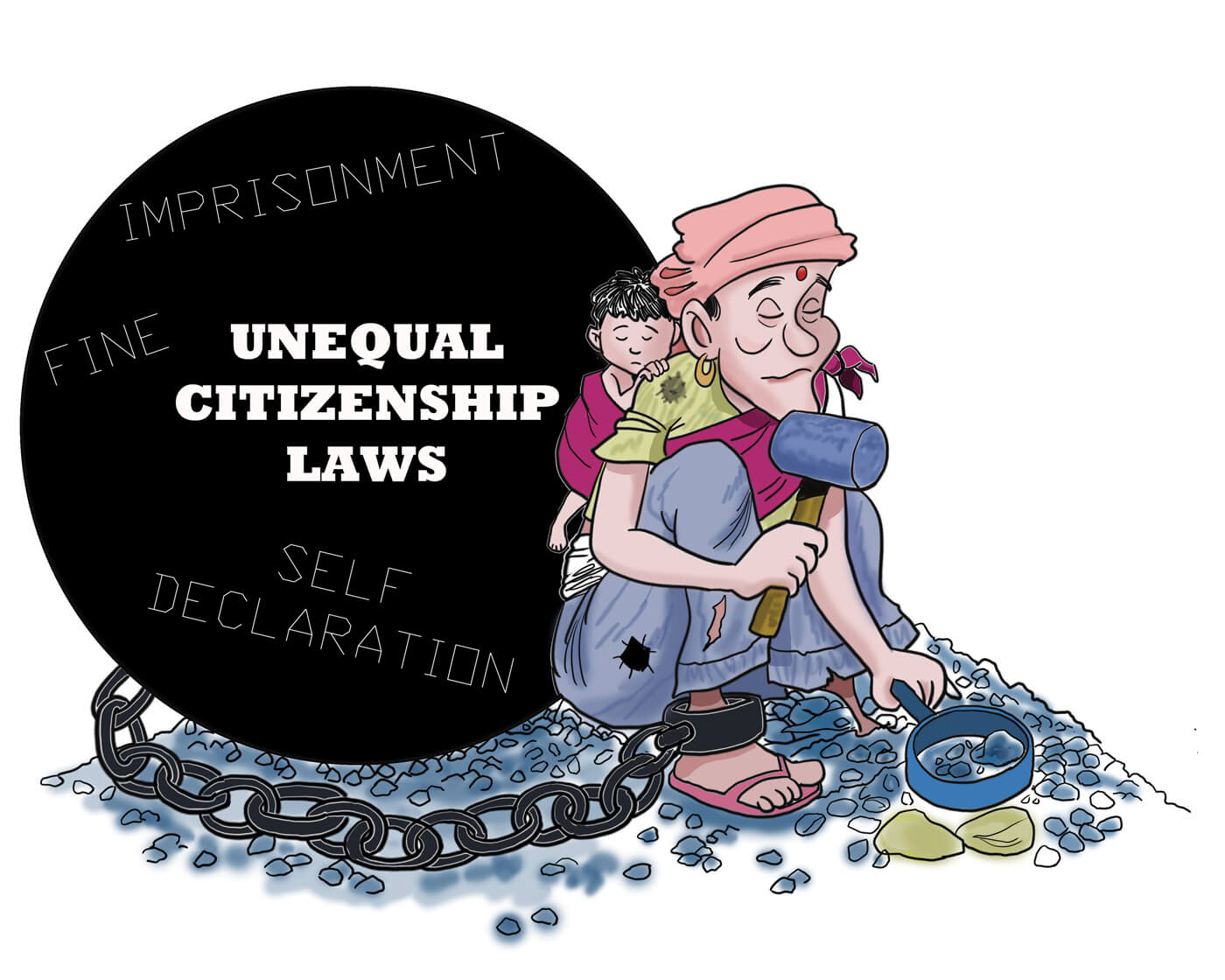
Nepal’s 2016 Constitution may be seen as the preeminent in the world by its framers, but there are still some design defects in it that need to be fixed.
Among the most glaring are provisions about citizenship that directly contradict the preamble proclaiming all Nepalis to be equal whatever their gender, creed, caste or class. Chapter 2 of the Constitution makes the sweeping promise: 'No citizen of Nepal may be deprived of the right to obtain citizenship.’
However, clauses on the requirements for citizenship have been deliberately left vague. This was probably done to fast-track the Constitution at a volatile time, but the provisions on citizenship in the name of the mother has been left to interpretation.
Read also:
Statewomanship, Editorial
Nepal's suffragette moment, Om Astha Rai
In a society steeped in patriarchy and a male-dominated bureaucracy, this means single mothers are bullied, ridiculed, humiliated, and given the run around when trying to obtain citizenship papers for their offspring. Many children therefore remain stateless, depriving them of education, jobs and other state facilities.
The debate has surfaced again this month because the Citizenship Amendment Bill tabled last year is now being discussed in the State Affairs and Good Governance Committee of Parliament. While some lawmakers have tried to fix flaws that discriminate against women, others (and a surprising number of them are female MPs) have argued against making the Bill fairer and less discriminatory towards women.
The Constitution says a person whose father or mother is a Nepali citizen will get citizenship by descent, but this is not applicable if the mother is married to a foreigner. Mothers with children whose fathers are absent, divorced, unknown cannot automatically get citizenship for their children.
If a Nepali man marries a foreign woman, he can get Nepali citizenship for her and their children automatically. However, if a Nepali woman marries a foreigner, the husband does not immediately get citizenship and their children cannot be Nepali by descent.
Even while the debate rages in the Parliament Committee, there are women facing obstacles at CDO offices across the country while trying to get citizenship papers for their children. Many are referred to the Home Ministry which has the final say. Some with husbands who have left them are asked to prove Nepali citizenship of parents who are long dead.
Women who marry foreigners are also made to produce proof that they have not already obtained the citizenship of their husband’s country, which Nepali men who marry foreigners are not asked to do.