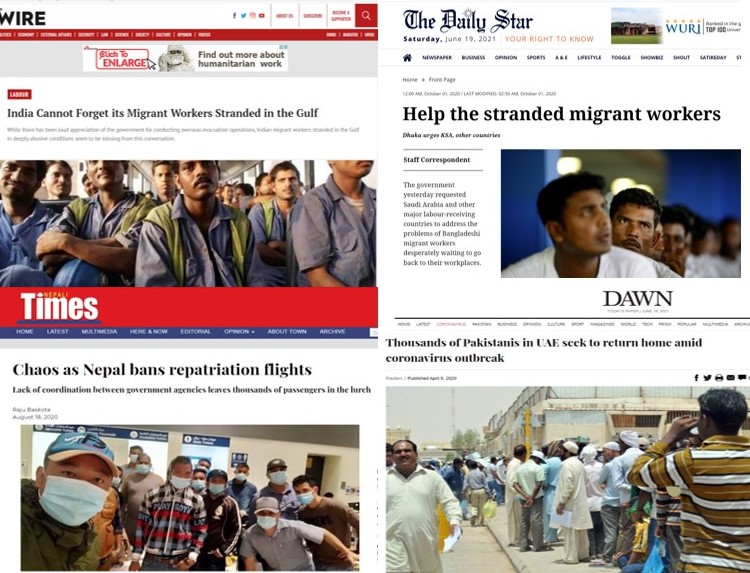
This week, Nepali Times along with major media outlets in Pakistan, Bangladesh and India simultaneously carried a comment on a unique South Asian initiative to promote mass mask usage as a strategy to mitigate the pandemic while we wait for universal vaccinations.
The authors called on countries to come together to solve problems that affect us all, and to let the lasting legacy of the pandemic be a new era of partnership in social innovations that can benefit all South Asians.
This struck a chord with those who work on common regional issues -- one being international labour migration, which is a key feature of all these four South Asian economies.
Much of the characteristics of migration that we often discuss in Nepal’s context also apply to other sending countries in the Subcontinent.
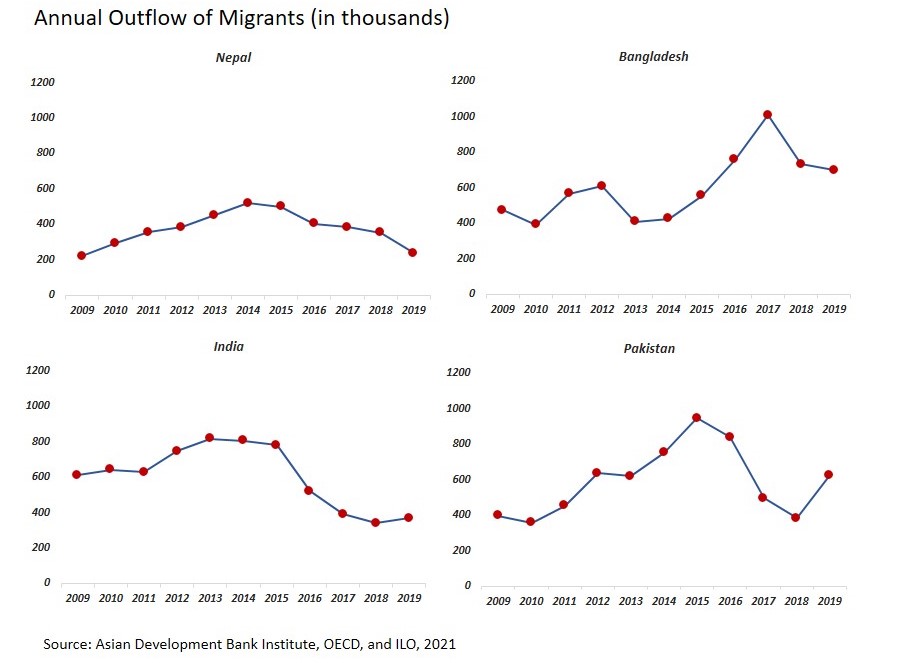
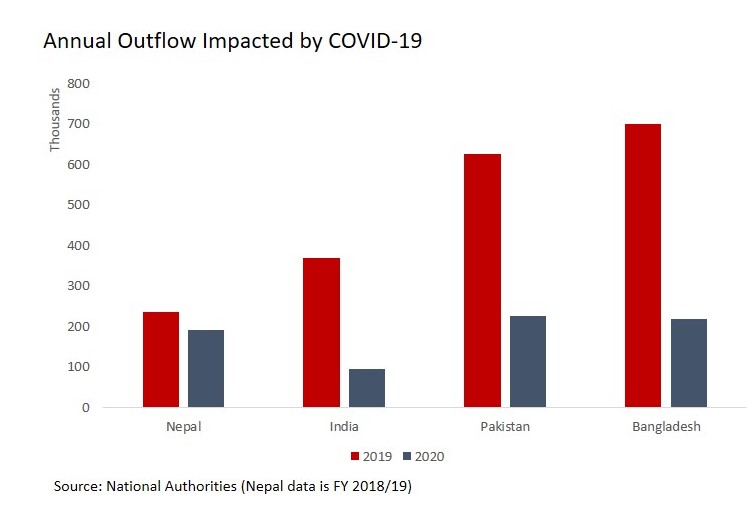
The majority of migrants are predominantly male, headed to the Gulf Cooperation Council (GCC) countries on temporary employment contracts. Pre-pandemic, for example, annual outflows were highest among Bangladeshis (700,000) and Pakistanis (625,000). (See below).
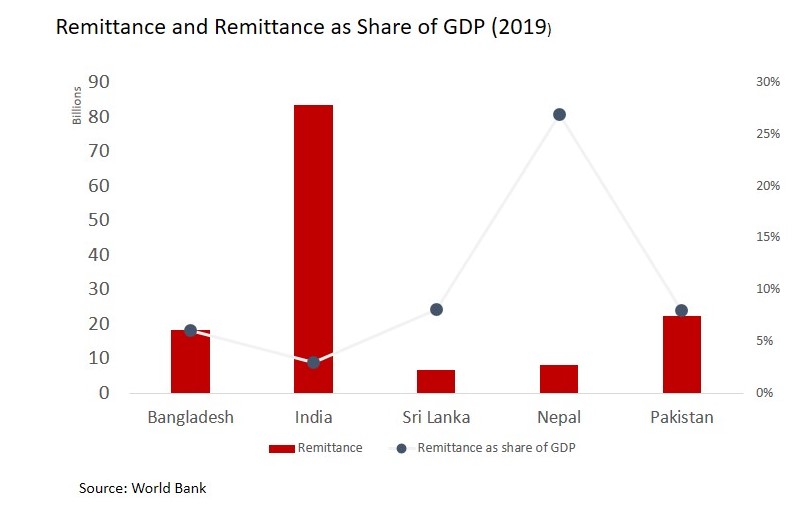
The resulting remittances have transformed lives of families and communities, while being an important source of foreign exchange earnings.
According to the World Bank, remittance to South Asia was about $131 billion in 2018, close to a fifth of the global remittances of $689 billion the same year. Among South Asian countries, India and Pakistan fall in the top ten remittance recipient countries worldwide, whereas Nepal falls in the top ten list in terms of equivalence to GDP (see below).
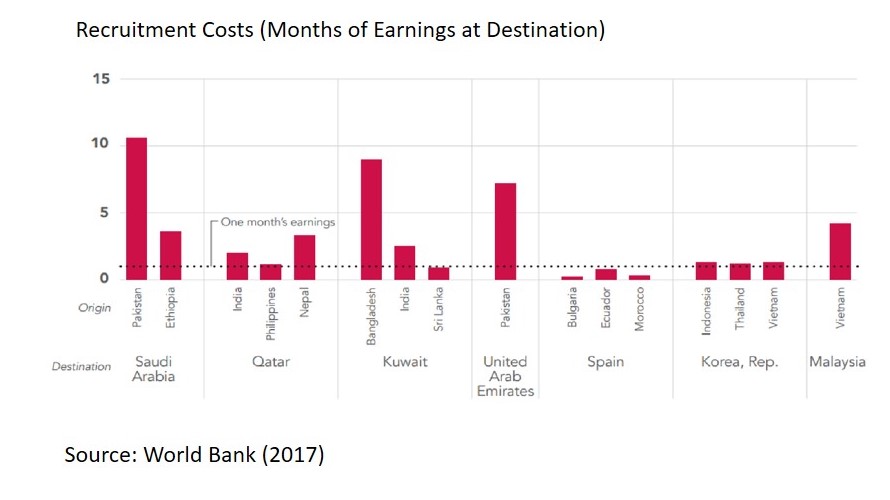
But the gains of labour migration are often dampened by malpractices including high recruitment costs and inadequate rights and protection of migrants in the destination country under arrangements that disproportionately favour employers such as the abusive Kafala system in the Gulf.
And then came Covid-19, which further revealed the pre-existing fault-lines in the recruitment, employment and living conditions of migrants abroad. It put the spotlight on the squalid labour camps that deserve attention not just during a crisis demanding social distancing, but at all times and how minimal efforts to correct this can have wider consequences in the public health of the nation because the virus did not distinguish between nationalities or legal status.
It also challenged the distinction between low/unskilled versus higher skilled work because to keep the societies functioning amid lockdowns required shopkeepers, warehouse workers, cleaners, delivery boys who were now being referred to as ‘essential workers’.
Many lost their jobs and were stranded, and each sending country's government had to embark on massive repatriation exercises to bring back hundreds of thousands of workers amid travel restrictions, flight shutdowns and public health risks. Migrants who returned did so to rudimentary reintegration programs, battered economies and strained health systems.
With the Gulf accounting for over 77% (Bangladesh) to over 96% (Pakistan) of annual out-migration in 2019, it has long been recognised that the reliance of many South Asian countries on a handful of destination countries in the GCC has made them vulnerable to macroeconomic and geopolitical shocks in these countries (see below).
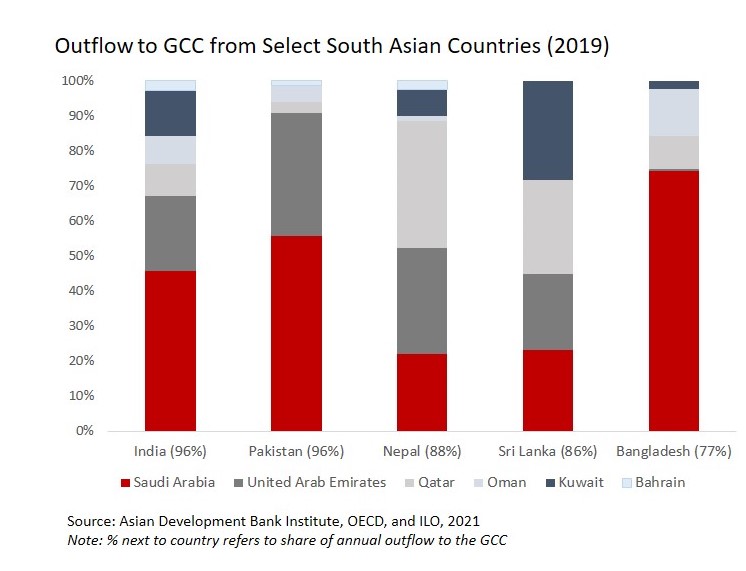
This was seen in the 2014 fall of oil prices, in the blockade of Qatar and recent geopolitical instability in the region. Other policies such as the Gulf’s nationalisation policies that prioritise recruitment of locals and has banned entry of foreigners in certain sectors also influence recruitment of workers, pressuring countries to think about diversification strategies.
There were also spikes and falls for bilateral reasons which revealed the interconnectedness of migration corridors. In May 2018, Nepal stopped workers from going to Malaysia owing to high recruitment costs paid by migrant workers. A month later, Malaysia stopped Bangladeshi workers from coming to Malaysia owing to malpractices in the recruitment system.
While the Malaysia-Nepal corridor resumed in September 2019, the draft Bangladesh-Malaysia MOU modeled after the agreement with Nepal was stalled by a number of factors such as Covid-19, change in leadership in Malaysia and its ban on new foreign worker recruitment.
Many interlinked factors shape the outflows and return of workers but the shocks brought by Covid-19 were unprecedented as no country has been shielded from its effects and the impact isn’t localized to specific regions to target interventions. Deployment of new workers dropped significantly in 2020: 74% in India, 64% in Pakistan, and 69% in Bangladesh. (See below).
But remittances defied expectations and even increased in Pakistan by 17% and in Bangladesh by 18.4%, whereas India and Nepal saw marginal drops. There were many reasons including the shift from informal remittances, incentives by select governments, transfer of the last savings, end-of-service benefits of migrants, the counter-cyclical nature of remittances, and the engagement of migrants in essential sectors that were needed to keep societies functioning through the lockdowns.
Emigration again appeared to overwhelm health systems, leading to lockdowns, travel restrictions and pushing emigration back into the throes of uncertainty. Flights from India to Saudi Arabia were banned, and Indian migrants found their way to Nepal to fly out of Kathmandu airport despite the health risks. When flights from Nepal were then halted due to a surge in cases here, many transit migrants were left in a limbo and needed the authorities to intervene.
The virus knows no borders, and containment and coping mechanisms demanded cooperation across countries given our interdependence. The common elements of the migration story across countries raise an important question: what should cross-border collaboration across sending countries look like to ensure the safety and well-being of our migrant population overseas?
Platforms on regional migration governance do exist that have tried to bring together the collective voice of countries sending migrants. This includes the regional consultative Colombo Process which comprises 12 labour sending countries including in South Asia. The idea is that such collaboration would help optimise the benefits of labour migration while protecting migrants from exploitative practices in recruitment and employment.
Then there is the Abu Dhabi Dialogue that comprises both sending and receiving countries from Asia and the Middle East. These platforms have opened up consultations on migration priorities and brought the spotlight on issues facing migrants.
Many recommendations that come through these platforms have made their way to the global discourse on migration and been incorporated into documents like the Global Compact for Migration to represent the interests of sending countries. While causality is hard to draw, advocacy efforts via these platforms also have a role in destination countries committing to and working towards dismantling the Kafala system which benefits all nationalities.
But in terms of tangible interventions beyond scripted briefings and talkshops, there is also significant room for improvement. A few emerging good examples of practical interventions include the Comprehensive Information and Orientation Program piloted between Bangladesh, Sri Lanka, Philippines, Saudi Arabia and the UAE to ensure migrants are equipped with the right set of information throughout the migration cycle, and a joint skills project between Sri Lanka and UAE.
Separately, while the South Asian Association for Regional Cooperation (SAARC) was established in 1985, it was only in 2014 that labor migration was recognised as a regional policy priority during the 18th Summit. The Kathmandu Declaration adopted during that summit included commitments to collaborate and cooperate on labor migration from South Asia.
But progress has stalled with the 19th SAARC Summit not held as originally scheduled in 2016 due to India-Pakistan tensions. This is a missed opportunity for regional cooperation on migration.
Ray Jureidini, a professor at Hamad Bin Khalifa University in Qatar, says the frequent transfers of both ministers and bureaucratic staff of sending countries pose a challenge to sustained, collaborative dialogue across states.
“Even when Governments are willing to collaborate, it is difficult to achieve anything meaningful with frequent rotations of leadership as momentum is lost, history is forgotten and you have to start from scratch all the time,” he says.