
Even the most optimistic scenario is that it will take at least five years for Nepal’s travel industry to recover from the pandemic impact.
However, the country has an opportunity for a ‘better normal’ and to evolve a tourism model that does not damage nature and heritage, but rather enhance them-- a clean industry that is environmentally and socially sustainable.
The pandemic has shown that many journeys may actually not be necessary at all, and when they do travel, passengers are now more aware about their carbon footprint.
“Low carbon footprint tourism that benefits the maximum number of local businesses is the only way forward,” maintains Shilshila Acharya of the Himalayan Climate Initiative (HCI).
International aviation accounts for 2.5% of global CO2 emissions. At a first glance, this may look insignificant but its impact is disproportionate across the world and more acute in the Himalaya.
Moreover, the 2015 Paris Agreement does not include other greenhouse gases from aviation. International air travel is not counted within any country’s emission targets either.
The International Civil Aviation Organisation (ICAO) has adopted the Carbon Offsetting and Reduction Scheme for International Aviation (CORSIA) requiring member states to voluntarily offset carbon starting this year. This may mean individual passengers will not have to offset themselves, but the additional cost of carbon credits might trickle down to air fares.
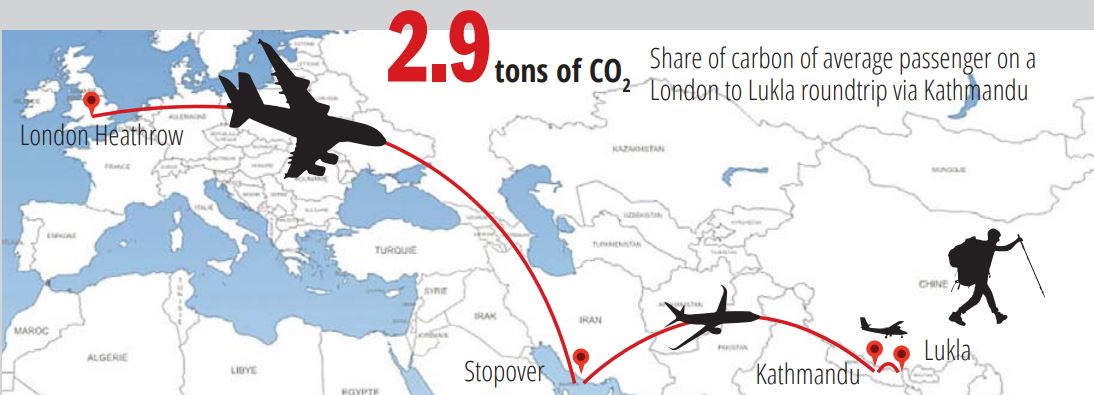
An average tourist flying to Lukla from London via the Gulf burns nearly 3 tonnes of carbon. On treks, LPG for cooking and fuel for jeep rides add up.
While airlines wait to switch to biofuels, there are alternatives like carbon offsetting which allow passengers to compensate for the CO2 by paying for projects around the world that reduce the buildup of greenhouse gases in the atmosphere.
Passengers calculate the carbon they burn on a trip, and buy equivalent credits from organisations working on projects such as biogas, reforestation, hydropower, water treatment or solar energy.
“It would be ideal if Nepal could offer a locally-based offset system, for example through community forestry or social impact projects so tourists could increase the benefits of their trip to Nepal,” says Robin Boustead, promoter of the Great Himalayan Trail, who is researching the effect of climate change in Sagarmatha National Park (read box, below).
“Such a program could become a significant point of difference for Nepal and put tourism and the climate agenda in the spotlight, especially as the Himalaya are suffering so much.”
Tourism, aviation and carbon, Sanghamitra Subba
At the moment the government’s Alternative Energy promotion Centre (AEPC) is the only Nepali entity that offers carbon credits, mostly in biogas, micro-hydro and wind energy, with buyers and rates already fixed.
Pre-Covid, voluntary offsetting internationally was at an all-time high with a 140-fold increase between 2008-2018 and 430 million tonnes of emission reductions generated worldwide.
The demand for voluntary offsets has grown exponentially, often leading to oversupply of carbon credits in countries like India and China.
Companies claiming to be green often buy cheap credits, which is why is it crucial to check a project is certified.
Some experts say offsetting does not tackle the root of the problem, which is wasteful consumption. They say the priority must be to reduce emissions at source, and not try to assuage one’s guilt by buying offsets. Buying carbon credits should go hand-in-hand with a domestic reduction strategy, they add.
“For a landlocked and tourism-dependent country like Nepal, carefully selected and accounted for carbon offsets in aviation in the absence of low carbon travel can be a good option, at least in the short-term,” says carbon finance expert Rastraraj Bhandari. “But air travel is only one aspect of green tourism. There is domestic transport that needs to transition away from fossil-fuel and the energy-intensive hotel industry that can make strides by reducing its carbon footprint.”