
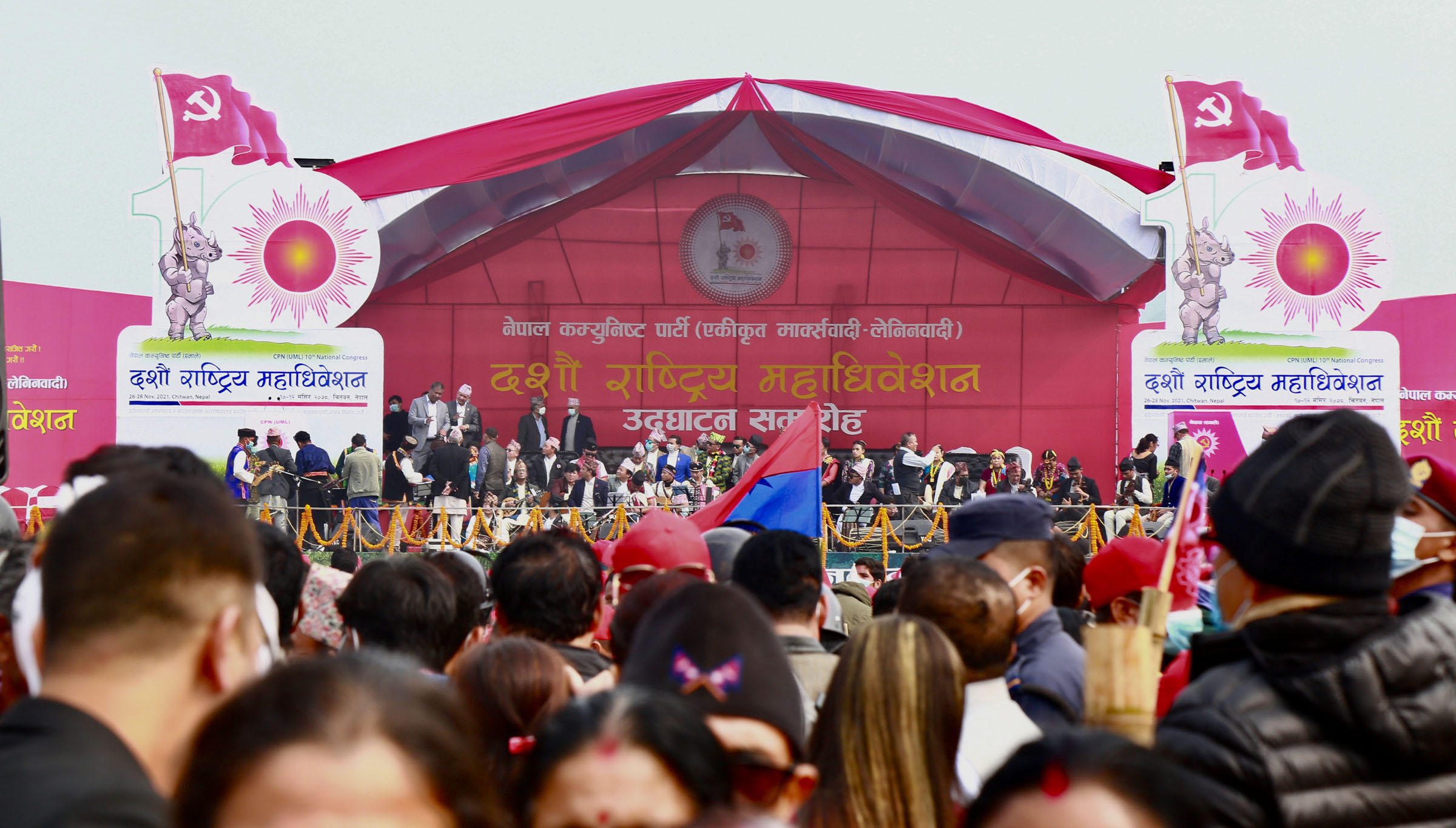
Nepal’s governance is once more grinding to halt as the two major parties, the Nepali Congress (NC) that leads the ruling coalition, and the opposition UML gear up for their general conventions.
Such is the relentless focus on heated contest for influential posts within these parties that even the mutiny within the Supreme Court against the Chief Justice has dropped off the headlines.
The conventions, during which Deuba and Oli will once again vie for top leadership positions within their respective parties, will take place even as the three branches of government are all tangled up. The UML conclave is being held in Chitwan this weekend, and the NC is holding its in mid-December in Kathmandu.
The row over Chief Justice Cholendra SJB Rana has not only spot-lit the transactional relationship between the judiciary and executive, but also how the state is being held hostage by the internal power struggles within the main political parties.
What is happening to Nepal’s Supreme Court?, Santa Gaha Magar
Nepal’s current political turmoil came to a boil in December 2020 when Prime Minister KP Oli dissolved the House in response to a months-long internal power struggle between him and his Nepal Communist Party co-chair Pushpa Kamal Dahal. The PM’s move was unsuccessful, as the Supreme Court restored the House in February 2021.
This ultimately led to the Supreme Court deciding that the NCP unification was null and void, thus driving Pushpa Kamal Dahal of the Maoists and UML dissenter Madhav Kumar Nepal to ally with the opposition led by the NC’s Sher Bahadur Deuba.
Oli dissolved parliament for a second time in May and the Supreme Court once more deemed it unconstitutional, even ordering that Deuba replace Oli as prime minister.
Deuba began his fifth term as prime minister in July, leading a five-party coalition government by proroguing parliament and passing an ordinance to amend the Political Parties Act that made it easier for political parties to split.
This was directly intended to allow his ally Madhav Nepal to break away from the UML and form his own party, so making it possible for him to team up with the coalition government and seek cabinet positions. Many saw the prime minister's move (something he and his own coalition partners had accused Oli of committing) as an undermining of the parliamentary process.
Nepal’s post-breakup politics, Santa Gaha Magar
But Deuba outdid Oli: after the ordinance had served its purpose and begun to become a burden during his much-delayed cabinet expansion, he got President Bidya Devi Bhandari to repeal it. Deuba was bitterly criticised for running roughshod over the Constitution, but he was happy to form a full government.
In the days leading up to the Cabinet expansion, news emerged that Chief Justice Rana wanted his nominees to also be given ministerships. The public, media and the legal fraternity was outraged by this blatant violation of the separation of powers. Among Deuba’s cabinet picks was Gajendra Bahadur Hamal for Minister of Industry, Commerce and Supplies, who just happened to be the brother-in-law of Chief Justice Rana and an NC member.
Both Justice Rana, as well as Deuba’s camp, vehemently denied having negotiated for Cabinet positions, but the damage had been done. Hamal could not stand the heat and resigned three days later, leading many to conclude that there had indeed been a deal between the chief justice and the prime minister.