
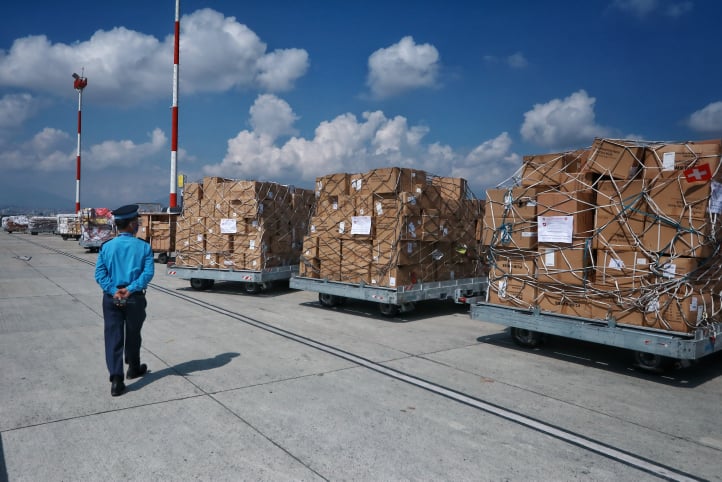
The flood of social media posts of donated medical supplies being unloaded at Kathmandu airport every day, gives the impression that the outside world cares more about the humanitarian emergency in Nepal than the country’s own leaders.
This week proved that the Nepali politicians still do not get it. Except for the chatting classes locked up at home, not many Nepalis follow, or care, about a dissolved Parliament, elections in November, or writs at the Supreme Court. They are preoccupied with trying to prevent relatives from breathing their last.
Prime Minister K P Oli has proven that he is not just a shrewd manipulator, but also has elastic ethics. In the past year, he has shown that he will stop at nothing: split the NCP that he himself united, dismantle his own UML, dissolve a Parliament in which he had a two-thirds majority. All is fair, it seems, in love and politics.
Nepalis might have followed the political games in Kathmandu more closely if the alternatives to Oli inspired more confidence. But they are all tried, tested and failed ex-prime ministers themselves. The main contender Sher Bahadur Deuba of the Nepali Congress lined himself up to be PM for the fifth time, and has still not given up.
The crises due to the pandemic would have been the opportunity to form a national unity government, and work together to fight the virus. This would be the time for all the parties to skip a generation and bring up some young do-ers. That is what they may have done if this was a war. But this is a war.
The needs are great: ensuring adequate oxygen supply, rushing relief for the millions who have lost their income during the lockdowns, ensuring that ICU care is available and affordable to the general public, and negotiating a reliable vaccine pipeline. Preoccupied with politicking, the leaders had little time for any of this.
Most of Nepal’s politically-appointed ambassadors overseas are more beholden to their patrons back home than to the people. With the exceptions of our female envoys in Oman and Spain, other missions have not stepped up to the task of conveying the emergency like we did after the 2015 earthquake.