
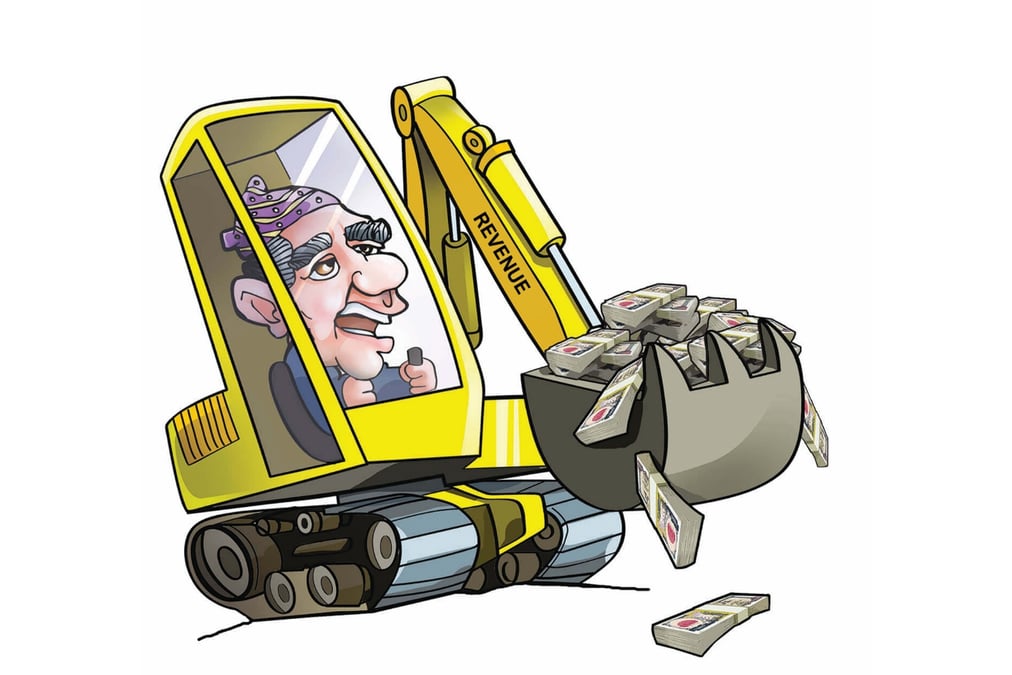
Nepal’s Finance Minister Bishnu Poudel is a Red. And as Finance Minister in a coalition led by his Communist Party of Nepal (Unified Marxist-Leninist) he has the unenviable job of saving a country deep in the red.
Despite its impressive name, there is nothing even remotely ‘communist’ about his party as Poudel works on the upcoming budget. He has warned repeatedly about a massive revenue shortfall with Nepal’s expenditure now 25% higher than its income.
The government has already reduced subsidies to local governments due to lack of money, and plans to cut small-scale programs entirely in the budget. But such rollbacks do not even make a dent in reducing the deficit gap.
Revenue has been falling since Covid-19, and never really recovered — even though in 2023/2024 revenue was a record high compared to the previous year. The fiscal year 2022/23 marked the first time in the last five decades that Nepal experienced a negative growth rate in revenue.
This year, collections rose to Rs919 billion by mid-May, a 11.5% increase over the previous year, but with only two months to go before the end of this fiscal year, the government has only collected 65% of the expected revenue.
Revenue mainly comes through VAT, customs, excise and income tax. A slowdown in imports and domestic economic activity has led to a fall in collection. Domestic consumption has slowed as young Nepalis migrate overseas. There is also concern about smuggling across the border.
“Our revenue is not rising in proportion to our imports,” says Kewal Prasad Bhandari, former Secretary to the Government of Nepal. “This points to significant leakage at border checkpoints.”
Customs evasion has been rising since Covid-19, and non-compliance with custom duty regulations worsened during the 2022 elections. This prompted lawmakers to approve an amendment to Nepal’s Revenue Leakage Act 1995 that proposes the formation of a Central Revenue Leakage Control Committee under the coordination of the Finance Minister.
Read also: Now the economy, stupid
“Customs evasion has been out of control since 2022, with people blatantly flouting the laws,” says a former secretary who wished not to be named. “Customs fraud is widespread because there is little political will to hold those who break the law to account because of their political connections.”
The Finance Ministry is currently staffed by officials who have no experience and expertise in the sector. “It used to be called a ‘Super Ministry’ with capable financial administrators, but that is no longer the case,” adds the former secretary.
VAT fraud is also rampant with almost 28% of registered taxpayers failing to file annual turnover details to revenue offices. Another 24% of VAT-registered taxpayers who do file documents show zero VAT on transactions.
“We can generate up to Rs2 trillion in revenue if we make active efforts to monitor tax, VAT, and customs fraud,” says Min Bahadur Shrestha, former Vice President of the National Planning Commission.
With the implementation of the federal system, government expenditure has increased exceptionally in the form of grants administered by the central government for provinces and municipalities. Such grants are a significant part of current expenditure, which also includes social security and administrative spending.