
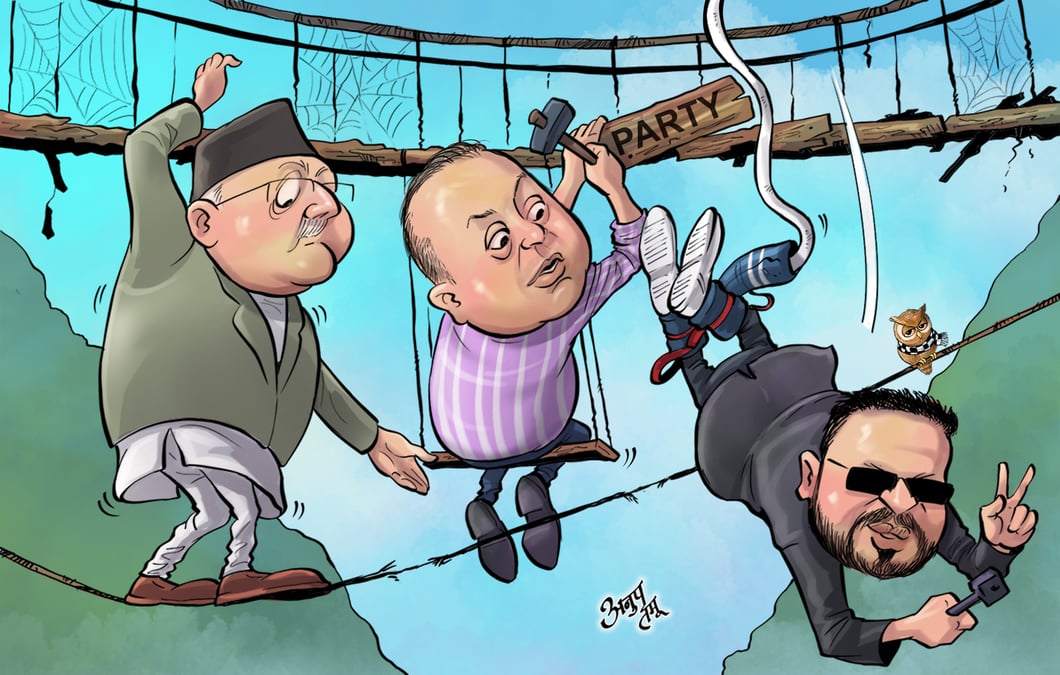
K P Oli of the UML is trying not to fall from a precarious tight rope, Gagan Thapa is busy mending his NC party, while the RSP’s Balendra Shah is bungee jumping off the bridge in this cartoon (above) made exclusively for Nepali Times by artist Anup Tamu.
This post-GenZ movement election is a contest between a stale past, and the promise of a fresh start. The post-1990 politics saw instability, polarisation, an insurgency, a royal coup that briefly brought back the absolute monarchy, and will now be replaced with a new, accountable political culture.
At least that is the hope.
The old is represented by 75-year-old Oli who was deposed after the 8-9 September upheaval. Challenging him directly in his own constituency of Jhapa-5 is Shah, the popular former mayor of
Kathmandu. If informal polls are right, Shah and the RSP are set to win. That means this is ultimately going to be a contest between
Balendra Shah and Gagan Thapa, the new leader of the grand old party.
This election came down to a personality clash between personality cults. Most are voting for the prime minister of a party, not for the party of a future prime minister. Below are profiles of the three prime ministerial hopefuls:
K P Oli
The comeback kid. Forced to resign and flee after disastrously banning social media in September, yet here he is, back again, elected chair of the UML for the third time in a row.
The UML party line is that those protests were fuelled not by genuine frustration with the leadership, but by bad actor infiltrators. The election is between those who want to build the nation and those who want to burn it down, Oli says.
It seems unlikely that after the September upheaval, the country will allow Oli Ba a return to the office he was forced to vacate. Yet his longevity is undeniable, despite two kidney translpants.
Oli started at age 18 in the radical Communist underground in eastern Nepal in the early 1970s. He spent 14 years in prison, emerged in 1987, and became a central committee member of the UML, served as Home Minister, and was known for his oratory.
He became prime minister for the first time in 2015, opposing India’s unofficial blockade and making trade deals with China. He was adept at playing the nationalist card, and pushed for the adoption of the Nepal map that included disputed Limpiyadhura, riling New Delhi no end.
Oli has been prime minister four times, which is also how many kidneys there are in his body. Tons of experience in age and at the very top of Nepali politics is certainly what he has over both Gagan Thapa and Balendra Shah. This is a negative too because he represents obsolete politics.
Oli defended his multiple premiership: “I have been PM for a total of five years. How come nobody gets a headache when neighbouring countries have been leaders for 15 years? How come other 80-year-old leaders are not criticised?”
Oli has a sharp tongue and a wicked sense of humour that often gets him into trouble. He is prone to hyperbole and weaving fantasies, making him the target of ridicule. Over the years, he has promised ocean-going ships on the Kosi, gas pipelines, supercomputers, and rapid airport development, with zero follow-through.
Oli developed a thin skin towards the end of his tenure, squeezing the press and social media. He has chosen not to issue any apology or accept accountability for the 8 September massacre. His own party has gone along with this delusion, but now the people will have their say.
Gagan Thapa
Of the three prime ministerial hopefuls, Gagan Thapa of the NC would seem to be the ideal compromise of old and new, youth and experience. Starting as a student activist, he has had an extensive political career, and is an anti-monarchist who has seen stints in jail.
Thapa was elected to the first Constituent Assembly in 2008 and has since always been an MP. As health minister in 2016-17, he introduced Nepal’s first health insurance scheme. Almost 50 now, Thapa can no longer claim to be a Young Turk, although he is still 25 years younger than Oli.
Thapa has waited patiently for his day in the limelight, and sensed his time had come after the GenZ movement. He seized the NC leadership from Sher Bahadur Deuba, becoming president unopposed during a ‘special’ general convention. Deuba seems to still be in shock after a near-lynching and the burning down of his house.
Contesting from Sarlahi and not his usual Kathmandu constituency, Thapa has launched an extensive campaign on the ground and on social media. Much of this focuses on a rebranding of his party as Nepali Congress 2.0. He is also making a distinction between a reformed NC and newbies in the RSP, but is facing a stiff challenge in Sarlahi-4 from former NC member Amresh Singh who defected to the RSP.
He is one of few politicians who use social media effectively. After the September protests, even when his house was burnt down, he spoke directly into a camera to say sorry on behalf of his party. “Our core values are still the same: democracy, social justice, democracy,” he said.
No more coalitions that go against principles, no more corruption, judge us by performance and not speeches, Thapa has said. Idealistic, but can he pull it off in a party so rooted in the old ways of doing things?
Thapa’s heart seems to be in the right place. As MP he has spoken up against his party’s aging leadership, and in favour of the right to free expression. He represents the voting block that is tired of the old, but sceptical of the new.
Balendra Shah
‘Rapper/Structural Engineer/Kathmandu Metropolitan Ex Mayor’ reads the TikTok bio of @balenshah. Balendra Shah could not be more unconventional as a Nepali politician.
He is running a brave gambit, choosing to contest Jhapa-5 and challenge K P Oli in his home turf. If Shah wins, it will be quite a statement from voters. What a blow to Oli, and all of the legacy parties. The apt bell symbol of his RSP is sounding the alarm.
Despite his rapper background, Shah’s campaign so far has been scanty with words. He has chosen to partake in aurafarming — in one video he pilots a boat in Udaypur, in another he drives on a rural road. Many posts position him as a family man.
Unlike Gagan Thapa, Shah has few videos that speak directly to the voting public. And he never spoke to the press while mayor and on the campaign trail. There were sarcastic comments after his recent campaign address, one feigning surprise: “He speaks!”
This is carefully curated brand-building, along with the trademark beard and sunglasses. With a ‘Balen Craze’ sweeping the country, his thinking perhaps is: ‘The less I say, the less chance that I mess up.’
And he has messed up in impulsive social media posts since deleted (page 10-11) in which he heaped abuse at India, China and the US. He also once threatened to burn down Singha Darbar after being stopped by traffic police.
Shah has been campaigning not just in Jhapa but all over the country, trying to establish his credentials as a national leader. At a speech in Itahari this week, he vowed to solve problems of agriculture, tourism, sports, and connectivity.
It was a weak speech, lacking focus, much stuttering, superficial, and without the powerful tone of Thapa or Oli. However, the crowd was engaged and loved every minute of it. Shah’s supporters have made up their minds.
As Kathmandu mayor, Shah got mixed reviews. Many were outraged by his crackdown on street vendors and squatters, and his flashy attempts to beautify Kathmandu were seen to be performative. Budget spending was one of the lowest among metropolitan cities, yet the public perception is that Kathmandu is cleaner and better managed.
If Shah looks to succeed and last in Nepal’s politics, and perhaps as prime minister, he would have to conduct himself in a much more diplomatic and transparent manner.
To some, he is a populist and too new to be taken seriously. Others are skeptical about him joining the RSP, with all of the scandals of its leaders.
But as the elected mayor of Kathmandu, and holding on to the position for four years, he has proven that at least he has initiative and effectiveness.