
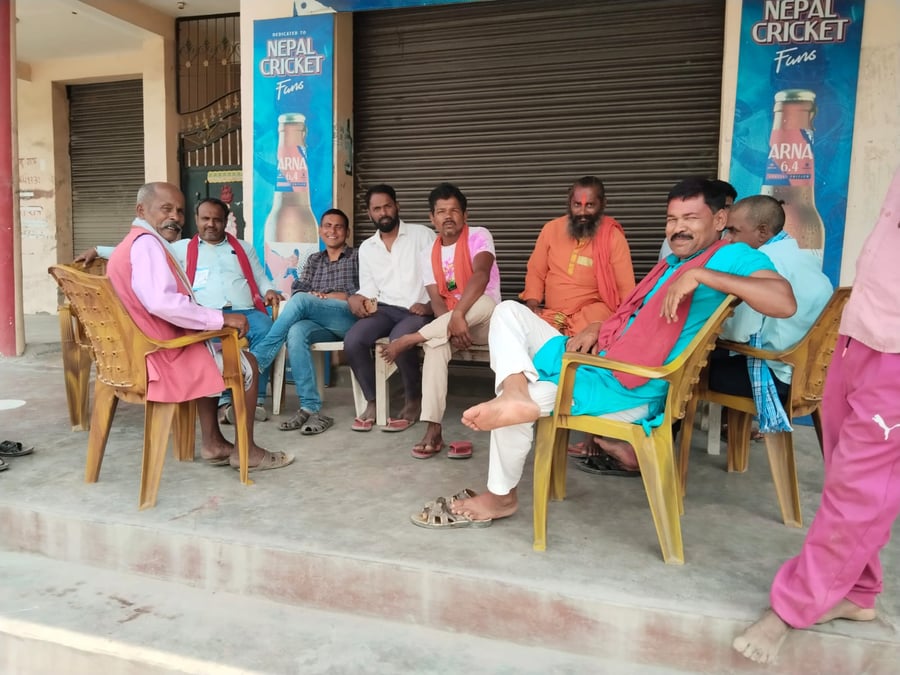
Nepal's general election was notable not merely for its electoral outcome, but for the quality of civic discourse it produced. In homes, tea shops, polling queues, and university corridors across the country, citizens engaged with political questions in ways that felt qualitatively different from previous cycles.
Conversations extended well beyond candidate assessments and partisan allegiances — they were about institutional integrity, government accountability, and the structural direction of the country over the coming decade. For a significant portion of the electorate, the election carried the weight of a historical inflection point.
For others, it prompted measured reflection rather than unqualified optimism. Both responses deserve serious consideration.
Among the most consequential developments was the mobilisation of young voters on an unprecedented scale. Over one million new voters registered with the Election Commission, bringing the total electorate to 19,005,324 — a substantial expansion in a country of 30 million people.
The visible presence of first-time voters at polling stations across Kathmandu Valley was striking. Many waited patiently and with purpose at polling stations. This was a meaningful departure from earlier elections in which many young Nepalis considered the political system to be inaccessible, corrupt, or indifferent to their concerns.
But when citizens internalise a sense of ownership over democratic processes, participation deepens in ways that institutional incentives alone cannot produce.
National voter turnout reached approximately 60%, with several constituencies like Kathmandu-5 recording 71.31%. That reflected genuine civic engagement but also revealed that four in every ten eligible voters did not exercise their franchise.
This gap was not uniformly distributed. It correlates with geographic remoteness, socioeconomic disadvantage, and, critically, migration status.
Nepal's diaspora population - concentrated primarily in the Gulf states, Malaysia, and South Korea - contributes remittances that account for close to one quarter of the country's GDP. They constitute one of the most economically significant constituencies in the nation, yet many are not allowed to vote.
This disparity between economic contribution and political representation is widely recognised among young Nepalis abroad and represents a fundamental inconsistency in Nepal's democratic framework.
GENERATION GAP
This election marked a generational transition in Nepal's legislative composition. For several decades, political leadership at the national level was dominated by figures who retained prominence across successive constitutional and governmental changes. Now it is a cohort of younger parliamentarians drawn from backgrounds in law, civil society, policy analysis, and the professional sector.
Their entry into the legislature has generated a palpable sense of renewal among segments of the electorate that had grown disenchanted with the continuity of familiar leadership. Notably, in a number of constituencies, candidates from opposing parties offered public congratulations following the announcement of results, and in some instances participated jointly in post-election gatherings.
While such gestures may appear ceremonial, they reflect a civic disposition — the capacity to acknowledge political competition without resorting to antagonism — that democratic systems require in order to function sustainably.
The consolidation of electoral support around a single political force raises legitimate questions about the future character of parliamentary debate. Opposition parties perform an indispensable function in democratic governance: they scrutinise legislation, interrogate executive decisions, and represent constituencies and perspectives that may not be served by the governing majority.
Historical evidence, both in Nepal and internationally, demonstrates that the weakening of opposition does not produce more effective governance — it produces governance less subject to accountability. Nepal's incoming Parliament would do well to recognise that principled disagreement is not an impediment to the democratic process, it is an expression of it.
The electoral performance of the RSP invites comparison with earlier moments of political transformation in Nepal's recent history. The scale of popular enthusiasm surrounding the RSP's rise is not without precedent. Following the conclusion of the Maoist insurgency, the Communist Party of Nepal (Maoist) secured a decisive electoral mandate in 2008 amid widespread public expectation of systemic change.
The parallels are instructive, not as a prediction of failure, but as a reminder that democratic renewal requires sustained institutional commitment well beyond the period of electoral momentum. The capacity to translate popular mandate into durable governance reform is the measure by which political movements must ultimately be judged.
Nepal's constitutional guarantee of at least 33% female representation in Parliament has genuine democratic import. However, the mechanisms through which this threshold is met warrant critical examination.
In this election, women constituted only 388 of the 3,046 candidates contesting 165 first-past-the-post seats. The constitutional quota is fulfilled primarily through proportional representation lists, a process that formally satisfies the legal requirement while potentially obscuring the absence of genuine structural support for women's direct electoral participation.
Women candidates routinely operate with fewer financial resources, reduced party infrastructure, and disproportionate public scrutiny directed at personal rather than policy matters.
The parliamentarians who succeeded did so as a consequence of sustained commitment in the face of considerable institutional obstacles. Their presence is important. The conditions that made their path unnecessarily difficult must be addressed.
Democratic participation cannot be conceived solely in terms of legal rights, it must also be understood as a function of physical access. The design of electoral infrastructure communicates, in concrete terms, who is envisioned as a participant in democratic life.
Observing the formal transfer of ballot boxes under security escort prompted a recognition that institutional processes, however routinised in appearance, are sustained by collective trust and collective sacrifice. Democratic systems endure not because they are structurally perfect, but because citizens continue to invest them with meaning and hold them to account.
The 5 March election was held three days before International Women's Day. In Nepal, as across much of the world, women continue to face systemic disadvantages in public life, economic participation, and personal safety.
There must be an honest assessment of these conditions and in concrete commitment to their redress — through a safer public environment, equitable political representation, fair access to economic opportunity, and the consistent application of dignity in everyday social conduct. Anything less risks reducing a serious occasion to a performative exercise.
Nepal's current political moment carries genuine promise. A younger legislative cohort, a more politically engaged citizenry, and a demonstrable willingness among many citizens to hold institutions to higher standards.
They do not, however, constitute change in themselves. The critical work of democratic consolidation lies ahead: in the formulation and implementation of sound policy, accountability, and in the cultivation of a political culture in which public office is understood as a form of civic service rather than a source of personal authority.
Political progress is not measured by the energy of an election night. It is measured by the quality of governance that follows — by decisions made outside the public eye, by commitments honoured or abandoned when scrutiny recedes.
Nepal does not require only new faces in positions of power. It requires a durable transformation in the relationship between those who govern and those who are governed — one founded on the principle that public officials are, in the most fundamental sense, accountable to the people they serve. The ballot has rendered its judgment. The responsibility for what follows is shared by all.
Ishika Panta is a Nepali social entrepreneur, policy advocate, and founder of Project Abhaya.