
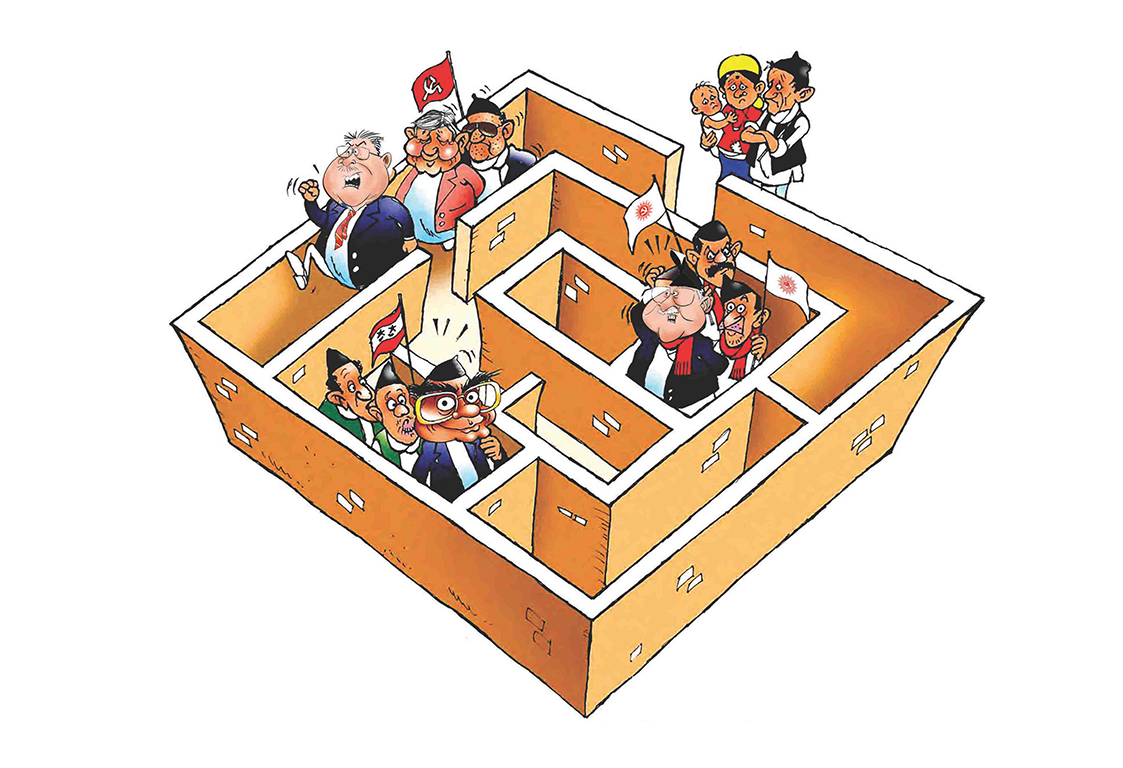
We will finally know in 12 July the fate of the dissolved House, whether or not K P Oli stays on as prime minister, if Sher Bahadur Deuba becomes prime minister for the fifth time in 20 years, or if Nepalis have to vote in early elections in November.
After two weeks of deliberations, on 12 July the Supreme Court’s Constitutional bench is set to decide on writ petitions challenging Prime Minister Oli’s dissolution of the Lower House and President Bidya Devi Bhandari’s rejection of leadership bids by both Deuba and Oli on 21 May.
Throughout the submissions by petitioners and government lawyers, depositions by the four members of the amicus curiae, as well as questions from the bench, the debate has boiled down to this: in a multi-party democracy, does the party whip have more legitimacy in a floor test than a non-party individual vote?
Can MPs from a ruling party seeking a confidence vote side against it, and even back the candidacy of an opposition leader to replace their own prime minister?
There were spirited arguments by lawyers from both sides. The petitioners went beyond censuring Oli to accuse President Bhandari of complicity and failing in her duty to protect the Constitution from Oli’s ambition to cling on to power.
Both Oli and his main challenger, former prime minister Madhav Kumar Nepal, have claimed that their actions were constitutional, and it was the other side that is acting against its letter and spirit.
The Constitutional Bench itself was formed last month on the basis of seniority by Chief Justice Cholendra SJB Rana and includes Justices Dipak Kumar Karki, Anand Mohan Bhattarai, Mira Dhungana, Ishwar Prasad Khatiwada.
We have no way of guessing which argument the individual justices will favour, but if some of its recent judgements overturning Prime Minister Oli’s moves one by one are anything to go by, they may also restore the dissolved House on Monday.
If you remember, after Prime Minister Oli got president Bhandari to dissolve the House for the second time on 21 May, Deuba of the Nepali Congress, Pushpa Kamal Dahal of the Maoist Centre and dissidents from Oli’s own UML and the JSP gathered 149 signatures to stake a claim to form the new government.