
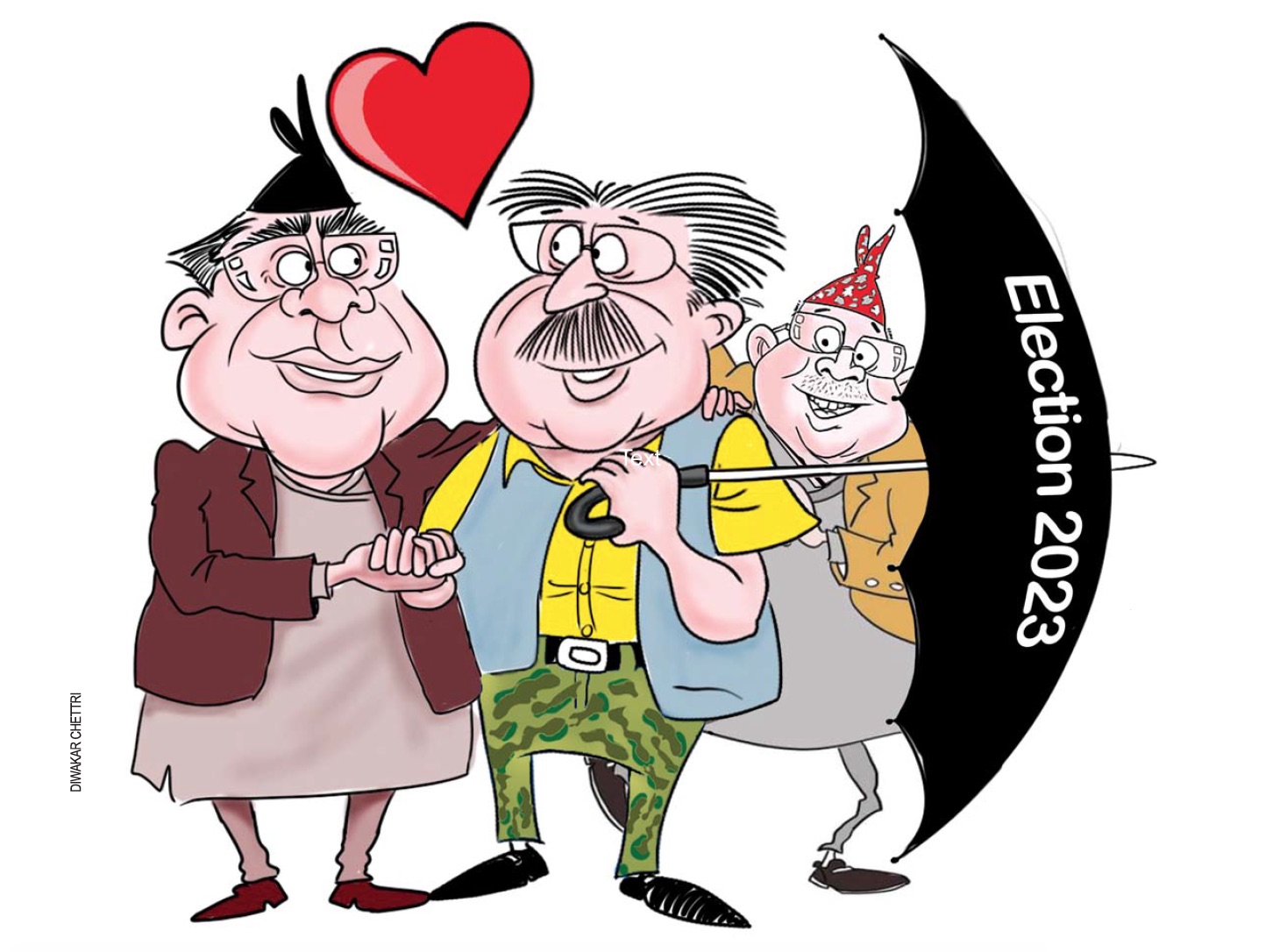
Prime Minister Sher Bahadur Deuba took office nearly two months ago, but aside from five ministers he has not been able to set up a full Cabinet.
It is not for the lack of trying: he needs to balance disparate demands of coalition partners who want their rewards for backing him. The second Covid wave may be waning, and Kathmandu Valley lifted its three-month lockdown on Wednesday, but the economy and development are at a standstill.
But that seems to be of little concern to personalities in the parlours of power whose eyes are set on grabbing important portfolios ahead of the 2023 elections so they can build up war chests, as well as command the government and security apparatus.
Staking their claims to Cabinet positions are Madhav Kumar Nepal who launched his own party, the CPN (United Socialist) on 25 August, and whose defection in July led to the collapse of the K P Oli government, and paved the way for Deuba to become prime minister for the fifth time.
Deuba also needs to pacify other members of the five-party alliance, including his own Nepali Congress (NC), where rival factions need to be placated ahead of his party’s general convention in November so that he can counter rivals for presidentship.
Deuba has to decide whether it is more important to pacify dissidents like Ram Chandra Poudel, or dangle carrots in front of members supporting Bimalendra Nidhi’s candidature for president of the NC.
The Maoist Centre (MC) is also demanding its share, and not just a pound of flesh. The MC’s Pushpa Kamal Dahal complained publicly that he was under “tremendous stress” because of demands from many of the party’s 49 members for ministerships. “I wish I could make all 49 MPs ministers, but there are only 7 slots,” an exasperated Dahal told a gathering last month.