

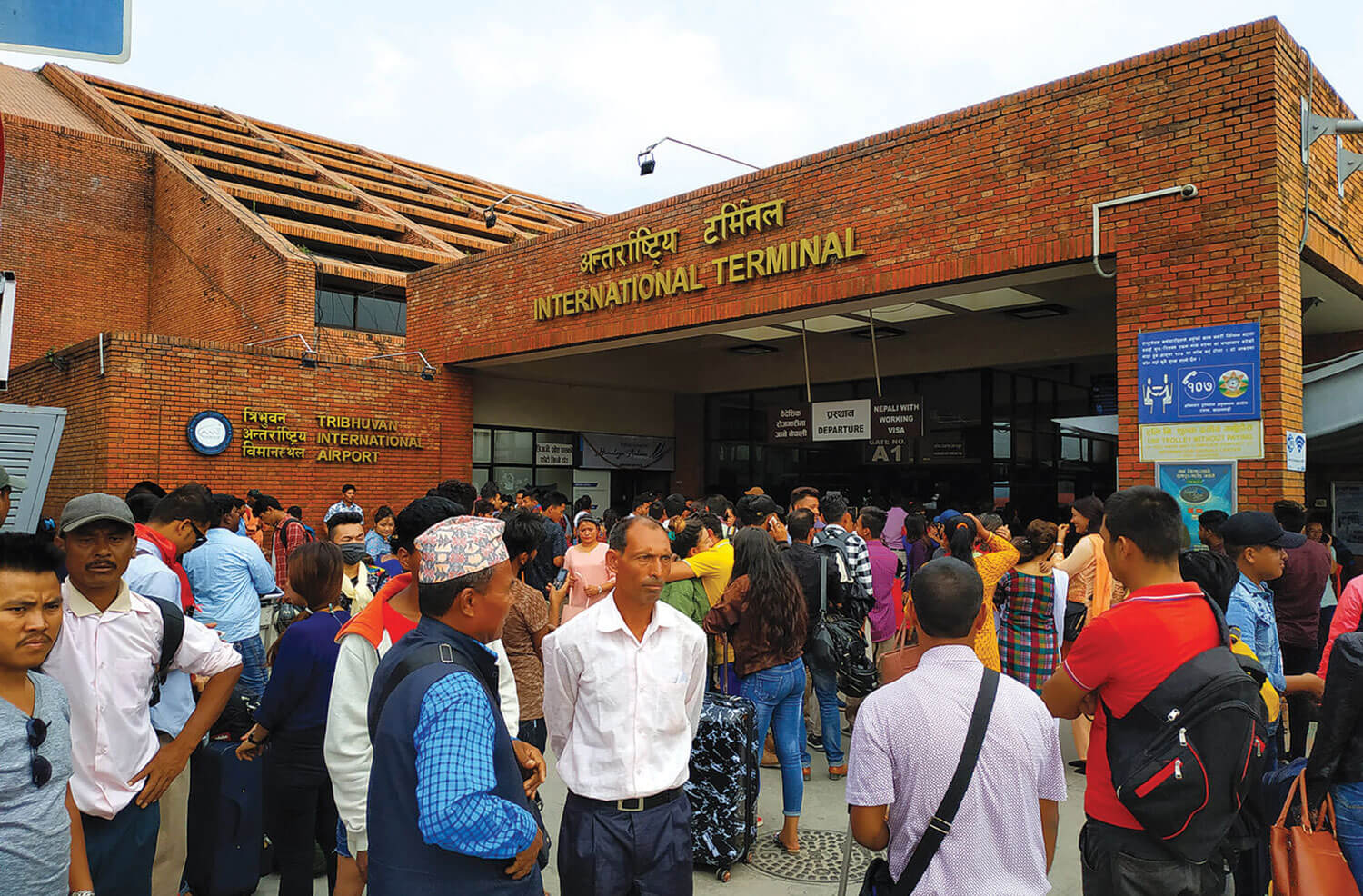
Labour migration touches every Nepali in one way or another. The pain of departure at the airport, the joy of reunion. Aspirations drive us to move to wherever we get more credit, recognition or money.
The confidence with which a person fastens the seat-belt on a plane reveals whether Doha is the final destination or just a place of transit – and that determines treatment by flight attendants. Regardless of the differences in where, why and how we move, we are all aspiring for a better shot at life.
Read also:
Back to Nepal for good?, Upasana Khadka
For Nepal's migrant workers, good news in small bites, Upasana Khadka
The migrant industry has evolved: the private sector has seen an opportunity for arbitrage, the government tries to regulate it with policies, and the media, human rights organisations and non-profits are story-tellers, watchdogs and advocates.
Platforms like the Global Compact for Migration and the Sustainable Development Goals advocate a ‘whole-of-society’ approach where different stakeholders will work collectively to advance the goals of good migration.
We have come a long way, but we need to see more tangible impact. The discussion has to move from what should be to where we actually are. The chasm between de-jure and de-facto in the foreign employment industry is so wide that it is easy to fall between the cracks.
Everyone is quick to point out that zero-cost migration is not happening. There is public litigation and there are supreme court orders. We hold rallies and conferences and we write about the issue. There are random surveys at airports that seek to find out what workers are paying. And guess what, it is not zero.
Read also: Greens from Nepal in Qatar’s desert, Upasana Khadka
While this attention is necessary to keep the debate alive, the focus of our discourse should now shift from ‘if’ it can be implemented to ‘why’ it has not been, and ‘how’ it can be enforced.
Workers are willing to pay. Let’s start there. They are convinced there is a brighter future waiting for them. If you take me to America, I will pay you $40,000. If you get me a janitor job in West Asia, I will pay $1,500. If you find me a security guard or driver job, I may pay you $5,000.
The cases that end up coming to the notice of authorities are those in which there is no job in return for the money spent. By the time this becomes clear, it is too late because the worker does not have proof of the transaction. On the flipside, after the provision in the Malaysia-Nepal MOU requiring employers to pay for visa and ticket, Malaysian companies are reportedly lamenting that it is too expensive to hire Nepalis. Let that sink in: a profit-driven industry in Malaysia is complaining about losing competitiveness after having to bear the costs that had otherwise been borne by a poor worker himself.