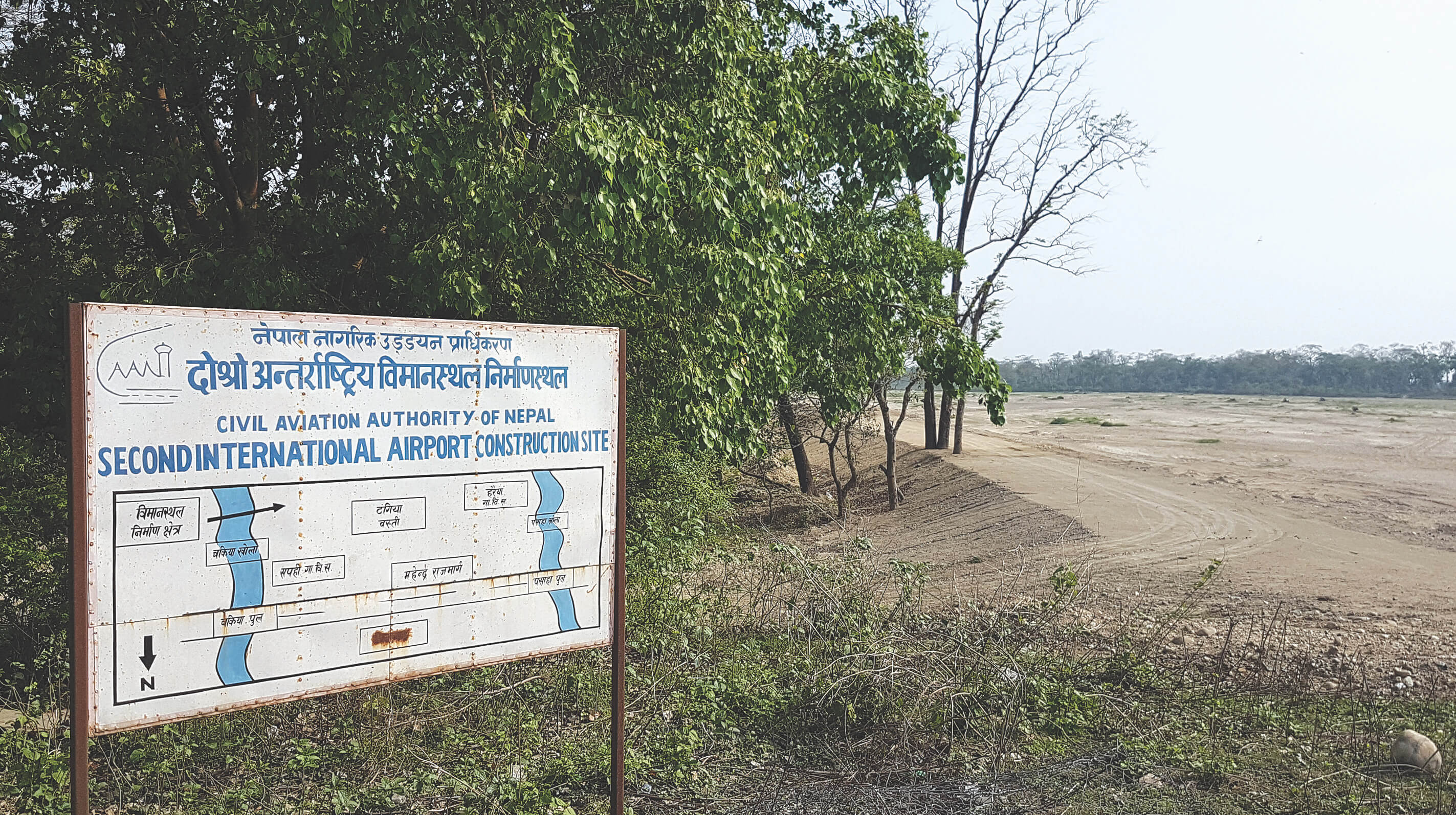
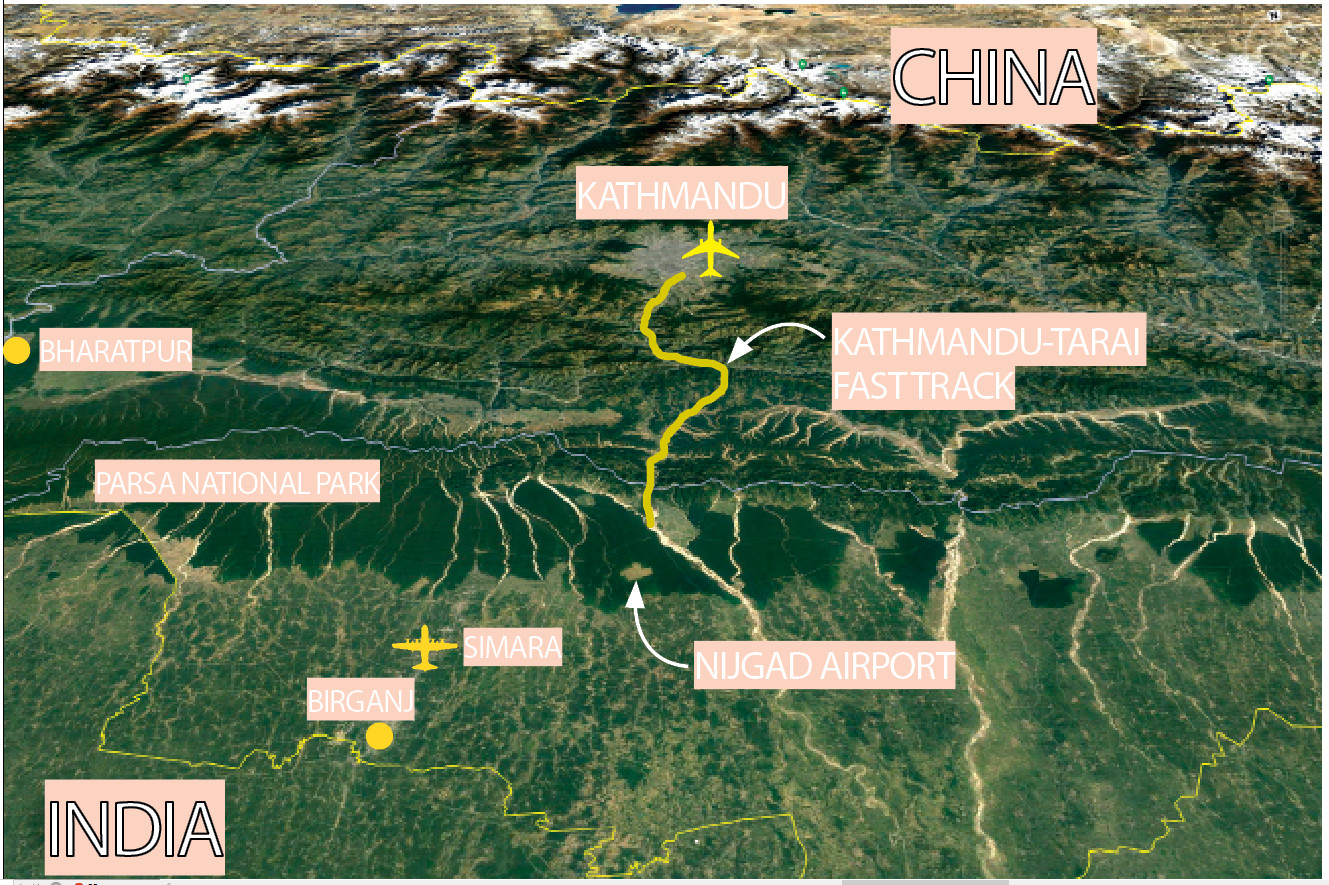
As the date for a final Supreme Court ruling on the proposed new international airport in Nijgad approaches, uncertainty once more shrouds the $3.5 billion project. Supporters call the airport 60km south of Kathmandu as a necessary infrastructure investment for the country’s economic growth, while opponents say it is an expensive and an ecologically disastrous white elephant.
On 26 May, the Supreme Court is slated to give a final verdict on a public interest litigation citing irreversible environmental damage, since it will mean felling 40sq km of primary tropical forest.
A 2010 feasibility study by Korean consultants Landmark Worldwide proposed a 3-phase construction with a single 4,000m runway for 15 million passengers per year at a cost of $650 million in the first phase to be completed in 4 years. By the third phase, there would be four runways for 67 million passengers a year at a cost of $6.7 billion. It will take another ten years for the final completion.
Successive governments, including those led by parties in the current coalition as well as the opposition, have all enthusiastically backed Nijgad, saying it is important for Nepal’s future.
Read also: Does Nepal need a 4th international airport? Om Astha Rai
“Kathmandu airport was built for 9.2 million passengers a year, and it has already exceeded that,” says Pradeep Adhikari, Director General of the Civil Aviation Authority of Nepal (CAAN). “Annual international passenger growth is 9-12% and domestic flights have grown by 33% in the past year. Tourism was growing at 10% a year pre-pandemic, and will revive,” he added.
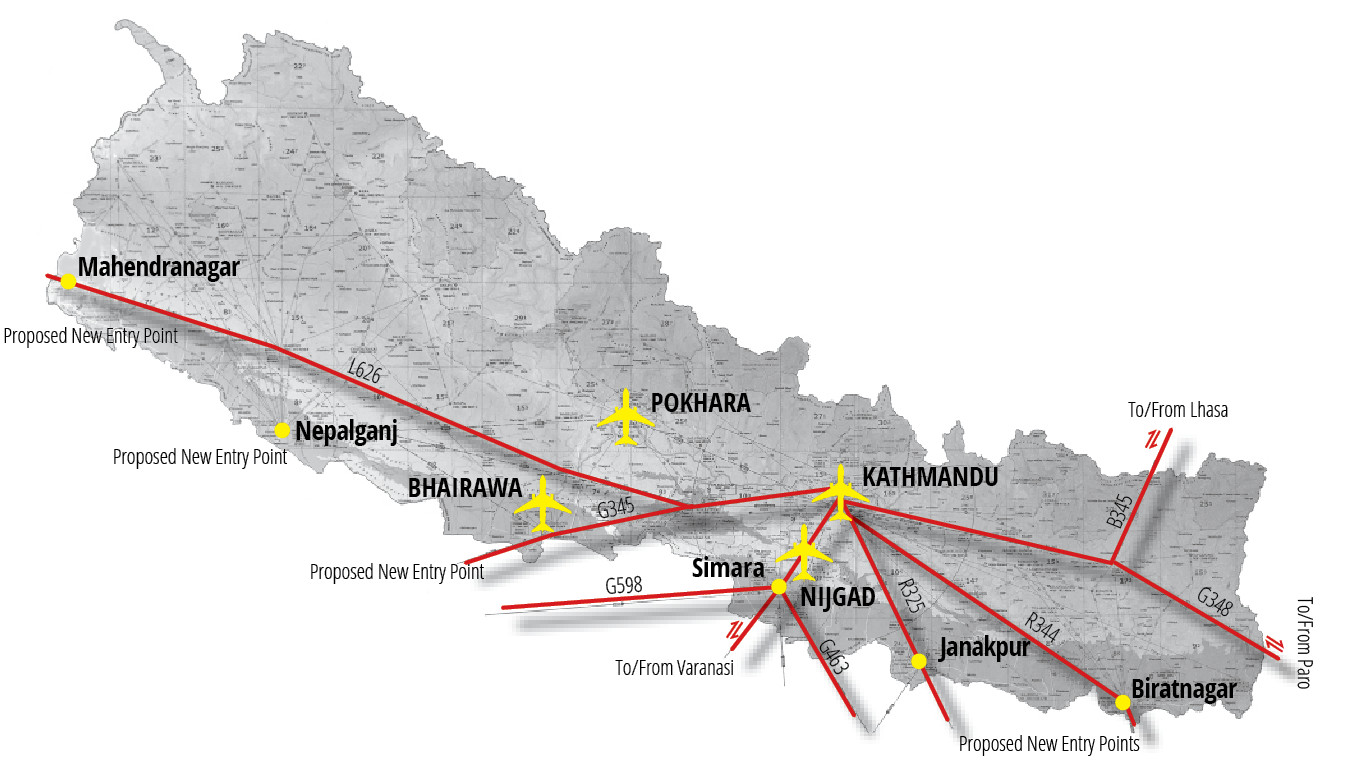
With Kathmandu projected to handle 25 million passengers per year by 2040, Pokhara and Bhairawa just do not have the capacity to reduce that pressure.
“We have reached the limit of air space capacity, terminal capacity and runway capacity,” Adhikari explains.
However, it is not just environmentalists who question the rationale for Nijgad. They say the airport is designed for an obsolete ‘hub-and-spoke’ model, whereas global aviation has moved to point-to-point destinations with new generation of aircraft that can circumnavigate the globe with just one stop.
They also say that with the impact of the pandemic and spreading awareness about the climate crisis, there is already a slowdown in civil aviation growth in parts of the world, and that the age of mega-airports is over. Besides, can Nepal afford the debt financing for such a mammoth undertaking?
The writ petition at the Supreme Court faults a 2018 Environmental Impact Assessment (EIA) for downplaying the impact on biodiversity and carbon sequestration potential of the Nijgad jungle – the last remnant of the once extensive Char Kose Jhari that stretched across the central Tarai.
Nepali Times received a copy of the EIA report, and found that it actually copy-pasted from a hydropower project in the mountains. It did not even delete technical references to ‘headwork’ and ‘powerhouse’. It cites Nijgad as being the habitat of the ghoral, an antelope-like mammal found only in the Himalaya.
One of the other concerns is noise pollution from heavy jets on the nearby Parsa National Park, but the EIA misses the point. Saying instead that noise will be mitigated by using ‘less dynamite’. Again, this seems to be from an EIA of a hydropower project.
The EIA was prepared by the firm GEOCE Consultants, whose area of expertise is hydropower. The EIA also overestimates passenger handling capacity of 60 million per year, lacks environmental and ecological assessment of the proposed ‘aeropolis’, quarry sites, and infrastructure in the construction and operation phases.
In its final phase, the airport would ultimately require 8,046 hectares of which nearly 95% is heavily forested at present. This has led critics to call Nijgad a “logging concession” rather than an international airport project.
Destruction of the Nijgad forest could impact on ground water recharge and river flow, affecting irrigation and agriculture production downstream in the fertile Tarai plains.