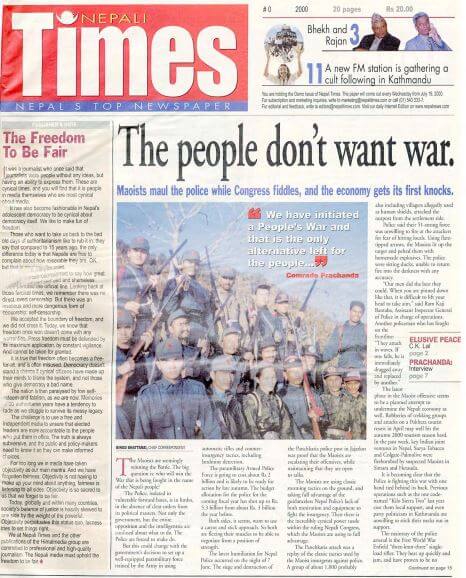
Retailing for Rs20 and running to a full 20 pages, the ‘demo issue’ of the Nepali Times, NT #0, was printed and distributed in early July 2000 (below). Its ambitious masthead asserted that it was (or perhaps would be) ‘Nepal’s Top Newspaper’. This was at the height of Nepal’s civil conflict, and the front cover led with the headline ‘The people don’t want war’. Alongside ran a ‘Publisher’s Note’ extolling the virtues of fairness, objectivity and professionalism in the media, and pushing back against the dominant cynicism of the time.
Many of the contributors to this demo issue would go on to become regular columnists, including C K Lal with his ever-thoughtful ‘State of the State’, the late and direct Barbara Adams and her ‘Barbs’, Sujeev Shakya writing under the pseudonym Artha Beed in a wide-ranging column entitled ‘Economic Sense’, and editor Kunda Dixit’s spicy ‘Under My Hat’ satire on the back page. A first-rate collection of Nepali writers and journalists filled out the rest of the issue. The publishing landscape of Nepal was about to change forever.
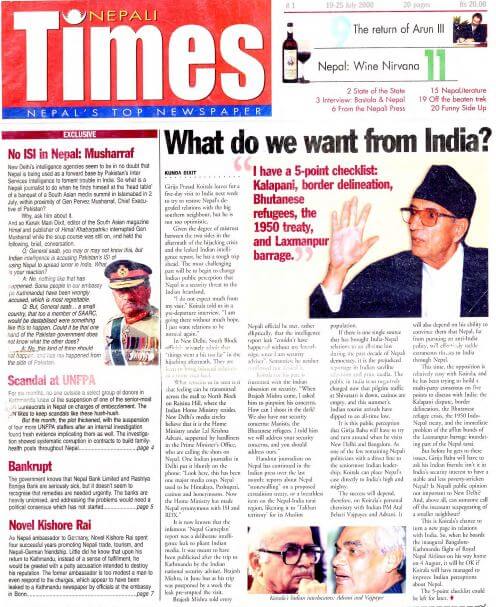
In the following week’s issue, NT #1 (19-25 July, 2000), editor Kunda Dixit answered an implicit question that many were asking: why this weekly, now, and why in English? Noting that 1,300 newspapers were currently registered in Nepal, Dixit made an impassioned case for the relevance of an English-language weekly, arguing that the Nepali Times would 'take the concerns of those who matter to those who chatter', and do so by talking 'about us in a language that they understand'.
Read also: 16,600 pages of Nepali Times on Digital Himalaya, Mark Turin
An essential element in achieving this broader goal was the page of translated articles ‘From the Nepali Press’ that became a regular, and much anticipated, weekly feature of the newspaper, ensuring that important local and national news received appropriate attention in Nepal’s English-speaking international community. Twenty years since the first issue, I caught up with Publisher and Editor Kunda Dixit to ask about the present and future of the Nepali Times.
Mark Turin: What were your goals in establishing the Nepali Times in 2000?
Kunda Dixit: We aimed for the Nepali Times to be a window on the whole of Nepal -- not just Kathmandu -- for the outside world. We opted for the ‘Berliner’ tabloid format with visually rich design, world-class production values, and a lively presentation of serious and not-so-serious issues. In short, a paper that people would read cover to cover. Actually, I could quote from the Editorial from NT #1 on 19 July 2000: 'Nepali Times will aspire to be a true reflection of our times -- a journal to record the life and times of Nepalis in the decades ahead.'
Have your goals changed over time?
We never had a big circulation compared to the Nepali-language broadsheets, but very soon after starting we sensed that we had influence disproportionate to our reach. The reason was obvious: the language, subscription price, and subjects we dealt with, put us in a different bracket. A former Finance Minister once told me the Nepali Times made him nervous because donors came to meetings on Fridays carrying the morning’s print edition. Not much has changed in terms of the mission and vision of the paper. We haven’t even tampered with designer Rustom Vania’s original masthead and page arrangement -- it has stayed the same for 20 years.