When Kathmandu Valley was still known as Swoniga (three cities), back in the medieval Lichhavi-Malla era, the Ganga plains did not send diplomats or spies here, they sent rulers. The Lichhavi arrived from nearby Vaishali, and later the dynasty of Mallas from Tirhut/Karnataka.
The unifying king Prithvi Narayan Shah instructed his followers and successors to be wary of the East India Company, which was then galloping across the Indo-Gangetic plain in conquest and about to swallow Avadh. He chastened the British with devastating defeat at the battle of Sindhuli Gadi in 1767, and it was only after the Kathmandu Durbar under Bhimsen Thapa became territorially ambitious in its eyes that the Company Bahadur waged war. The guerilla tactics of the Gorkhali fauj were no match for the heavy ordnance deployed by the Viceroy, and Kathmandu sued for peace.
The Treaty of Sugauli (1815) not only reduced Nepal to its present size and shape, but it also extracted concession in the form of a residency in Kathmandu, and that is when, for the first time, the consolidated southern power became a player in the Nepali polity. The political actors were in thrall of the British Resident at Lazimpat (from ‘lodging part’, according to some) and Lainchaur (‘lain’ from ‘civil lines’) and the sheer military power he represented. And the kings and bhardar nobility were not above using it to benefit when it suited them.
This proclivity continues, with Nepali politicians cosying up to Indian interlocutors (diplomats, spies) while in power, and turning virulently anti-Indian when out. The best example is the Maoist leader Pushpa Kamal Dahal, always taking matters to an extreme, who wrote supplicatory letters to Indian intelligence agency heads, and yet dug trenches to ward off an Indian invasion.
In the mid-19th century, the polymath diplomat Brian Houghton Hodgson was the resident Machiavelli of Kathmandu, playing a delicate game of supporting and warning various factions in the Durbar, even while treading a fine line with the Governor-General in Calcutta. One tool often used was safe passage to Banaras for Durbar dissidents, and their upkeep in the holy city as a useful political pawns.
Hodgson supported the rise of Jang Bahadur who, following his 1850-51 visit to Queen Victoria’s England (and then France), decided that siding with the Company was geopolitically the best option for Kathmandu. Hodgson, by then retired to Darjeeling, persuaded the East India Company to accept the military support offered by Jang to quell the ‘Sepoy Mutiny’. The Kathmandu satrap led a military detachment to Lucknow and Banaras, and returned with Company favours that included the return of the Naya Muluk lands of the Tarai, besides looted Avadh jewelry. The Rana oligarchy begun by Jang Bahadur evolved a policy that simultaneously included implacable xenophobia, and distanced subservience to the colonial power.
During the remaining Rana era, the Resident was left with relatively little to do, because the ruling clan had ensured fealty to the British, and sending Nepali soldiers to fight in the two world wars, besides the second and third Afghan campaigns. Meanwhile, Nepal's rulers made an easy shift in focus from Banaras to the capital of British India in Calcutta.
The political economy
Since medieval times till the late Rana era, the Valley’s economy was overwhelmingly north (Tibet) oriented, while the geopolitical radar pointed both north and south. After the British built a narrow-gauge railroad starting in Siliguri which hugged the border and ended up in Agra, India began to replace Tibet as Nepal’s main trading partner. Following the Younghusband invasion of Tibet of 1903-1904, in which the British deployed their 8th Gurkha detachment, and also took the support of yaks and porters provided by Chandra Shumshere, Kathmandu was forced to pivot almost entirely to the south in terms of commerce and political relationships. The British became even more central to the Kathmandu Durbar’s worldview.
The lasting gift of the Ranas to Nepal, utilising all the goodwill they had amassed with the British colonial powers, which enriched them beyond belief, was to negotiate and sign the Nepal-Britain Treaty of 10 December 1923, under which the British accepted Nepal’s sovereign status. The country was lifted above the level of princely states of the Subcontinent which were much richer than Nepal and potentially more powerful, and made Nepal a one-of-a-kind power within the otherwise colonised Subcontinent. This, in turn, would provide protection when the point of acquisitive Indian Independence arrived.
The shift of the colonial capital to New Delhi in 1938 pushed Kathmandu into an era of uncertainties, with the security of Calcutta’s cosmopolitanism overtaken by the New Delhi’s unabashed imperium, whoever the rulers may be. Thereafter, India’s transition from colony to self-rule meant that the nuanced relationship informed by culture and history was dumped for a power relationship.
Young political activists from Nepal saw that Rana rule would not end unless the British were pushed out of the Subcontinent, and enthusiastically joined the struggle for Indian Independence. In the process, they developed deep links, as equals, with India’s emerging political class. Little did they know Independence would make the new Indian rulers – politicians as well as members of the civil service – don the mantle of the departed colonials. The haughty posture of the Indian interlocutor is matched only by the obsequiousness of the later generation of Nepali politicians, which continues to give many Delhi-wallahs today a sense of empire.
Dakota Diplomacy
One turning point in the relationship between Indian and Nepali politicians can be said to have occurred in 1950 at a meeting between the newly anointed Prime Minister of India, Jawaharlal Nehru, and his erstwhile fellow-revolutionary Bishweshwar Prasad Koirala, still a freedom-fighter against the Ranas. When a DC-3 aircraft loaded with money looted from the Rana customs point at Birganj landed at Safdarjang Airport in Delhi, Nehru had the aircraft surrounded by security and the cargo confiscated. Later, at Teen Murti House, the livid prime minister confronted Koirala. BP understood that the ‘bilateral’ dynamic between the two comrades had changed, and from a fellow revolutionary Nehru had transformed into a head of government with attendant interests and responsibilities.
Prime Minister Jawaharlal Nehru’s attitude towards Nepal has since been adopted by successive prime ministers right down to Narendra Modi (except the internationalist and regionalist I K Gujral) and the ambassadors, diplomats, visiting and resident spooks. The modern Indian state got its taste for intervention through Nehru’s example, including Ambassador CPN Singh, a Bihari aristocrat and civil servant. Much of the rushed movement between New Delhi and Kathmandu at the time was conducted through ‘Dakota Diplomacy’ which had brought the Rana regime to a close. My great grand-uncle Narendra Mani Dixit, a foreign policy adviser of the Ranas, writes of this in his unpublished memoir.
In the Rana era, the super-elite of Nepal nurtured the image of a ‘forbidden kingdom’ and to a large extent succeeded in keeping the colonial officialdom wowed, much as Bhutan does today in its dealings with New Delhi. While Nepali politicians and diplomats alike are from plebian backgrounds, perhaps the most effective Nepali ambassador to India was Bijaya Shumshere, about as ‘elite’ as you could get in the mid-20th century, who was there for the tightrope walk when the Rana regime fell to the Nepali Congress democrats.
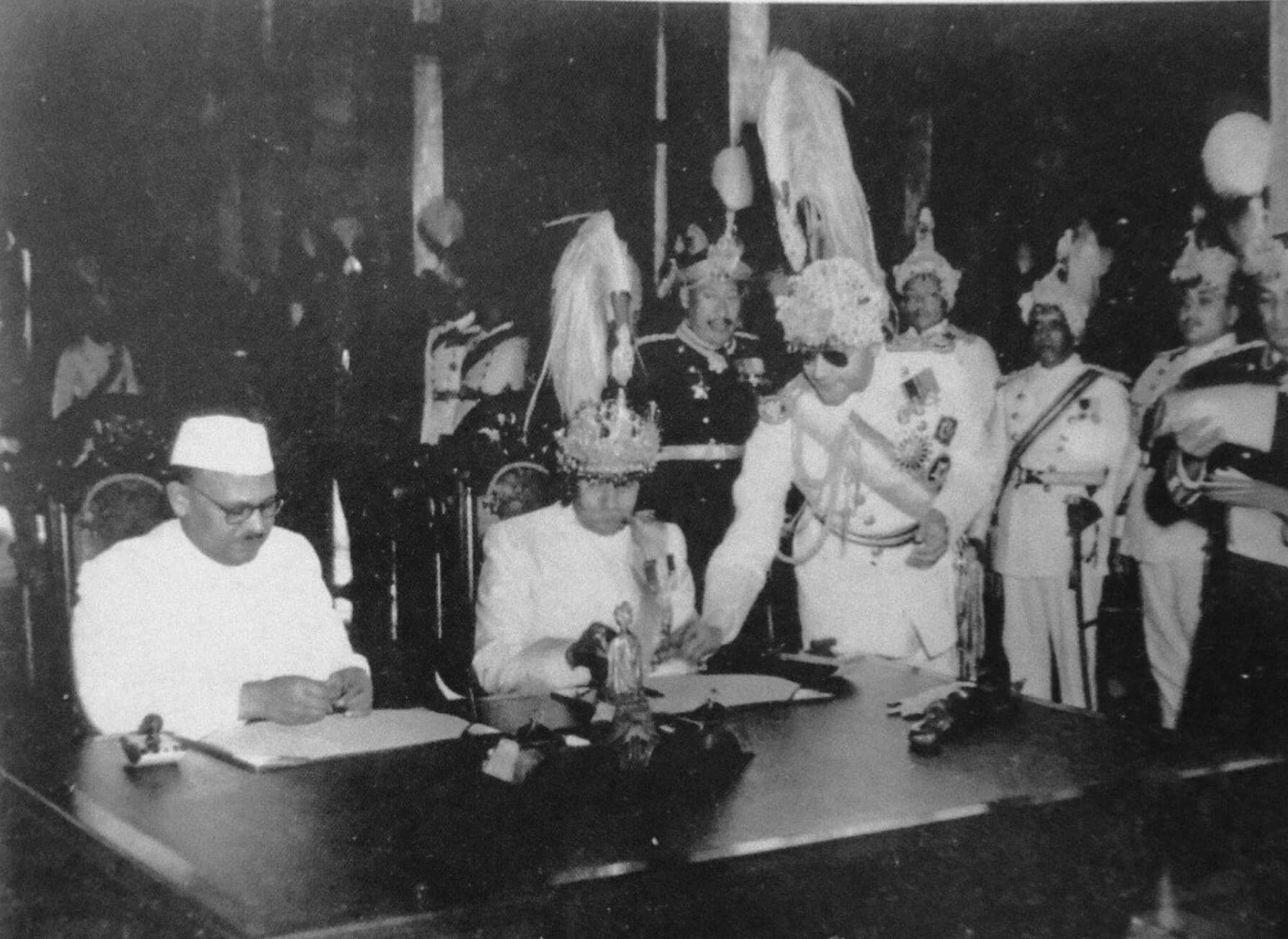
While Nepal’s sovereignty was left intact in the course of India gaining Independence, this did not mean that New Delhi’s influence waned. The Ranas were so weakened that in formal ceremonies the Indian ambassador had an elevated place in the dais. Nehru made a charade of three-way talks between himself, the Ranas and the Nepali Congress, while foisting an interim government on Nepal with a Rana as Prime Minister and the revolutionary Nepali Congress in secondary position. Indian bureaucrats attended and guided Nepal’s cabinet meetings, and India went on to place more than a dozen listening posts in the mountains to monitor Chinese activities.
The severely weakened Rana regime, just before it fell, signed a treaty of peace and friendship with India on 31 July 1950. The treaty has rankled Kathmandu’s political class, starting with the fact that it was signed by a Nepali prime minister and an Indian ambassador. However, the treaty did lay out reciprocal obligations among equals, such as mutually acknowledging ‘the complete sovereignty, territorial integrity and independence of each other’.
The document commits New Delhi to allowing Nepal to import weaponry from third countries through Indian territory, but then it blockaded Nepal in 1989 on the excuse of Nepal having imported ordnance from China. A letter subsequent to the treaty allowed Nepal exception on the clause confirming equal treatment by each country of the citizens of the other, as a concession to the difference in the size of the two economies and respective population sizes.
The one that got away
Nehru continued to micromanage Nepal, often at the behest of the Nepali leaders who kept reaching out to him to resolve issues much as earlier rulers in Kathmandu used to approach Hodgson. This can be seen in published letters between Nehru and BP’s half-brother and competitor Matrika Prasad Koirala.
Several factors played a part in protecting the country’s sovereignty and New Delhi began to flex the muscles of Independent India: the strictures of the 1923 Treaty which were difficult to skirt, the pre-existing camaraderie between the Indian leaders and Nepali revolutionaries which provided a security umbrella, as well as the liberal leanings of Nehru. Despite the misgivings of Sardar Vallabhbhai Patel, all of this meant that Nepal’s sovereignty was respected even as Junagarh, Goa and Hyderabad fell.
Till today, there is little-disguised amazement among Indians visiting Nepal, with the unstated line, “How did you guys manage to get away?” Indeed, Nepal provides a refreshing change from the larger nation-states of South Asia, for being a country of heterogeneous population and a size that ensures the citizens are not too far removed from the fount of political power. While there are enough inherited and extant issues of mal-development, marginalisation, exploitation and Kathmandu-centricism, Nepalis have the possibilities of making the ‘nation-state’ work more than elsewhere – and not just because it is the oldest in the Subcontinent.
As long as Nepal was an absolute monarchy, the understandings and adjustments were made at the highest level between Narayanhiti Royal Palace and 7 Race Course Road, so there was little for diplomats – or espionage agents – to do. The Royal Nepal Embassy at Barakhamba Road was little more than a post box of the royal family, and government secretaries negotiating with Indian counterparts never had much leeway, always waiting for instructions from the Royal Palace Secretariat.
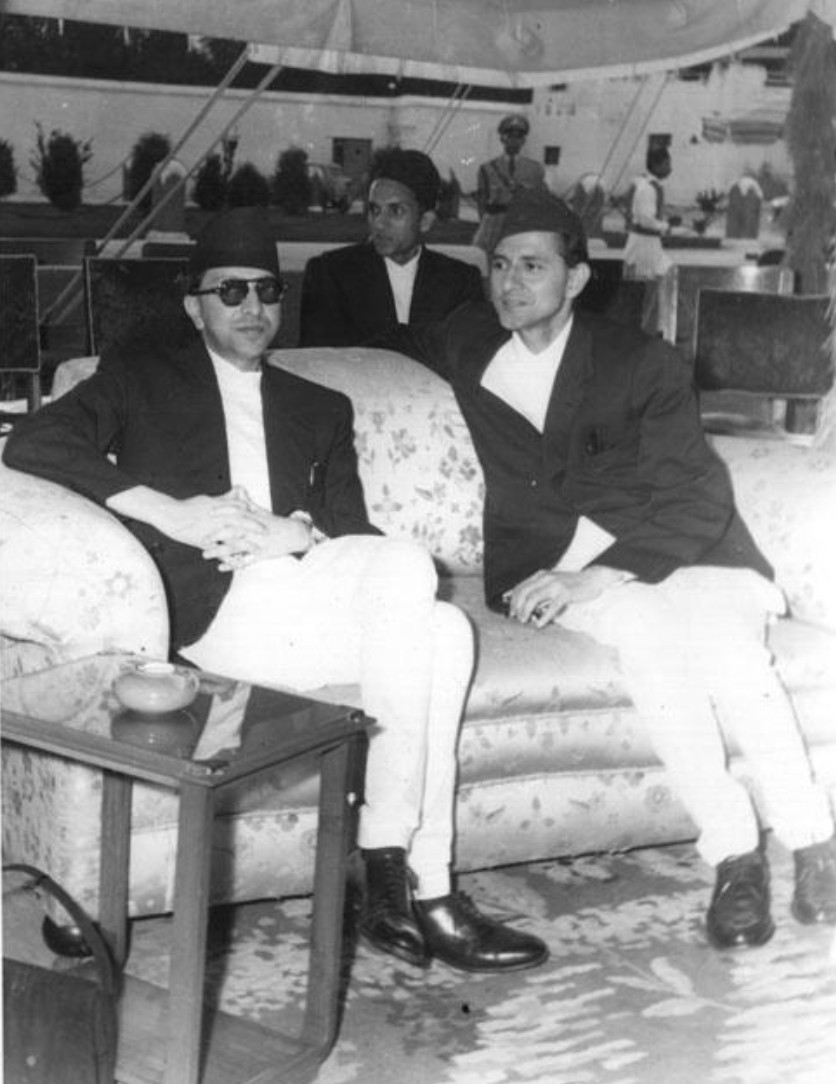
The fall of absolute monarchy in 1990 was a demand of the Nepali people. But the show of political solidarity by Indian politicians including Chandra Shekhar was important, and is used by many kneejerk analysts to cry Indian heavy-handedness. It was the People’s Movement which ushered democracy and the new Constitution of November 1990, but it is also true that the new polity with its multiple power-centres provided more opportunity for Indian diplomacy to engage as well as for the spreading tentacles of the Indian intelligence, particularly R&AW and IB.
How these external and internal espionage agencies divided (and continue to carve up) the Nepal turf between themselves is a matter for some scholar/researcher to pick up in the days to come, for nothing that is done so openly should remain unremarked or un-analysed.
Right hand, left hand
Nepal became a playground for all kinds of Indian actors, and in hindsight, it becomes clear that so many roadblocks in bilateral relations have to do with the fact that one hand of the Indian state often did not know what the other was doing. Down the timeline this is seen in the rise of the Maoists (when some agency seems to have been involved in training the rebels), the Indian blockade of 2015 (when someone in a darkened New Delhi cubbyhole decided to teach Nepal a lesson for going its own way in adopting the new Constitution) and the latest India-Nepal tangle on the ownership of the Limpiyadhura-Lipu Lek stretch north of Kumaon (where the Indian Army’s plans to inaugurate the road to the Lipu Lek pass was not communicated to South Block).
In the democratic era since the 1990s, India got active in influencing Nepal in various ways, from relatively benign to nefarious. One surefire tactic was to send the children of Nepal’s politicians and senior bureaucrats to Indian colleges and institutions of higher learning, from college to medical studies to ayurvedic studies, depending on the influence and importance of the supplicant. Medical treatment of political leaders has been a potent tool for New Delhi to try to get its way, except when individual politicians emerged more wily and slippery than expected. India also exercised enormous soft power across the open border, from being an aspirational democracy that Nepalis looked up to for decades, to an India was the destination for the youth seeking quality higher education.
As Lainchaur’s influence grew in Kathmandu, gradually a rock-solid point of view developed with the political class that you had to have ‘New Delhi dahina’ if you wanted to move ahead in politics. Within its own geopolitical space, with the rise of Chinese interest and activity in Kathmandu still years away, Nepal was in a unipolar space where New Delhi’s goodwill became essential for success in national politics. While Nepal had evaded the fate of Sikkim and inherited a better historical deal that Bhutan vis-à-vis New Delhi, India managed ever-stronger lock-hold on the Kathmandu polity.
However, in equal and opposite measure, India's tight embrace helped develop an anti-Indianism among the intelligentsia, also to be used by politicians out of power. It would seem that India was all-power and all-capable in pulling strings and levers on Nepal, often getting ‘credit’ for things it had no role in. For some in Kathmandu it seemed as if India’s entire foreign policy had nothing better to do than destabilise Nepal. The more likely scenario was that New Delhi’s rulers were so preoccupied elsewhere that the diplomats – and intelligence agents in particular – ran amok, with the policy-makers in New Delhi completely oblivious until after the damage was done.
When things get difficult, Nepal’s politicians relied on their links among the Indian political class. Indian princelings and royal families connected to Nepal’s Ranas or Shah royalty have always been for lobbying: from the Scindias of Gwalior to the Mayurbang royalty of Orissa, to Karan Singh of Jammu and Kashmir. Very few Nepalis had access to the higher echelons of power in Delhi, and one of the few who cultivated the top rung was the sagacious businessman with royal connections, Prabhakar Rana, whose passing in May 2019 has been a loss in terms of links to the Delhi establishment. The rise in power of the BJP/RSS combine has also added to shrinking connections between Nepali politicians and New Delhi.
Jai Prakash Narayan’s followers, Lohiaites, CPI-M leaders, all were active at one time or the other, maintaining links to Nepal and acting as go-betweens as and when required. At times, the rest of the population cringed as Nepal’s Parliament gave standing ovations to visiting Indian personages, such as Sitaram Yechuri after the end of the conflict in May 2006 and Narendra Modi in August 2014. During the 2015 Blockade, while there was goodwill all around from Indian politicians including Mani Shankar Aiyar and the just-departed DP Tripathi, it was the urging of the Indian Army (with its large contingent of Nepali citizens in the Gorkha battalions) that is said to have been effective the PMO having second thoughts.
Maoists approach Delhi
The unique and historically evolved open border between Nepal and India made New Delhi look at the northern neighbor from a security perspective. The fact that Nepal made up half of the strategic Himalayan ‘rimland’ meant that New Delhi was bound to pay inordinate attention to Nepali politics, which is probably why India is said to maintain its second largest embassy in Kathmandu.
The rise of the Maoists in Nepal gave different Indian functionaries further room to frolic. While at least some entity in the Indian security establishment seems to have worked to impart training to Maoists, other parts of the Indian establishment sought to take advantage of the weakening of the Nepali state during the conflict. When challenged on Maoists having a free run of India to make forays into Nepal, Ambassador Shyam Saran told this writer back in the day: “We can’t locate our own Maoists, how do you expect us to keep track of yours? India is a big country!”
The decisive entry of Indian intelligence into Nepal happened at the hands of the Maoists. The Nepal Army, which had kept out of the fray for six long years after the start of the conflict in 1996 while the Nepal Police very inadequately tackled the Maoists, finally picked up the gun, and after a few debacles gradually got the upper hand. The rebels felt the heat and began to look for a way out. Once a schism between the supreme Pushpa Kamal Dahal (Prachanda) and chief ideologue Baburam Bhattarai (Laldhoj) had been patched up, it is said with the interlocution of Indian intelligence, the two leaders wrote a letter to the Indian Prime Minister Atal Bihari Vajpayee asking for a hearing.
National Security Adviser to Prime Minister Vajpayee, Brajesh Mishra, directed the Maoist duo to write to the Intelligence Bureau, an instruction they dutifully complied with. Before long, the Dahal and Bhattarai had a deal with India’s spy-masters, and thereafter the Maoists had the run of India without having to face harassment, and they found it easy to make forays across the length of the Nepali border. Meanwhile, the Maoist leadership holidayed in Gurgaon and Noida.
This deal between Indian intelligence and Nepal's Maoists meant that the leaders of the democratic parties of the Nepal, too, were forced to deal with Indian spooks in order to make contact and conduct negotiations with Dahal and Bhattarai, even as King Gyanendra was developing autocratic tendencies in Kathmandu. Indian intelligence thus got into the inside track of Nepal’s polity.
The 12-point deal with the Maoists that led to the Comprehensive Peace Accord in 2006 was negotiated between the Maoists and UML and NC leaders in and around Delhi. It was obvious that the Indian authorities were in the know, but it would be excessive to say that India brokered or directed the deal, as some self-flagellating Nepali analysts would have one believe. The reason the 12-point deal was vital, even if it was negotiated in a foreign land, is that in 2005 an average of 7-8 Nepali citizens were dying every day at the hands of fellow Nepalis.
Micro-manipulation
Before long, the activism of the apparatchiks evolved from ‘handling’ Maoists in India to overt dealings in Kathmandu. Lainchaur’s diplomatic function was eclipsed by all manner of micro-management of politics by the agents even as the country got into the difficult phase of constitution-writing, where too they pushed and pulled. When we say India was micromanaging affairs in Nepal, it rapidly came to mean micro-manipulation by Indian intelligence officials.
Having made themselves comfortable in Kathmandu, the apparatchiks realised that they had a handle on the running of a good-sized country, not possible anywhere in the world. And so, with the blessings of the PMO in New Delhi, the spies went outward, and wayward. Perhaps the leadership felt that the perceived security threat represented by the open Nepal-India border required ‘handling’ Nepal differently than any other country, but again and again the adventurism has come back to haunt India. For example, the Blockade stiffened the spine of Nepalis and hence the state, and made Nepal look for the northward passage for commerce and connectivity, and elevated K P Oli to the prime ministerial seat with overwhelming mandate.