
The first step in reducing air pollution is to let the public and governments know how bad it is
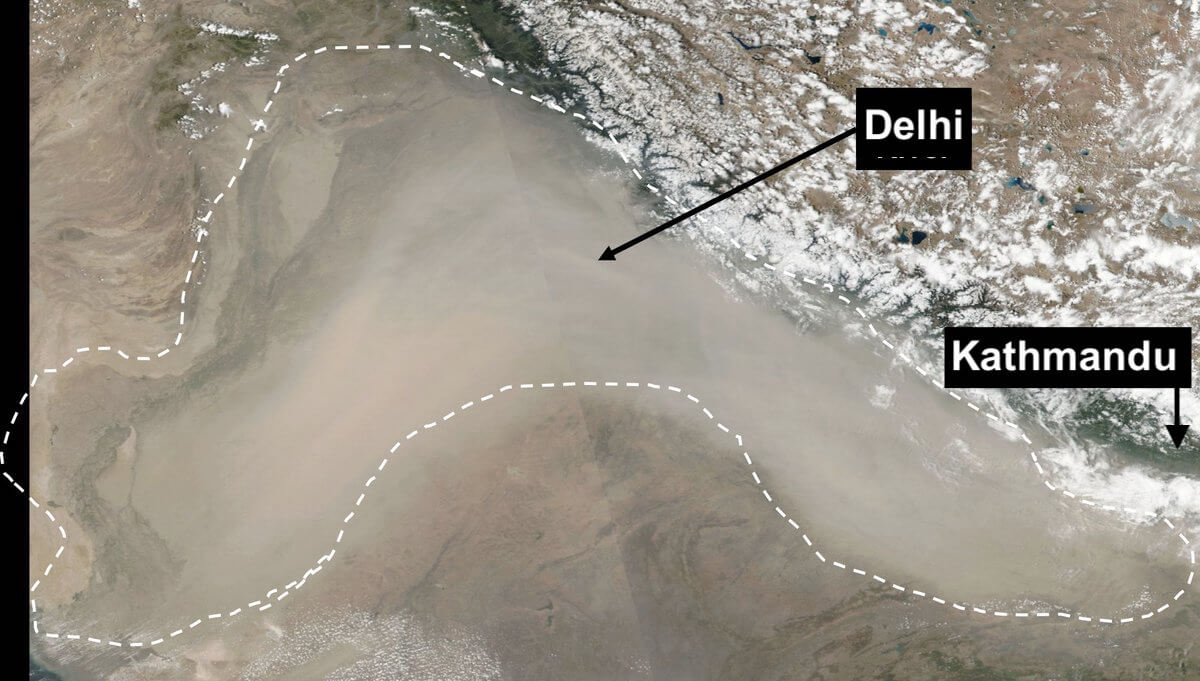
999: that was the reading in air pollution monitoring stations in New Delhi on 15 June. Adding to the city’susual vehicular emission pollution was a sand storm blowing in from the Thar Desert (see picture below). Usually, even on bad air days, the Indian capital’s Air Quality Index (AQI) is usually less than 160 – so last weekend was literally off the charts.
The dust was blown over by westerly winds into Nepal, where residents of Kathmandu saw trees, plants, parked cars and houses all covered in the muddy rain that fell for three days over the weekend.
This was proof that trans-boundary air pollution from India is a serious concern for Nepal. Fortunately the dust particles are bigger and are relatively less harmful than the more toxic smog also blanketing the north Indian plains that also gets blown over.
Atmospheric scientists say more than a third of the pollution in Nepal in winter is blown in from across the border. The rest is local dust, vehicular exhaust, soot particles from brick kilns and open garbage burning in Nepal itself. Air pollution is the reason for 250 out of every 100,000 deaths in Nepal.
Data this winter showed that Nepal’s mountain cities and the Tarai had some of the worst air quality in the world – sometimes dirtier than Beijing and Delhi. On 23 April this year, the AQI for Kathmandu was nearly double that in Beijing (153) and New Delhi (167) measured at that the same time.
Christa Hasenkopf, atmosphere scientist and co-founder of OpenAQ, world’s first real time air pollution data platform, was in Nepal this week for a series of workshops on ensuring that air pollution measurements has an impact on policy formulation and decision-making by raising public awareness and sensitising government officials.
Hasenkopf had previously worked in Ulaanbaatar, Mongolia, which also has high levels of pollution, and says making real-time pollution data available to the public can move governments to act.
“Nepal has had more political will for air pollution than many places I’ve visited before,” she told Nepali Times in an interview. “By no means has the issue been solved, but what’s happening here in terms of engagement and passion for air quality and how it has evolved is phenomenal.”