
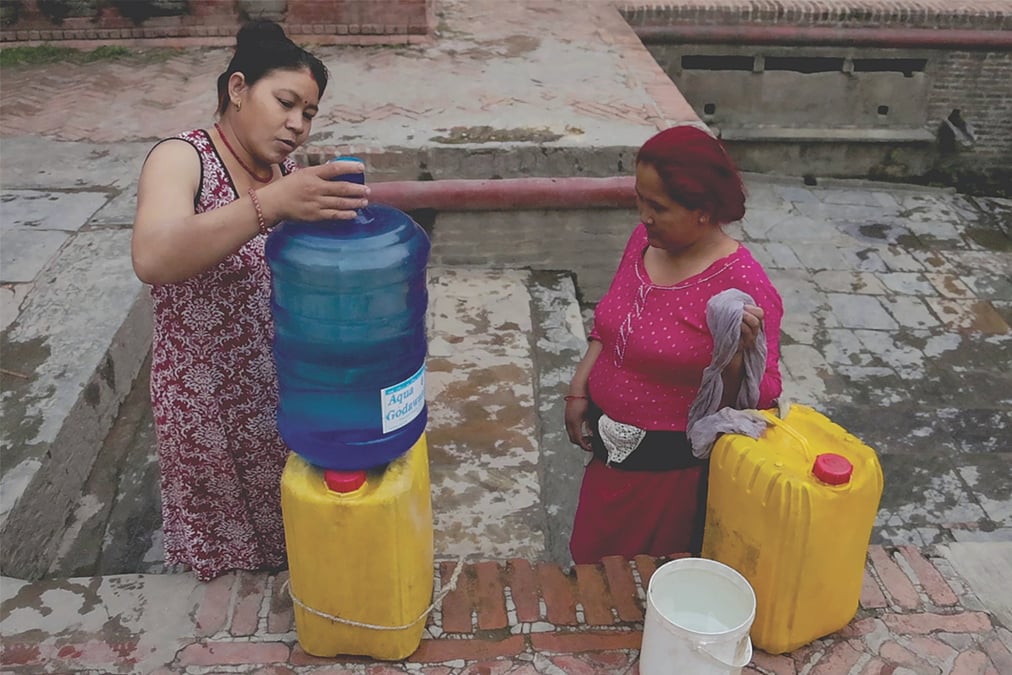
Every dawn in the Himalaya, before anyone else wakes up, women set out with empty vessels to collect water from the springs. They know these springs as intimately as their own breath.
They can tell you when the flow began to slow, how the taste subtly changed, often after a new road was built nearby or some development took place upstream. They feel these changes long before anyone comes to measure them. And yet, women are almost always left out of the conversations when “experts” gather to talk about saving the springs.
Having spent years studying the science behind Himalayan springs, especially in rural hills and mountain regions, I am certain it is the women who know the springs best.
Springs are not just hydrogeological features, they are vital social spaces woven deeply into the daily lives and identities of the communities that depend on them.
Women often walk long distances to collect water, wash clothes, and bathe at the springs, but the journey is even more arduous for the Indigenous and Dalit women who are denied equal access to water. Yet, often without recognition, these women become the custodians of the springs – intuitively sensing, and monitoring changes in water quantity and quality.
But recognition rarely translates into real participation. In many water user committees, women are appointed to leadership roles, but their actual influence is quite minimal. They are often not given space to speak during meetings, excluded from key planning discussions, or merely asked to sign off on decisions already made. This is not empowerment but tokenism, and happens also at the institutional and policy levels.
In many community meetings I attended, few women spoke even though they were the primary users of water. This gap between scientific planning and lived community realities made it clear that without inclusive processes, even the best restoration plans fall short. This exclusion is not only unjust, it is one of the primary reasons why multi-million-dollar spring revival projects often fail. Solutions designed without the sight of those who use and monitor the springs daily are bound to miss the mark.
Understanding recharge zones and aquifer dynamics is essential for springshed management. But so is the critical insight into who accesses the spring, when, how often, and for what purpose. Technical professionals often focus on the ‘where’ and the ‘how’ of water, but we must also ask for whom? Who uses this water? Who monitors it? And crucially, who is excluded from the conversation?
Read also: The heat beneath our feet, Sahina Shrestha
Moving beyond tokenism requires embedding Gender Equality and Social Inclusion (GESI) into the core of springshed management, not as a box-ticking exercise, but as a foundational approach.
It means the active engagement of women, Indigenous communities, and Dalits from the very beginning – mapping their access and dependence on springs, prioritising springs based on their needs, and creating safe spaces for dialogue and discussion, training them as Community Resource Persons (CRPs) and para-hydrogeologists, encouraging women to take meaningful leadership roles in local spring water user committees, and ensuring that interventions are designed to promote equitable sharing of benefits. We must monitor how spring depletion and revival affect women, children, and marginalised groups.