A much-delayed half-billion dollar US government project to upgrade Nepal’s infrastructure threatens to split Nepal’s governing coalition, amidst indications the Chinese have intensified lobbying with politicians to oppose it.
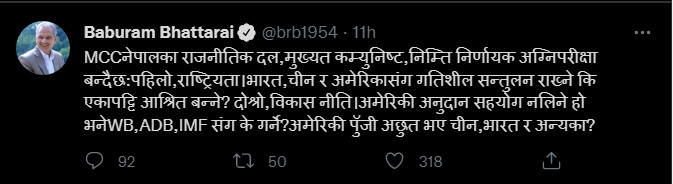
Prime Minister Sher Bahadur Deuba of the Nepali Congress (NC), a minor coalition partner Janata Samajbadi Party (JSP), as well as the main opposition UML support the project. But it is vehemently opposed by two Communist parties: the Maoist Centre (MC) and the Unified Socialists.
The strain within the coalition appears to have taken a turn for the worse after Prime Minister Deuba got wind that Parliament Speaker Agni Sapkota of the MC postponed a sitting of the House on Sunday that was to discuss the Millennium Challenge Corporation (MCC) project.
After a meeting of the five coalition partners on Saturday failed to agree on getting the MCC ratified by Parliament, Sapkota called off a scheduled House sitting for ten days without informing the prime minister.
Deuba is said to be so put off that he has leaked a threat to register a proposal to unseat Speaker Sapkota, and has hinted that he will push through the MCC even if it means a split in the coalition.
China’s Ambassador to Nepal Hou Yanqi has been meeting various coalition leaders in the past months to lobby against the MCC, the latest was a one-on-one with the opposition UML’s K P Oli at his residence on 22 December.
Then on Saturday, just after the inconclusive coalition meeting, the Maoist Centre’s Pushpa Kamal Dahal held an hour-long hush-hush virtual meeting on Saturday with Song Tao, the high-ranking head of the International Department of the Communist Party of China (CPC).
Although the conversation was said to have centred around greeting each other on Chinese New Year and Dahal being congratulated for being re-elected chair of the Maoist Centre, the timing of the online discussion on Saturday evening is seen as significant.
In November also, CPC officials had talked to senior party leaders in Kathmandu to actively dissuade them from passing the American project. The deputy head of the International Department of the CPC Chen Zhao had even called the UML General Secretary Ishwar Pokhrel on 13 December to try to change his party leadership’s pro-MCC stance. Zhao also spoke to Madhav Kumar Nepal of the Unified Socialists, and the latter is said to have assured him that he would not let the MCC be ratified.
Speaker Agni Sapkota has been known to be close to Beijing, and has made no secret for his opposition to the MCC, and this week was not the first time that he blocked ratification in Parliament. His predecessor Krishna Bahadur Mahara, also a close confidante to Dahal, was also publicly anti-MCC before he was removed from office in 2019 after allegations of rape.
China’s suspicions about the MCC as being an American geo-strategic counter to its own Belt Road Initiative (BRI) can also be gleaned from Chinese academics who have been writing in state controlled media as well as in interviews with Nepali portals. Wang Yiwei of Renmin University in an op-ed in October called the MCC ‘American ploy’.
Besides geopolitics, the MCC has also become a factor as Nepal’s domestic politics as parties try to position themselves for upcoming local government elections in May and federal polls later this year.
Last week, Deuba managed to convince Dahal and Nepal to lift their opposition to holding local elections on time in exchange for keeping the coalition in an electoral alliance. Although NC insiders say they also got a commitment from them to back the MCC, the two leaders have denied this.