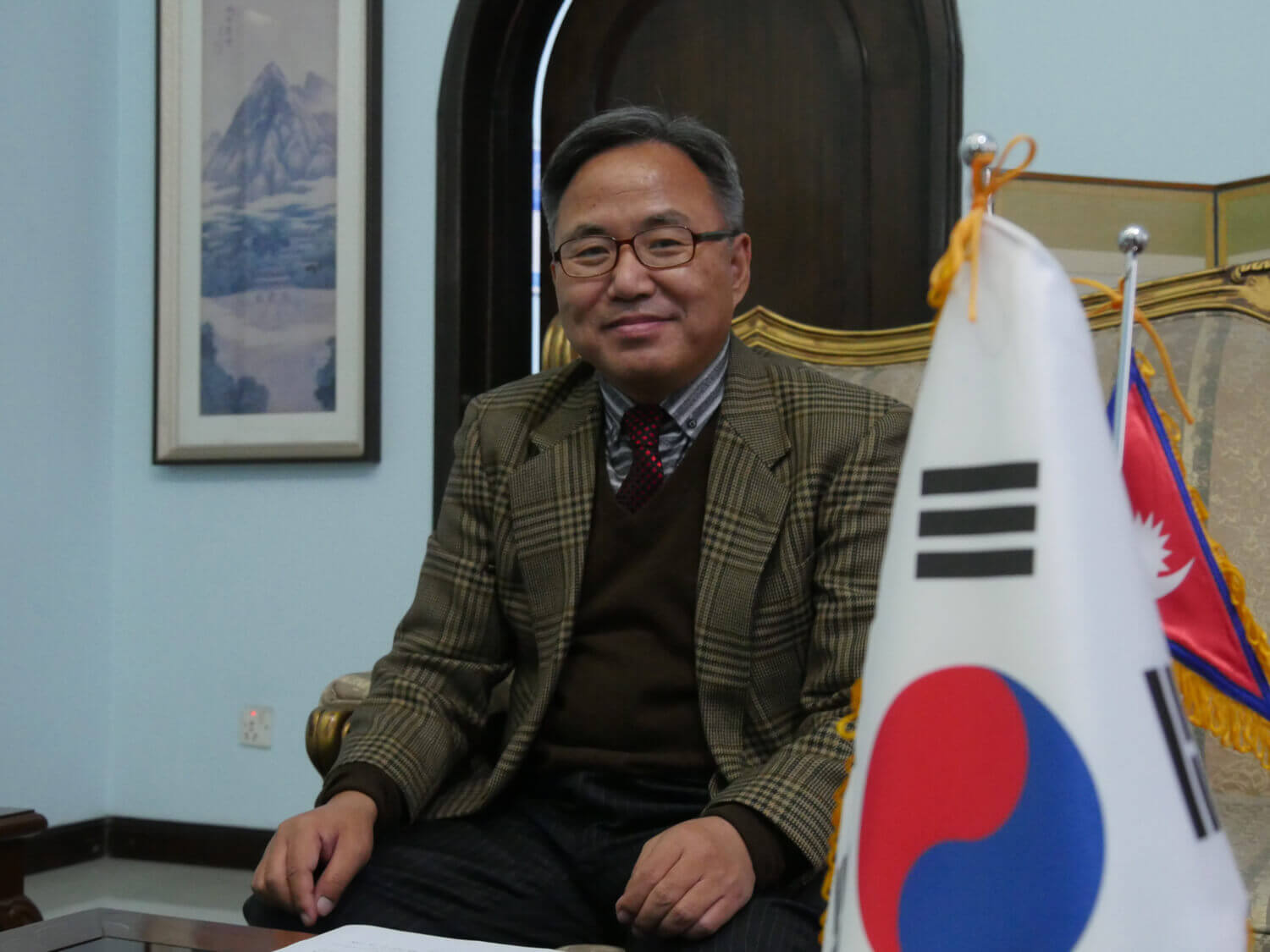
Korean Ambassador to Nepal Park Young-sik, spoke to Sangmin Kim of Nepali Times about tourism, Nepali workers, development assistance, investment, trade and tourism.
Nepali Times: What is the perspective of the current Moon Jae-In government on Nepal?
Park Young-sik: President Moon has visited Nepal twice on a personal trekking trips. During his last trek to Langtang in 2016, he volunteered in the rehabilitation efforts of a school damaged by the earthquake in Nuwakot. Many Koreans feel the need for taking the current partnership with Nepal to a higher level. I hope to try to make this happen by exchanging mutual visits of high-level leaders. This is the right time since the Korean government is trying to strengthen relations with South Asian and ASEAN countries within our ‘New Southern Policy’.
What has been the support to Nepal from Korea post-earthquake?
Before taking up my official duties as Ambassador, I met many Koreans to discuss what could be done to help Nepal after the 2015 earthquake. The focus is on rehabilitation, the Korean government is building a hospital and ten health posts in Nuwakot through the Korean International Cooperation Agency (KOICA). The Korean private sector is also involved in rehabilitation.
Read also: "Hope Nepal's difficulties end soon", Seulki Lee
What is KOICA’s main area of focus?
The Korean government has assisted in building two vocational training centers in Nepal: Korea-Nepal Institute of Technology (KNIT) in Butwal and Kathmandu University Technical Training Center (KUTTC). Nepal cannot rely only on remittances by sending workers abroad. Nepali workers should remain in Nepal to lift the domestic economy, while technology and experience of returnee workers should be fully utilised. We welcome two policy initiatives introduced by the Nepali government: Establishing technical schools in all seven provinces and 753 local units and establishing start-up business ventures by returnee workers by providing a maximum of $10.000 loan at less than 6% interest rate. Korea University of Technology and Education is conducting a project to enhance the quality of CTEVT (Council for Technical Education and Vocational Training) through capacity building of instructors which will contribute to the development of Nepal’s technical schools under the guidance of CTEVT.
What do you see as the main constraints and challenges of operating the EPS (Employment Permit System)?
I had an opportunity to meet members of ANKUR, the organisation of Nepali workers who have returned from Korea who wish to make use of the skills and technology which they learned for the development of Nepal. The Korean government will try to find suitable ways to implement industrial technology transfer. EPS has been running successfully, but we still need to see how we can improve this system. For example, some Nepali migrant workers are not able to adjust to life in Korea, and some have committed suicide. Both governments are trying to provide psychological care at worker’s orientation before leaving for Korea and after arriving in Korea. Another constraint is the shortage of air tickets which is causing problems for some Nepali workers to reach their destination in time in Korea.