
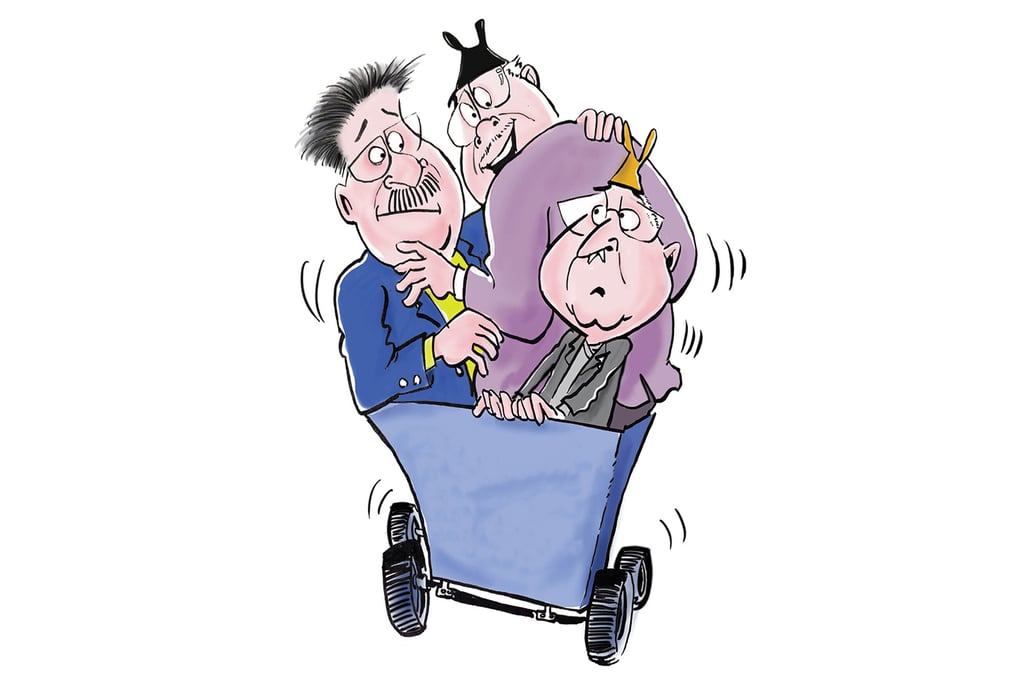
In a democracy, governments come and go. But Nepal had become so entangled in the triangular affair between Sher Bahadur Deuba, K P Oli and Pushpa Kamal Dahal that it was becoming impossible to tell who was canoodling with whom.
All three had long since abandoned their party ideologies. Staying in power was all that mattered as they turned Nepal’s democracy into a kleptocracy.
For the past at least 20 years, we have warned them to mend their ways. Democracy had to be rescued from the hands of such kakistocrats. Waiting to pounce were monarchists and anarchists of every ilk, outcast Maoists, and supporters of a leader jailed for fraud. Tycoon Durga Prasai said his rally in March was to restore a Hindu monarchy, but he was just a temporary royalist whom even the ex-king spurned.
All this converged into a perfect storm on 8 September. Commandos shot and killed 19 innocent young people outside Parliament, the anger boiled over into targetted arson and vandalism the next day. The government fell, and Sushila Karki was elected interim prime minister through Discord.
With not just their monopoly on power but also their very lives in danger, the triumvirate was at first in total shock. Then came conspiracy theories and an inability to gauge the rage from decades of misrule.
Nepalis had assumed that after September the old parties would see their folly, and step down to hand over the leadership to a new generation. But 10 weeks later, there is no sign of any act of contrition.
In the NC, Sher Bahadur Deuba has sidelined the caretaker he himself appointed, Purna Bahadur Khadka, and is active again as the party prepares for a showdown in its Convention next month. The UML is proceeding with its own General Convention, where Oli is fully assured of a third term as party boss. Dahal sees no alternative to himself in his newly-forged Nepali Communist Party and is eagerly eyeing becoming prime minister for the fourth time.
The three leaders who everyone had hoped would finally retire have reincarnated. It is obscene for obsolete politicians to still hanker for power after all that has happened.
SHOCK AND AWE
The three leaders who have been prime minister a dozen times between themselves want to cling on, but this is not abnormal if we apply Elisabeth Kübler-Ross’ theory of the five stages of grief. The author of On Death and Dying was analysing how people with terminal illness deal with their situation, but her 5-stage theory may be applicable to the way heads of the NC, UML and NCP are reacting to the shock of being overthrown — first with denial, then anger, bargaining, depression and finally acceptance.
On 9 September, distressed by what had befallen them, the three were in total denial. Then began the stage of anger. Oli ranted in public about a conspiracy to install an ‘unconstitutional’ interim government, blaming the Nepal Army, and vowing not to take part in election even while preparing for it.
The NC has decided to participate in elections, although it has to first sort out its internal power struggle. The NCP and the RSP have united with smaller parties and are actively preparing to campaign. GenZ groups are speaking in different voices, with Sudan Gurung and Miraj Dhungana openly trying to unseat an interim government they themselves installed.
The parties are now in the third stage: bargaining. Instead of asking himself in hindsight what he should have done, Oli wants Parliament restored but has also registered his party for elections. The UML won't allow elections unless the government lifts restrictions on Oli’s movement.
Likewise, GenZ groups are putting up conditions for supporting polls: arrest Oli and others. Karki is single-mindedly focussed on elections, even if it has to be put off by two months. The Army would also like polls on time because it does not want a repeat of September when it had to intervene to form the interim government.
If Karki’s 6-month mandate ends without elections, and if by then the GenZ’s trust in the interim government collapses, then UML and NC could plan to press for an all-party election government, restoration of Parliament which would then dissolve itself to appoint a new prime minister that Karki would also be agreeable to.
The current state of affairs makes it difficult to imagine elections being held on 5 March — mainly because polls would be incomplete without the three main parties taking part, and it is unlikely they would participate in polls that they are certain to lose since they have not reformed themselves. Amidst these ifs and buts, the role of the Army will be critical.
The fourth stage of grief is depression, and that is what will happen to the parties when the reality of their unpopularity finally hits them. Only then will they finally accept their fate, realise that it was all their own doing, and perhaps reinvent themselves.
Kübler-Ross said the five stages did not necessarily have to be in that order, or that sometimes there may only be three phases, which may be applicable to the parties. What is for sure is that the three leaders are in no mood to atone for their sins.
Rabin Giri is an editor with nepalnews.com.