
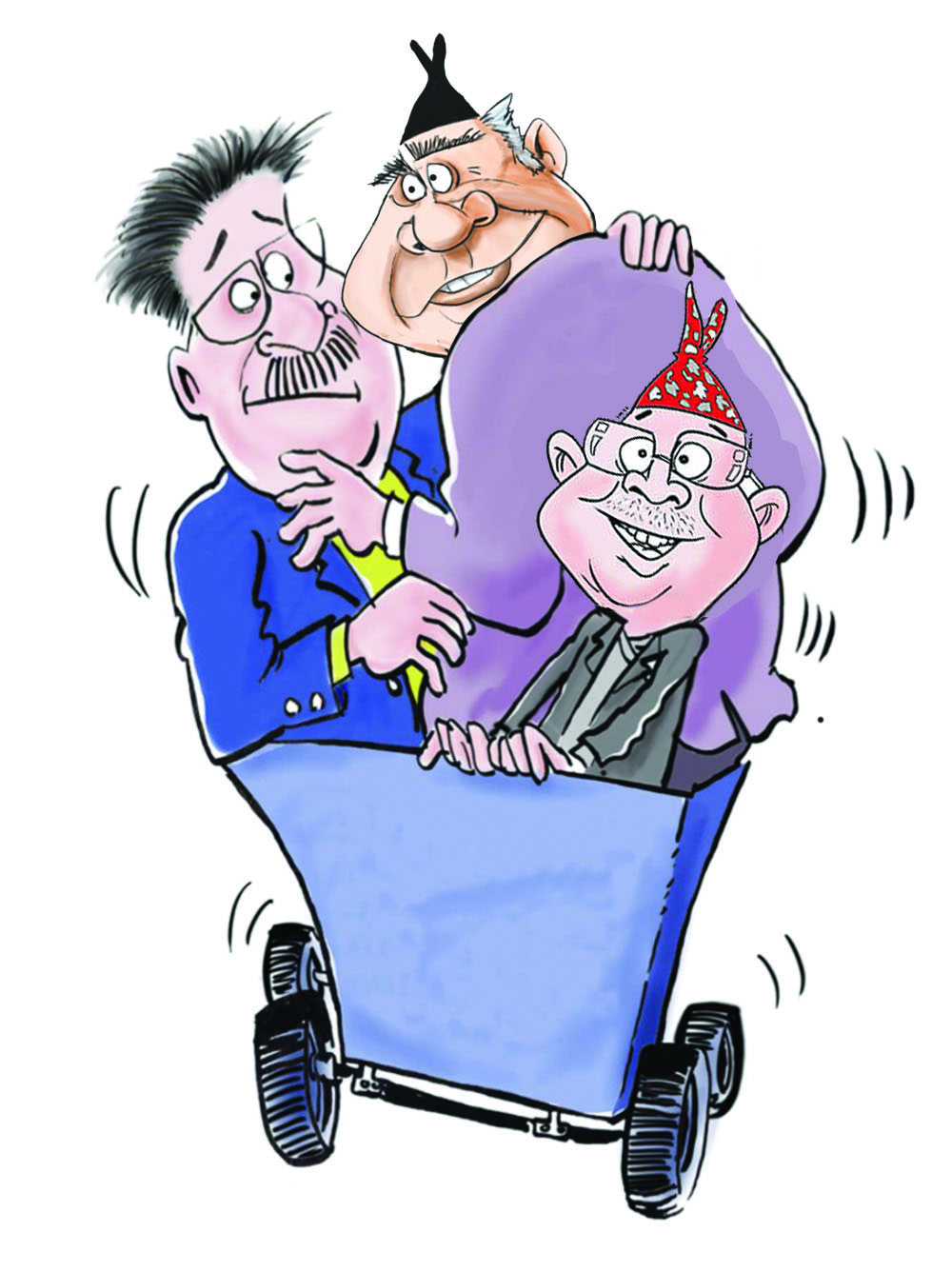
After hemming and hawing about holding local elections, top leaders of the five-party alliance that met on Tuesday finally made some headway.
The good news is that they said they were committed to holding the local polls “on time”. The bad news is that the parties were even thinking of postponing polls to suit their electoral prospects, even though that is entirely the purview of the Election Commission.
And who knows what they mean by “on time”? Nepali time is elastic.
The ‘high level political mechanism’ is an uber-government prone to bending the Constitution whichever way it suits them.
However, on elections, mechanism members are not united. Prime Minister Sher Bahadur Deuba’s Nepali Congress wants to hold local polls as scheduled on 27 April, and this puts him closer to the opposition UML’s stand.
The JSP also wants the local polls in April, but the Pushpa Kamal Dahal of the Maoist Centre and Madhav Kumar Nepal of the Unified Socialists being from fragments of larger parties, want more time to prepare for elections. And the pandemic has been the perfect pretext to argue for postponing it.
The other argument they are using is that elections are costly, and why not have all three tiers of elections in November?
There are differing provisions for local elections in Nepal’s Constitution and election laws. While Article 225 of the Constitution stipulates new local leaders be elected within six months after the terms of the current leaders expire, Nepal’s Local Level Election Act 2017 states that elections be held two months before the terms of the current representatives end.
Coalition leaders are said to be exploring the possibility of passing an ordinance to amend the local election law so that they can hold local elections when they see fit — which means later in the year.
That provisions for elections are inconsistent, subject to amendments at the convenience of political leaders, and that the Election Commission is unable to make an independent decision is emblematic of a failing state.
It shows just how centralised Nepal’s power structure is, and how blatant political interference in Constitutional bodies like the Election Commission has become.
Read also: Battle lines drawn for Nepal elections, Nepali Times
The differing positions within the governing coalition on proposed election dates have further exposed the volatile dynamics within the five-party coalition.