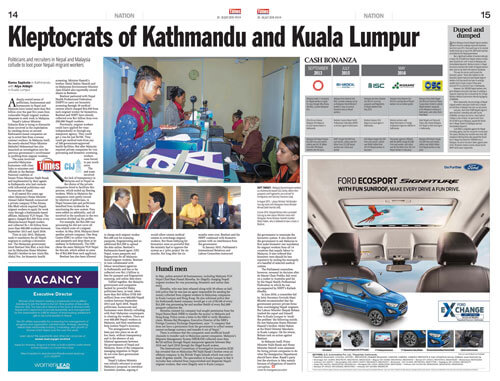
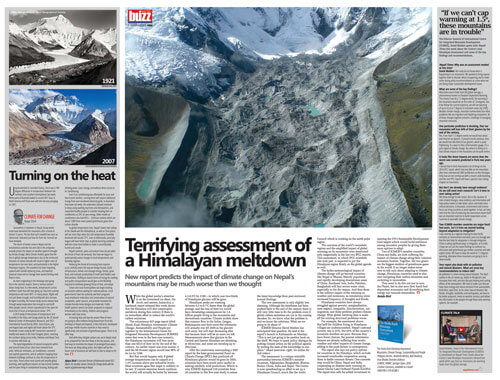
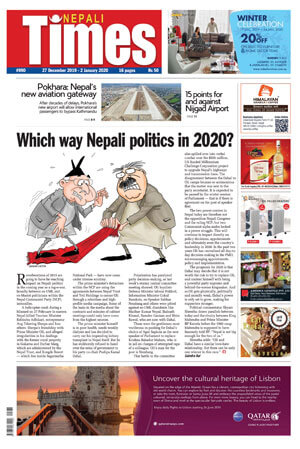
Since Nepali Times was established almost 20 years ago, we have covered everything from the royal massacre to the impact of the climate crisis on the Himalaya. These are some of the biggest stories from the last two decades.
2000: Constitution tinkering
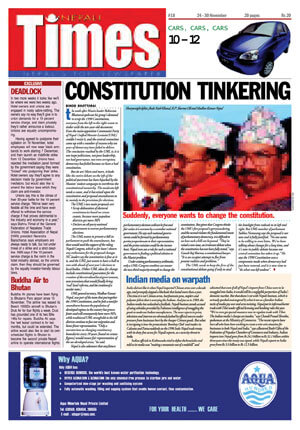
Twenty years ago too, the UML was pushing for a constitutional amendment. A much younger-looking K P Oli, Madhav Kumar Nepal and Jhalanath Khanal were pictured on the front page. Excerpt from page 1 of #18, 24-30 November 2000:
The week after Maoist leader Baburam Bhattarai spelt out his group’s demand to scrap the 1990 Constitution, everyone from the left to the right wants to tinker with the ten-year-old document. Even the main opposition UML couldn’t resist it, and the central committee came up with a number of reasons why ten years of democracy have failed to deliver. The conclusion reached by the UML is: it is not inept politicians, not poor leadership, not bad governance, not even corruption; democracy has failed because we have a bad constitution.
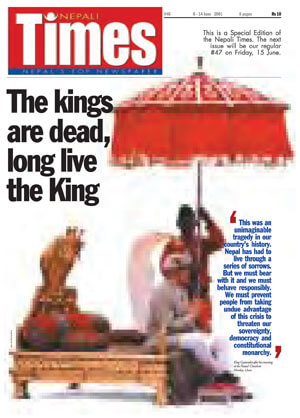
2001: The kings are dead, long live the King
The palace massacre of 1 June 2001 nearly wiped out Nepal’s entire royal family. King Gyanendra, who had just been enthroned, spoke about the need for the country to pull together. The Times quoted him on page 1 of #46, 6-14 June 2001:
“This was an unimaginable tragedy in our country’s history. Nepal has had to live through a series of sorrows. But we must bear with it and we must behave responsibly. We must prevent people from taking undue advantage of this crisis to threaten our sovereignty, democracy and constitutional monarchy.” - King Gyanendra after his crowning at the Naasal Chowk on Monday, 4 June.
2002: Nation in grief
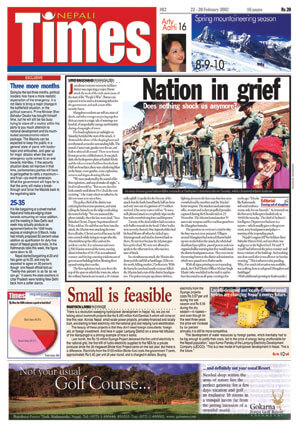
Fifty-six Royal Nepal Army soldiers were killed in a Maoist attack in 2002 in Mangalsen of Accham district, one of the heaviest casualties during the war. This exposed the army’s lack of preparedness and poor intelligence. Excerpt from a field report in #82, 22-28 February 2002:
Just about everyone in remote Achham district was expecting a major Maoist attack the week of the sixth anniversary of the start of the ‘People’s War’. But no one expected it to be such a devastating defeat for the government, and such a rout of the security forces. Mangalsen residents are still in a state of shock witnessing the unspeakable carnage and brutality during a long night of terror.
2003: Spring in the heartland
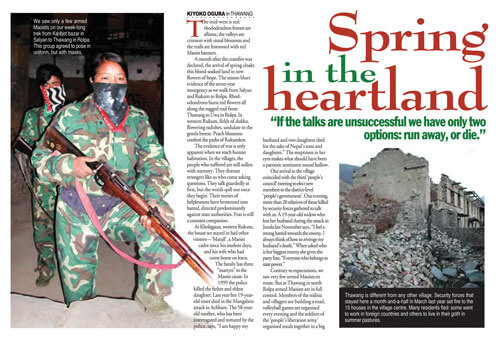
Japanese journalist Kiyuko Ogura visited Rukumkot for an eye-witness report of how the conflict was affecting ordinary Nepalis caught in the crossfire. Excerpt from #139, 4-10 April 2003: The mid-west is red: rhododendron forests are aflame, the valleys are crimson with simal blossoms and the trails are festooned with red Maoist banners.
The arrival of spring cloaks this blood-soaked land in new flowers of hope with the ceasefire, blurring the evidence of the seven-year insurgency. In western Rukum, fields of dukku, flowering radishes, undulate in the gentle breeze. Peach blossoms confetti the paths of Rukumkot. The evidence of war is only apparent when we reach human habitation.
2004: Bad blood in Beni
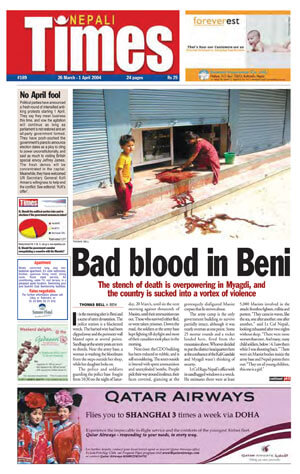
British journalist Thomas Bell was one of the first journalists from outside to reach Beni after the battle there that killed at least 200 people. Beni’s citizens shut themselves inside their homes, hiding under beds to the sounds of gunfire and explosions all night and into the next morning. Excerpt from Bell’s reportage #189, 26 March - 1 April 2004:
The police and soldiers guarding the police base fought from 10:30 on the night of Saturday, 20 March, until six the next morning against thousands of Maoists, until their ammunition ran out. Those who survived either fled, or were taken prisoner. Down the road, the soldiers at the army base kept fighting till daylight and most of their casualties took place in the morning.
2005: The week that was
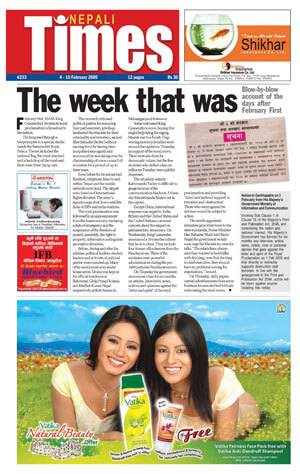
King Gyanendra’s surprise military coup toppled Sher Bahadur Deuba’s government, dissolved Parliament, and brought heavy censorship of media. Pages of the Nepali Times could go to press only after two Royal Nepal Army officers read every word and expunged criticism. The paper appeared the next morning with white holes in the print. Excerpt from #233, 4-10 February 2005:
On 1 February 2005 at 10 AM, King Gyanendra Shah read through a teleprompter for 28 minutes in a special studio inside the Narayanhiti Royal Palace. In the royal proclamation, the former monarch criticised political parties for misusing their parliamentary privilege, lambasted the Maoists for their terrorism, sacked Sher Bahadur Deuba (without naming him) for having been incapable (once again), and announced he was taking over the chairmanship of a new council of ministers for a period of up to three years.
2006: Scrubbed
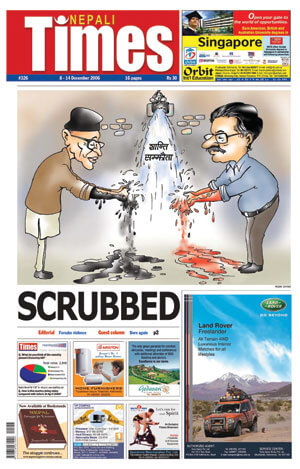
The astonishing success of the People’s Movement surprised everyone, most of all the agitating parties. Gyanendra restored parliament in April, 2006, and Pushpa Kamal Dahal and Girija Prasad Koirala signed a Comprehensive Peace Accord. Excerpt from a page 1 analysis from #326, 8-14 December 2006:
The 21 November, 2005 peace agreement was a rebirth in many senses: for Nepal, for Pushpa Kamal Dahal, and for Girija Prasad Koirala. Koirala can finally mask his sordid behaviour from 1991 to 2001. He can make the political connection between his present and what he was before 1991. Similarly, Dahal has washed his hands of the blood of thousands of Nepalis whose lives were lost during the ten years of conflict. He can separate himself from those who still think that a society can be violently transformed into utopia.
2007: Still undecided
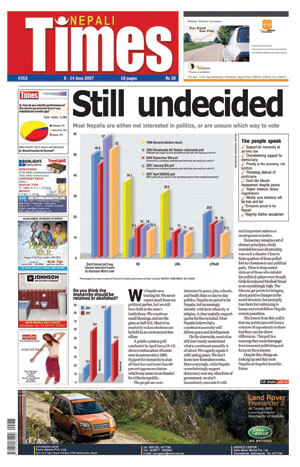
Two years after the ceasefire, the page 1 story ‘Still Undecided’ summarized results of a Himalmedia public opinion poll. The survey exposed what Nepalis thought about the monarchy and the future of Nepal. Excerpt from #352, 8-14 June 2007:
A public opinion poll conducted in April shows continuation of trends seen in surveys since 2003. Support for monarchy is at an all-time low. The people are more interested in peace, jobs, schools, health than in day-to-day politics. Most Nepalis believe that a Constituent Assembly (CA) will deliver peace and development. On the downside, most do not understand what a CA is all about.
2008: Changing of the guard
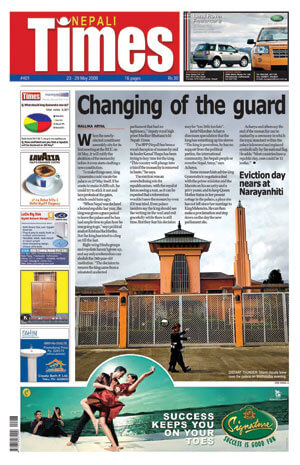
2008 proved to be a landmark year for Nepal as the newly elected CA abolished the 240-year monarchy. On 27 May, king Gyanendra held a press conference at Narayanhiti Royal Palace and then exited the palace, making Nepal a republic. Excerpt from #401, 23-29 May 2008:
When the newly elected CA sits for its first meeting at the BICC on 28 May, it will ratify the abolition of the monarchy before it even starts drafting a new constitution. To make things easy, king Gyanendra could vacate the palace on 27 May itself. If he wants to make it difficult, he could try to stick it out and face protests at the gates, which could turn ugly. The election was an overwhelming win for republicanism, with the royalist forces seeing a rout.
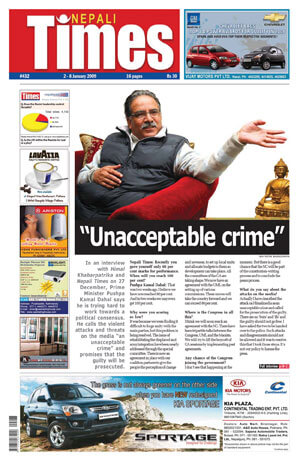
2009: Unacceptable crime
In this interview after his party supporters vandalised the Himalmedia office and assaulted staff, Prime Minister Pushpa Kamal Dahal criticised the attack, but did not really apologise. Over next decade, press freedom in Nepal was repeatedly threatened. The latest are pending bills in Parliament to muzzle the media. Excerpt from the page 1 interview with Dahal in #432, 2-8 January 2009:
“Actually I have described the attack on Himalmedia as an unacceptable crime and called for the prosecution of the guilty. There are no ‘buts’ and ‘ifs’ and the guilty should not go free. I have asked the two to be handed over to the police. Such attacks and disagreements should not be allowed and it was to resolve this that I took those steps. It’s not our policy to harass the press.”
2010: Jatra
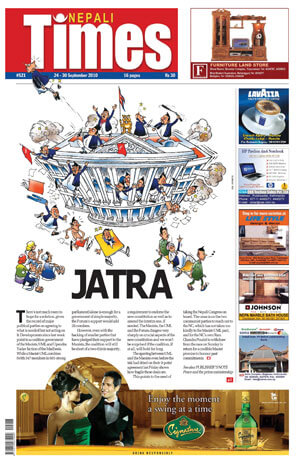
The year was marred by political instability, fragile coalitions, and a failure to move the peace process forward. This page 1 illustration aptly depicts the great political uncertainty of the time. Excerpt from an accompanying article in issue #521, 24-30 September 2010:
A day after the Maoists and the UML signed yet another 3-point deal, they have given contrasting interpretations of the pact. While the Maoists are saying that the move has paved the way for Maoist-UML majority government, the UML says it only agreed to a consensus government. The onus is on the UML to ensure that the Maoists honour their part of the bargain, and if they do, the UML should not hesitate to be part of a coalition with the Maoists. If the Maoists do not agree, the UML should revive the alliance with the NC and seek the Madhes-based parties’ support for their government. The sparring between UML and the Maoists even before the ink had dried shows how fragile these deals are.